Scratching posts: we measured nine, and most are too short
The single most common reason a cat ignores its scratching post is that the post is shorter than the cat. Height, stability and placement decide everything else.
Nadia Ferreira
Feline behaviour writer, ReMews. desk
Published 20 July 2026 · Updated 4 September 2026
Written against ISFM and AAFP scratching guidance
The short version
- Height is the whole game: at least 1.5 times your cat nose to tail base, which for most adults means 70 to 90 cm, not the 40 cm posts sold everywhere.
- Stability comes second. A post that shifts under a full-weight pull gets abandoned after one attempt and never revisited.
- Sisal rope or woven sisal fabric outlasts carpet and, unlike carpet, does not teach the cat that carpet is for scratching.
- Offer both orientations. Plenty of cats scratch horizontally, and a flat cardboard pad costs a few euros.
- Placement beats product. Posts belong where the cat already scratches and beside sleeping spots, not tucked out of sight.
- Scratching is territorial marking and claw maintenance, not damage. It cannot be trained out, only redirected. Never declaw.
Walk into any pet shop and the scratching post display is a wall of failure. Forty centimetres of carpet on a wobbly base, in beige, marketed to somebody with a twelve-week-old kitten who has not thought about what that kitten will be a year later.
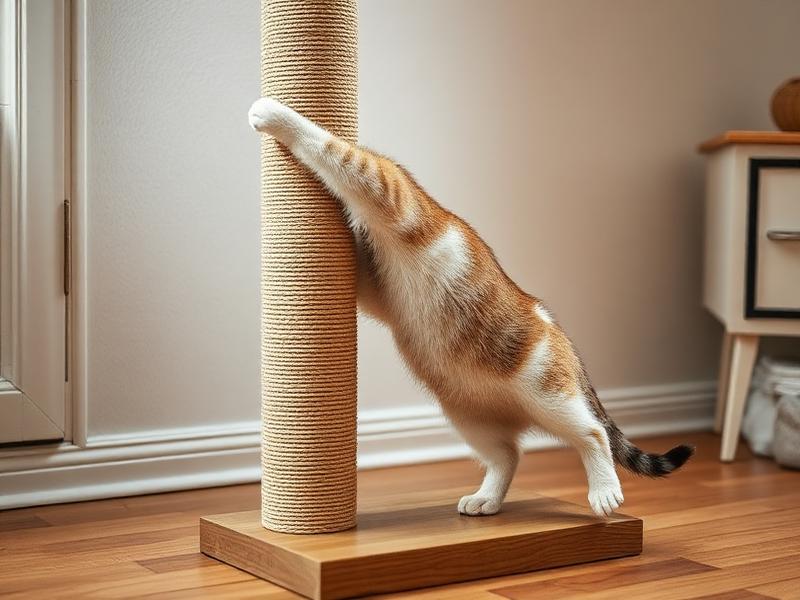
Cats scratch to maintain their claws, to stretch the whole length of their body, and to leave both a visual and a scent mark on a boundary. All three of those purposes require height. A post that ends at the cat's shoulder satisfies none of them, so the cat quietly transfers its custom to the arm of your sofa, which is taller, more stable and better placed.
We looked hard at nine posts on the mainstream market, measured them, and pulled on them with the force a five-kilo cat generates. Most of them fail on the same three numbers.
Height: the number nearly everything fails
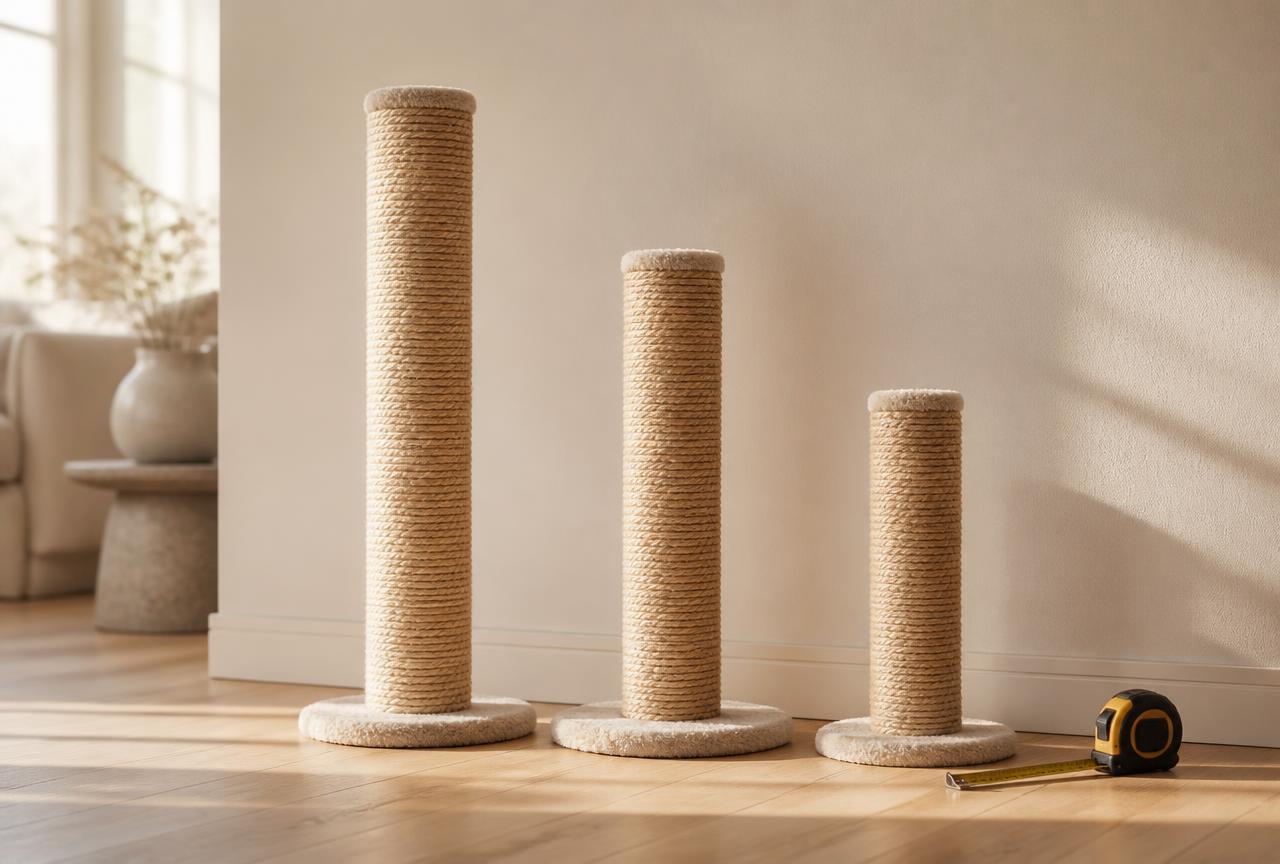
Measure your cat along the back, nose to the base of the tail. Multiply by 1.5. That is your minimum scratchable height, and a further quarter on top is what a cat will choose if given the option, because the stretch runs past full reach.
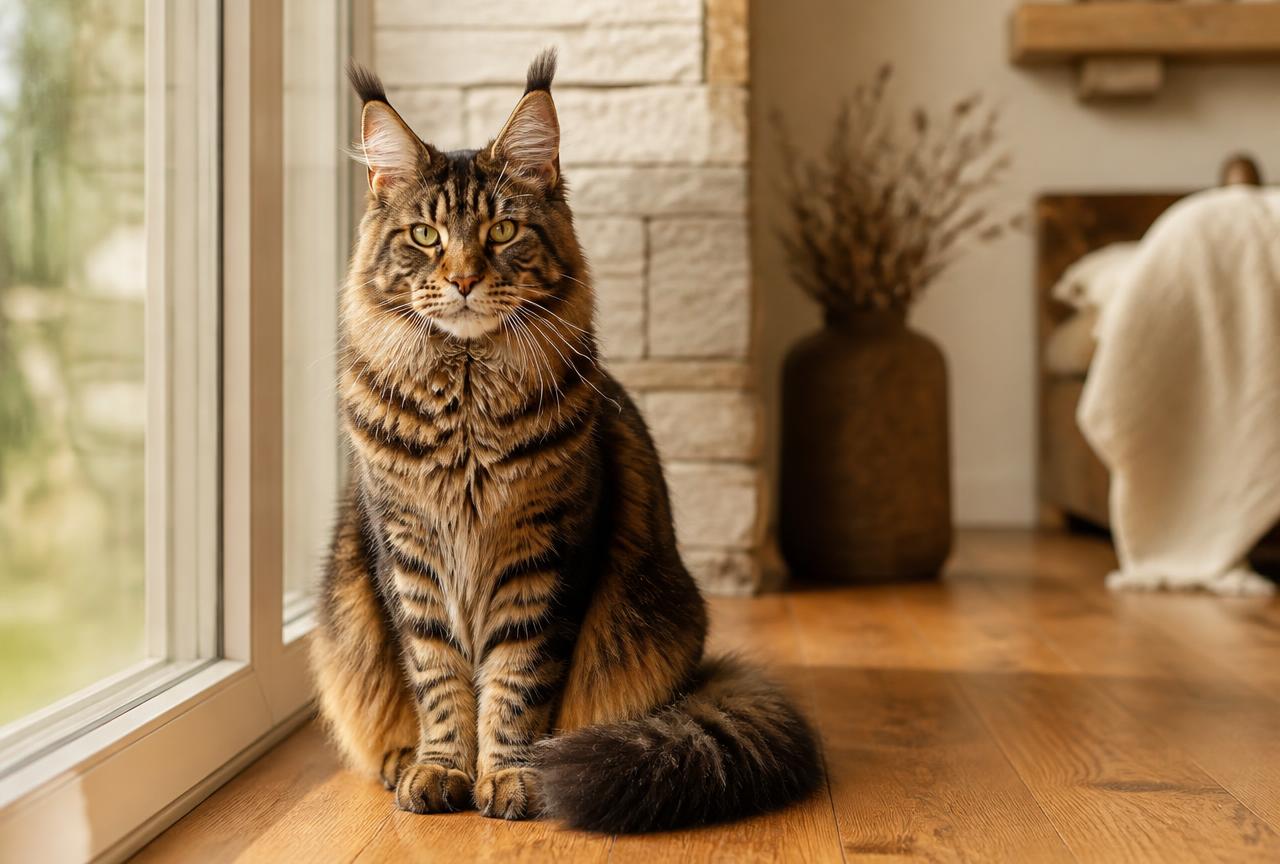
For a typical 45 to 50 cm domestic cat, that is 70 to 80 cm. For a Maine Coon it is regularly over a metre. Nine posts on the shelf, and only two cleared 80 cm.
The checker below does the arithmetic for your cat, and adds the base width and the number of surfaces your household needs.
Interactive · built for this article
Post fit checker
Measure your cat nose to tail base, then read off the minimum post height, base width and how many surfaces your home needs.
Minimum post height
72cm
Comfortable at 84 cm, so the cat can stretch beyond full reach.
Base width
32 cm
and 3 kg or more
Surfaces needed
1 + 1
tall posts plus horizontal pads
Sizing guidance, not a safety certification: always test a post for wobble with your own weight on it before letting a heavy cat climb. Planning the rest of the room? See the enrichment guide.
Stability: one wobble and it is over
A cat pulling down against a post at full stretch generates a surprising sideways load. If the post shifts, tilts or knocks against the wall, the cat stops, and in our experience it does not go back. You get one first impression.
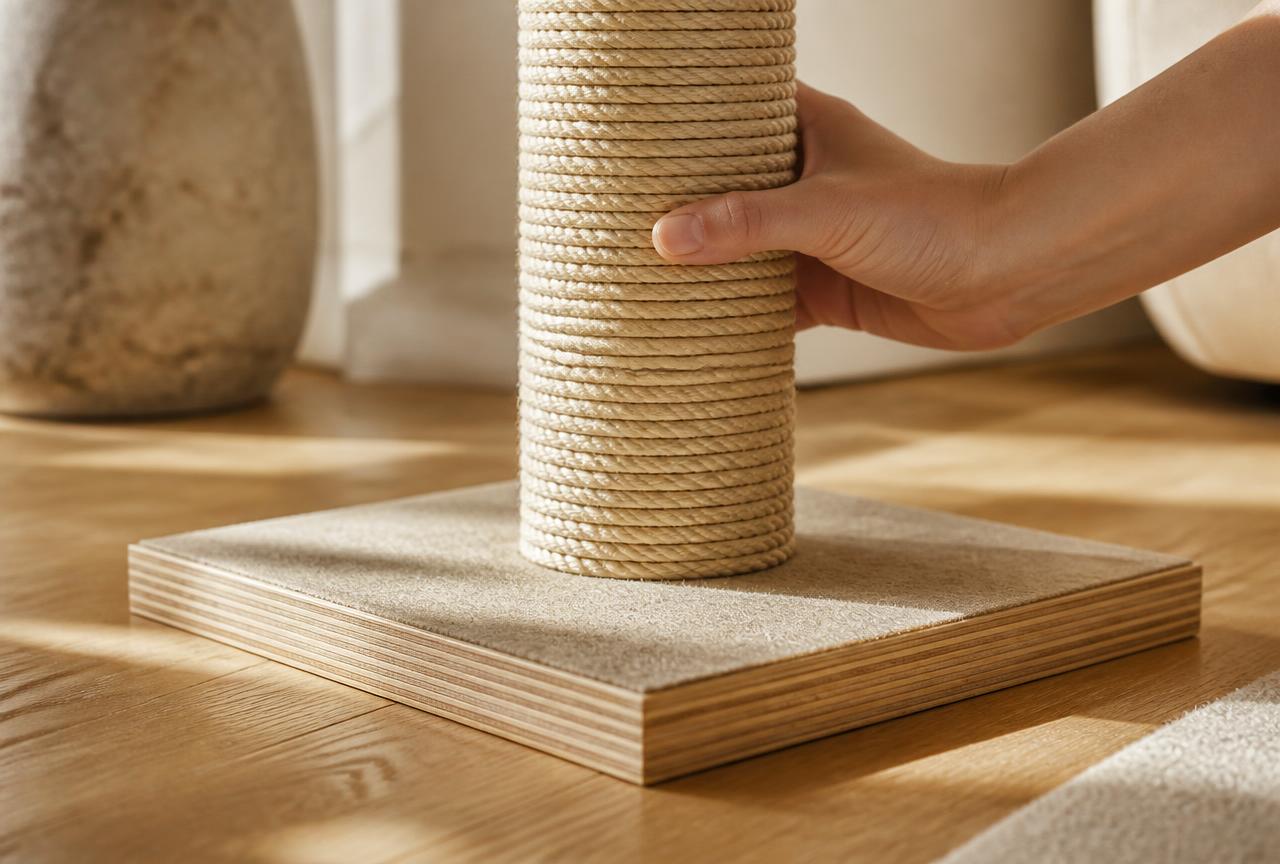
What good looks like: a base at least 40 cm square for an 80 cm post, ideally weighted rather than merely wide, and a post that does not rotate on its base. Assembly matters too. Two of the nine relied on a single central bolt into chipboard, and both had play in them straight out of the box.
| Feature | Minimum | Ideal | Avoid |
|---|---|---|---|
| --- | --- | --- | --- |
| Scratchable height | 70 cm | 1.5 to 1.75 x cat length | Anything under 60 cm |
| Base width | 35 cm square | 40 to 45 cm, weighted | Narrow round MDF discs |
| Covering | Sisal rope | Tightly wound sisal or woven sisal fabric | Household carpet, hessian |
| Frame | Solid timber core | Timber with a wide flange fixing | Chipboard, single bolt |
| Orientation | One vertical | Vertical plus a flat pad | Vertical only |
| Replaceable surface | Not essential | Re-wrappable or replaceable sleeve | Glued-on covering |
Sisal, not carpet, and why it matters beyond durability
Sisal rope shreds under claws in a way cats visibly enjoy, and a well-wound post survives years. Woven sisal fabric is even better where you can find it, because it wears evenly rather than unravelling into loose loops.
Carpet fails twice. It pulls into loops that snag claws, which some cats find unpleasant enough to stop using it, and more importantly it tells the cat that carpet is a legitimate scratching surface. You have then approved every carpeted stair in the house.
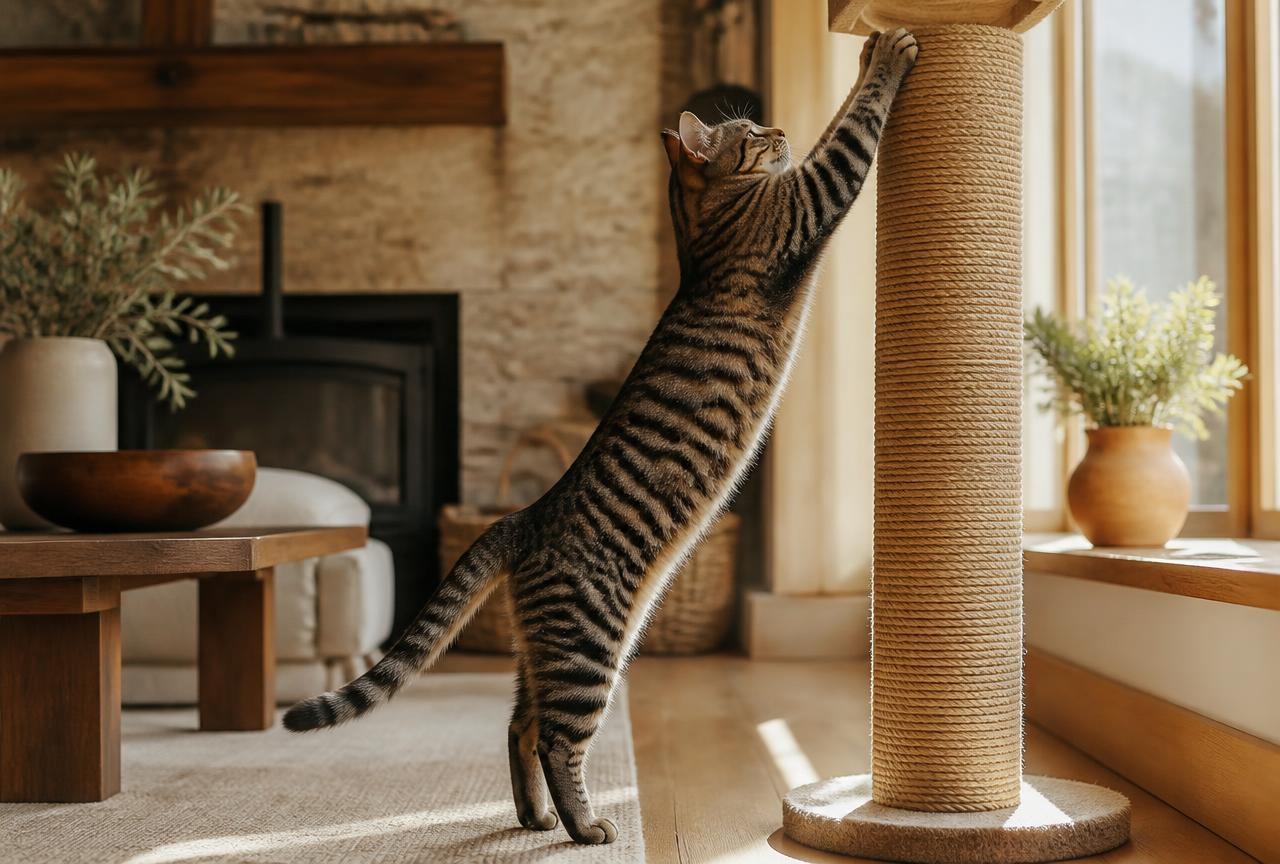
A scratching post is not furniture protection. It is the cat's noticeboard, and it needs to be somewhere the notices will be read.
Offer both orientations
A meaningful number of cats scratch horizontally, often on waking and near where they sleep. If you have only ever offered a vertical post and the rug keeps getting worked over, that is not disobedience, it is a missing product category.
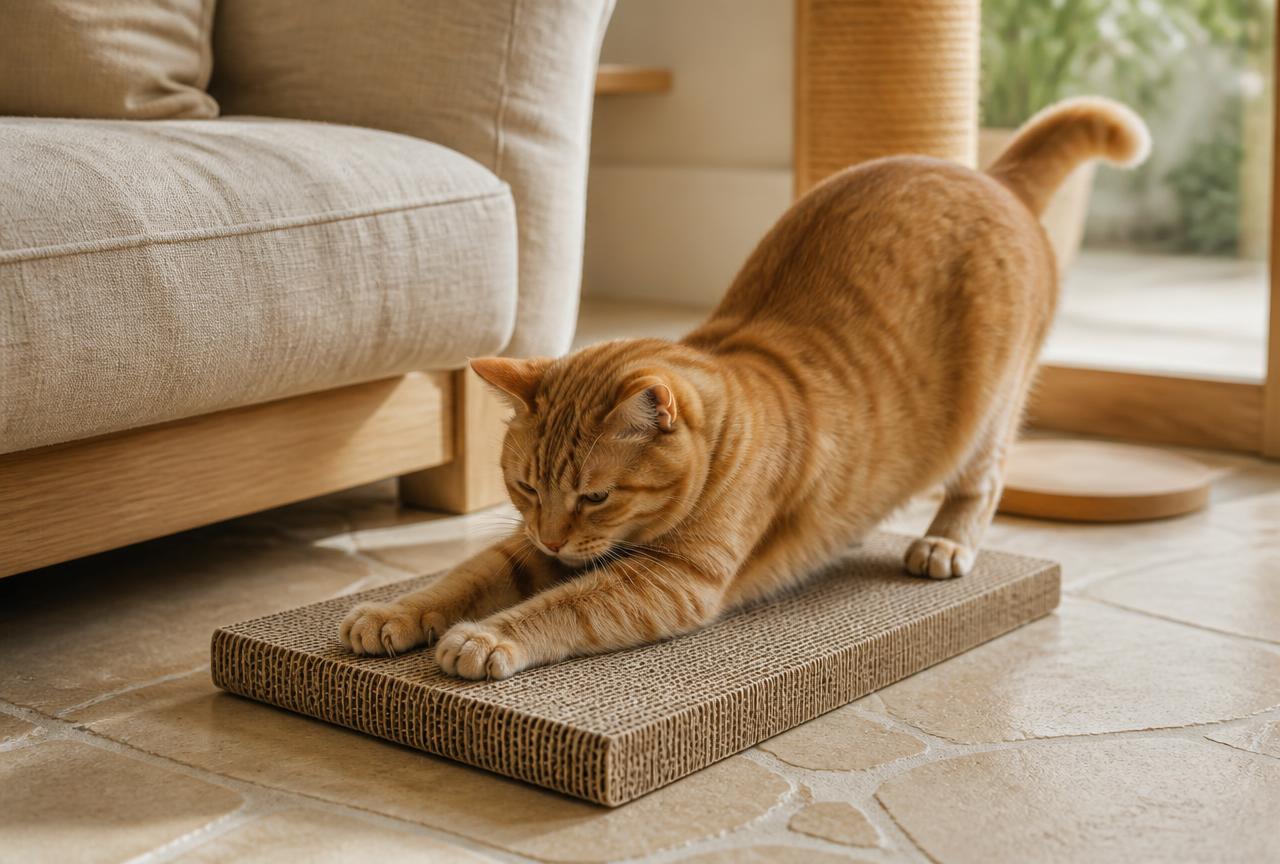
Corrugated cardboard pads are cheap, effective, and disposable. Angled scratchers split the difference and suit older cats who no longer want the full vertical stretch, which the senior signals piece covers in more detail.
Placement, which beats product every time
An excellent post in the spare room does nothing. Scratching is a boundary marker, so it belongs at the boundaries the cat cares about:
- Directly beside whatever is currently being scratched
- Next to sleeping spots, because cats scratch on waking
- Beside doorways and the entrance to the main room
- In the path of the daily patrol, not against the least-used wall
- Where a multi-cat household has separate zones, one per zone
- Never crammed next to the litter tray or the food bowls
Once the habit is established you can migrate a post a few centimetres a day towards somewhere you prefer. Move it across the room in one go and you will be starting over.
The seven-day sofa rescue
- 1Day 1. Put the new post immediately beside the scratched spot, touching it if possible.
- 2Day 1. Make the sofa temporarily awkward: a loose throw, or double-sided tape on the target area.
- 3Days 1 to 3. Run a wand toy up the post so the cat grips it during play, then feed. Never take a paw and drag it down the sisal.
- 4Days 2 to 4. Add a flat cardboard pad nearby so both orientations are covered.
- 5Days 3 to 7. Reward every use you see, with a word and a couple of minutes of play at the post.
- 6Day 7. Remove the tape. Leave the throw for another week.
- 7Week 3 onward. Only now begin moving the post, a few centimetres a day.
- 8Ongoing. Trim front claws every two to three weeks, and leave the shredded post alone: the scent marks are doing work.
Nail trimming reduces damage and is worth learning, but it does not remove the urge, and declawing is not a version of it. It amputates the last bone of each toe, and veterinary bodies including the AVMA advise against it.
The verdict, by household
- One average adult cat, small flat: a single 80 cm sisal post on a weighted base, plus a cardboard pad. Nothing else is required.
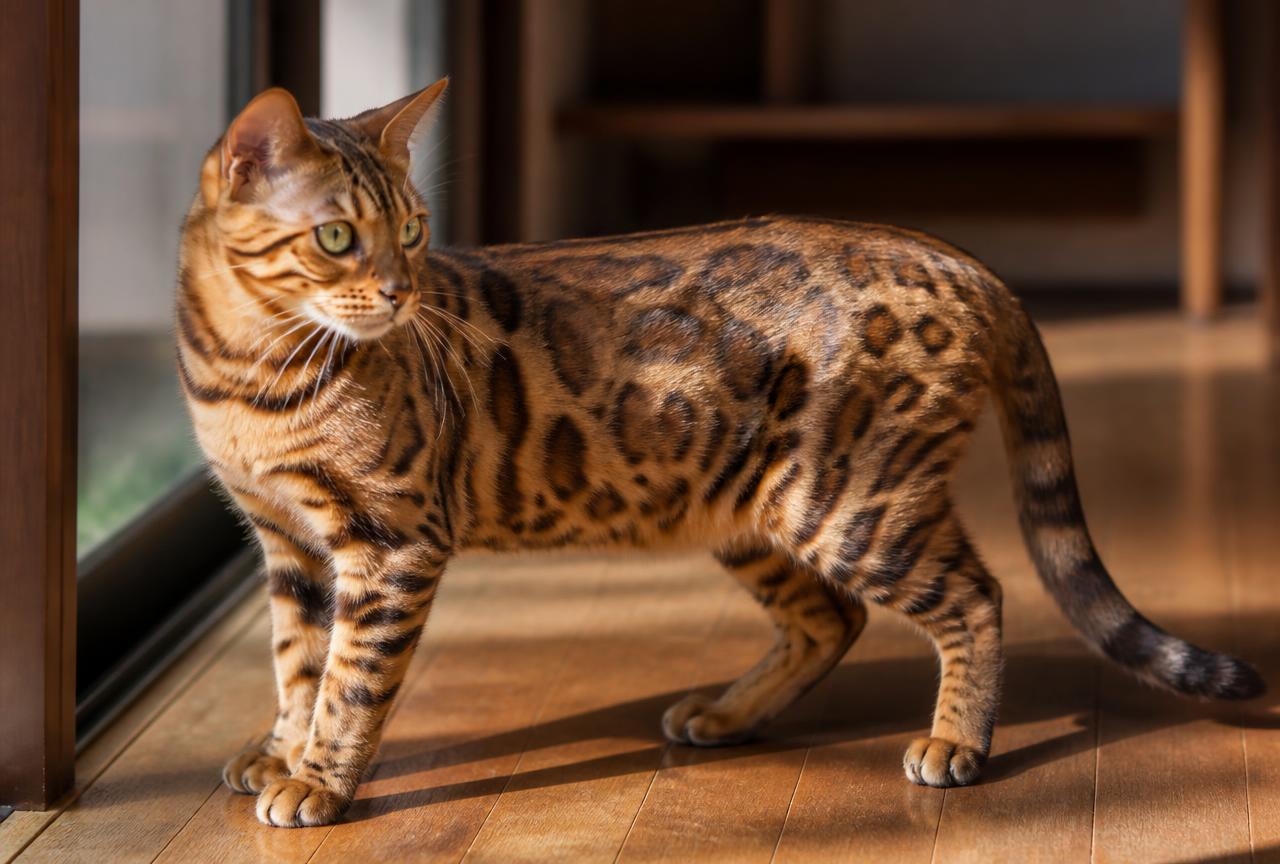
- Large breeds: a Maine Coon or a big Bengal needs a metre or more, which in practice means a cat-tree trunk or a wall-fixed column rather than a freestanding post.
- Two or more cats: one post per cat in separate locations, and expect the pads to be shared more readily than the posts.
- Kittens: buy the adult size now. A kitten will use a tall post happily; an adult will not use a kitten one.
- Older or arthritic cats: add an angled or horizontal scratcher at floor level and keep one low post beside the bed. A cat that has stopped using a tall post may be sore rather than uninterested.
- Heavy, powerful cats: stability over height if you have to choose. Check the weight of your cat honestly with our ideal weight tool before you buy.
When to call your vet
Scratching itself is normal. Book an appointment for a cat that has suddenly stopped scratching altogether, is limping or licking a paw, has a torn or overgrown claw or one growing into the pad, has swollen toes or is reluctant to be touched on the feet, or has started scratching far more than usual alongside other changes in behaviour.
A previously enthusiastic cat that abandons its post is telling you something about its joints, not its taste in decor.
What we would buy
Given the nine, the two worth the money were the ones that cleared 80 cm on a heavy square base with tightly wound sisal and a timber core. The other seven were either too short to be used or too light to be trusted, and no amount of catnip on the surface fixes either.
If your budget only stretches to one item, buy height and stability and skip every extra: the platforms, the dangling balls, the plush caves. Cats are not paying for those. They are paying for something taller than they are that does not move.
Questions people actually ask
What is the best scratching post for cats?
The best post is the tallest stable one you will tolerate in the room the cat actually uses, wrapped in sisal rope or woven sisal, on a base wide and heavy enough not to shift. For most adult cats that means at least 80 cm of scratchable height and a base around 40 cm square. Brand matters far less than those three numbers.
How tall should a scratching post be?
At least one and a half times your cat measured from nose to the base of the tail, which puts most adults at 70 to 90 cm and a large Maine Coon well past a metre. The point of scratching is a full-body stretch through the shoulders and spine, so a post the cat cannot fully extend against is doing only half its job.
Is sisal or carpet better for a scratching post?
Sisal, comfortably. Sisal rope and woven sisal fabric shred in a way cats find satisfying and survive years of use. Carpet-covered posts wear into loops that catch claws, and they teach the cat that carpet is an approved scratching surface, which is a problem you then have throughout the house.
How many scratching posts do I need?
One tall post per cat as a floor, plus at least one horizontal surface, and more if you have a large home or a scratching hotspot in more than one room. Two cats in a flat need two posts in separate places rather than one shared post, because scratching is partly a territorial signal and signals need their own locations.
How do I stop my cat scratching the sofa?
Put an excellent post directly beside the spot being scratched, make the sofa temporarily unattractive with double-sided tape or a loose throw, and reward use of the post with play right at it. Do not move the post to a tidier place until the habit has held for several weeks. Never punish the cat, which only adds stress to an instinct.
Do cats prefer vertical or horizontal scratchers?
It varies by individual, and many cats use both for different purposes. Vertical scratching is the full stretch and the visible territorial mark; horizontal scratching often happens on waking and near resting places. Offering one of each and watching which gets used is cheaper than guessing, since a flat cardboard pad costs very little.
Is declawing an alternative?
No. Declawing removes the last bone of each toe, not just the claw, and veterinary bodies including the AVMA discourage it; it is banned or considered unethical across most of Europe. It is associated with lasting pain, altered gait and an increase in litter tray avoidance and biting. Correct posts and nail trimming address the problem without amputation.
Sources
- Scratching behaviour and how to manage it, International Cat Care (icatcare)
- AAFP and ISFM Feline Environmental Needs Guidelines, American Association of Feline Practitioners
- Declawing of domestic cats: position statement, American Veterinary Medical Association
- Stop your cat scratching furniture, Blue Cross
- Feline behaviour resources, Cornell Feline Health Center
Breeds mentioned

Put it into practice
Read next
Cat litter: what nine types actually do
Best cat litter by type: how clumping clay, silica, wood, paper, corn, tofu and walnut compare on odour, dust, tracking and cost, and how to switch without a protest.