United States
Bengal
The leopard looks are the easy part. Living with the cat inside them is the decision.
Reviewed against TICA and International Cat Care breed profiles
A wild coat wrapped around a busy mind
The short version
- A Bengal needs two real play sessions a day, every day, for life, not as a kitten phase.
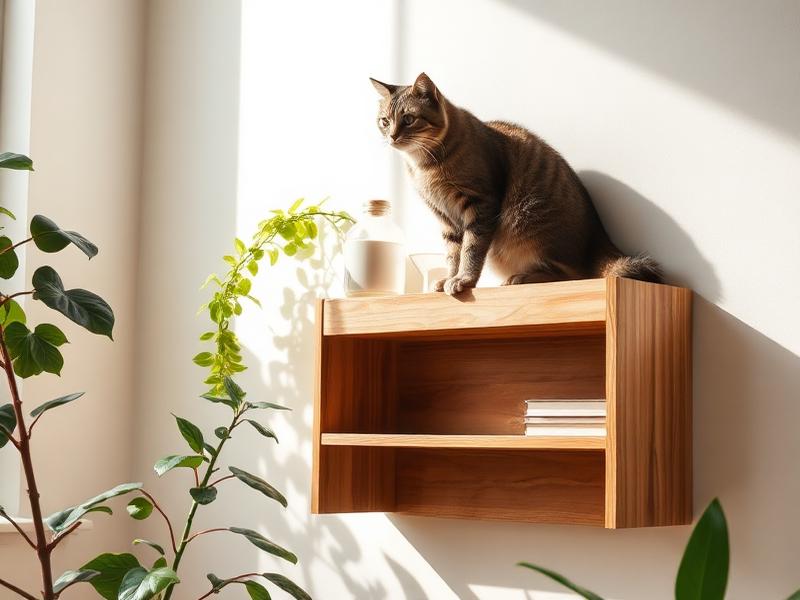
- Height matters more than floor space: tall trees and shelves are requirements, not furniture.
- Left alone all working day with nothing to do, this breed dismantles houses. A second playful animal helps enormously.
- The coat is genuinely easy, a weekly once-over, but the voice and the energy are not negotiable.
- Buy from a breeder who screens for HCM and PRA and shows you the paperwork; walk away from anything less.
- Weight
- 4.5–9 kg
- Lifespan
- 12–16 yrs
- Coat
- Short
- Size
- Medium
- Grown male
- 4.5–7 kg
- Grown female
- 3.5–5.5 kg
- Years to full size
- about 2
- One-off setup
- €280–700
Get one if…
- Active owners who want to train and play daily
- Homes with a catio or secure outdoor access
- People who want an interactive, dog-like cat
- Households with lots of vertical space
Think again if…
- First-time owners
- Quiet flats or noise-sensitive neighbours
- Homes empty all day
- Anyone wanting a calm lap cat
Trait profile
Energy is the honest headline: this is the most demanding trait profile on the site. Everything else, the voice, the climbing, the water obsession, is energy looking for an exit. Affection scores well because a tired Bengal is a genuinely loving cat; the catch is that you are the one who has to do the tiring.
Space & setup. Requires floor-to-ceiling climbing, daily wand play and enrichment; needs a catio if possible.
Allergies. Sheds very little, but produces normal Fel d 1 levels, not a solution for allergies.
The review
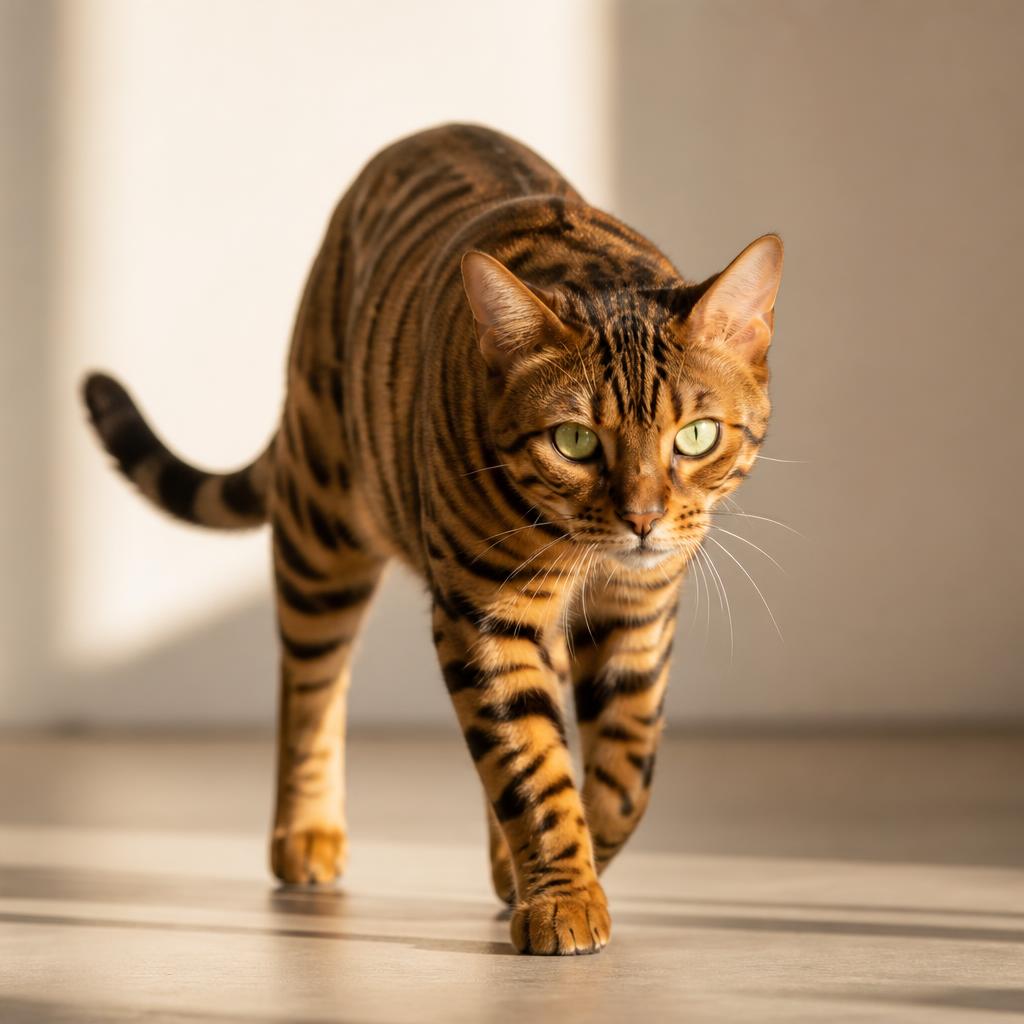
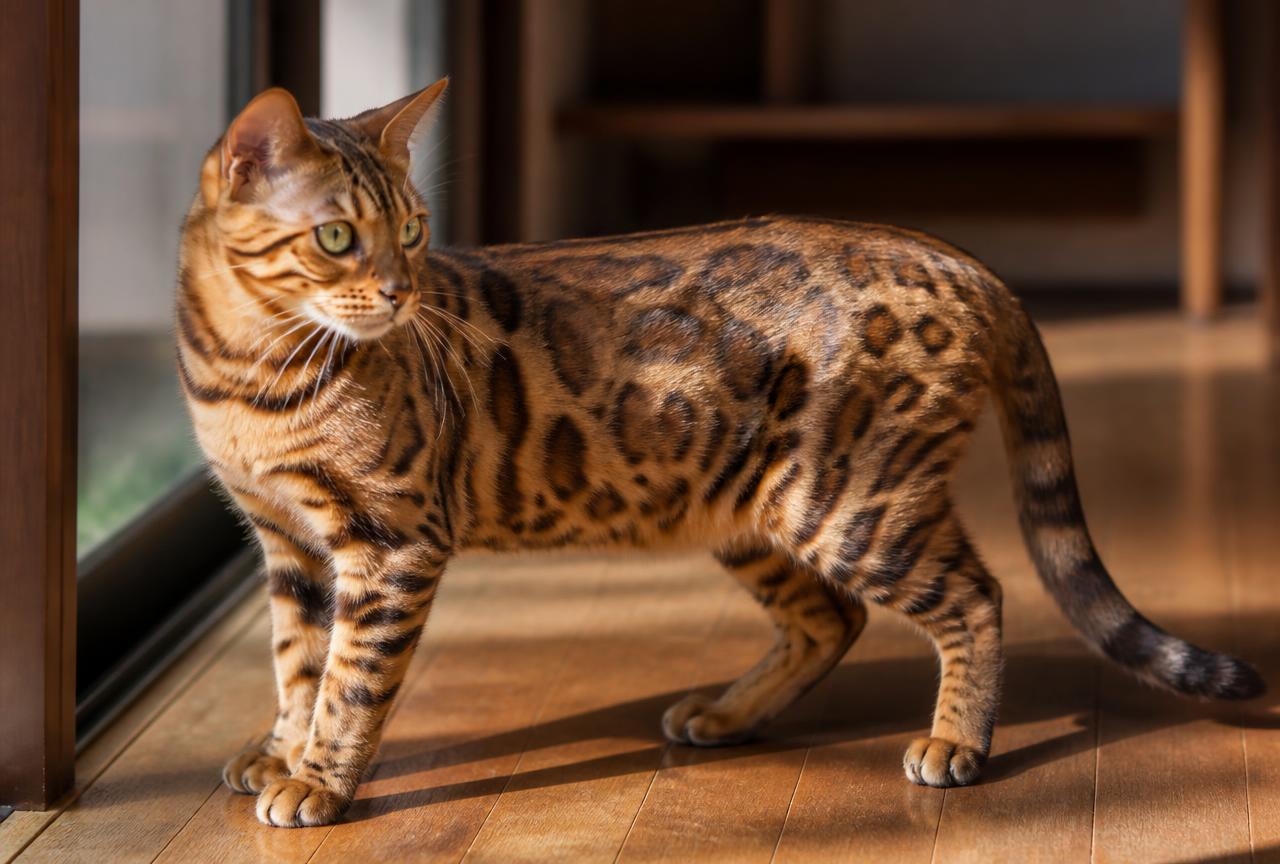
Bengals descend from crosses with the Asian leopard cat and keep the rosetted, glittered coat to prove it. They are athletic, water-curious and relentlessly intelligent, a Bengal without a job will invent one.
Living with a Bengal is the closest most people will come to sharing a house with a small wild animal that also loves them. That sentence contains both the pitch and the warning, and any honest review of the breed has to hold both halves at once.
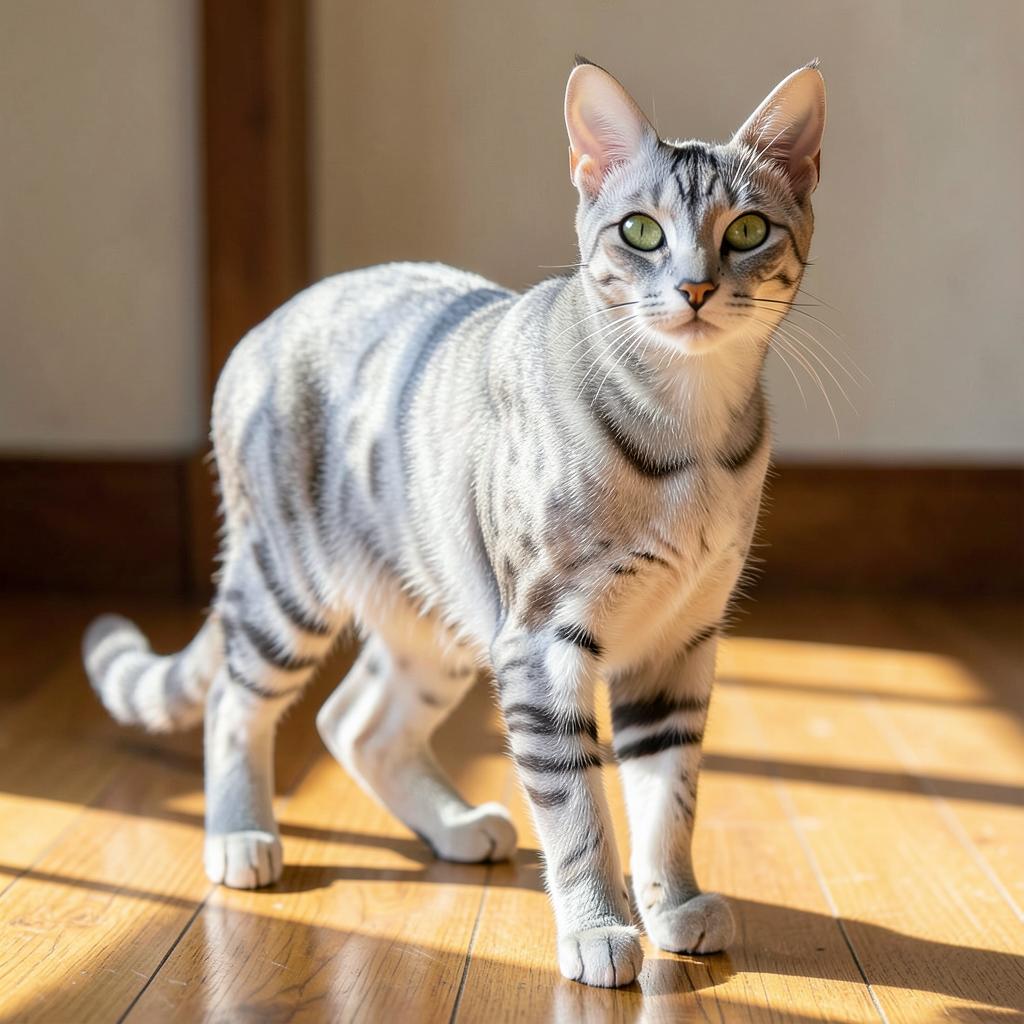
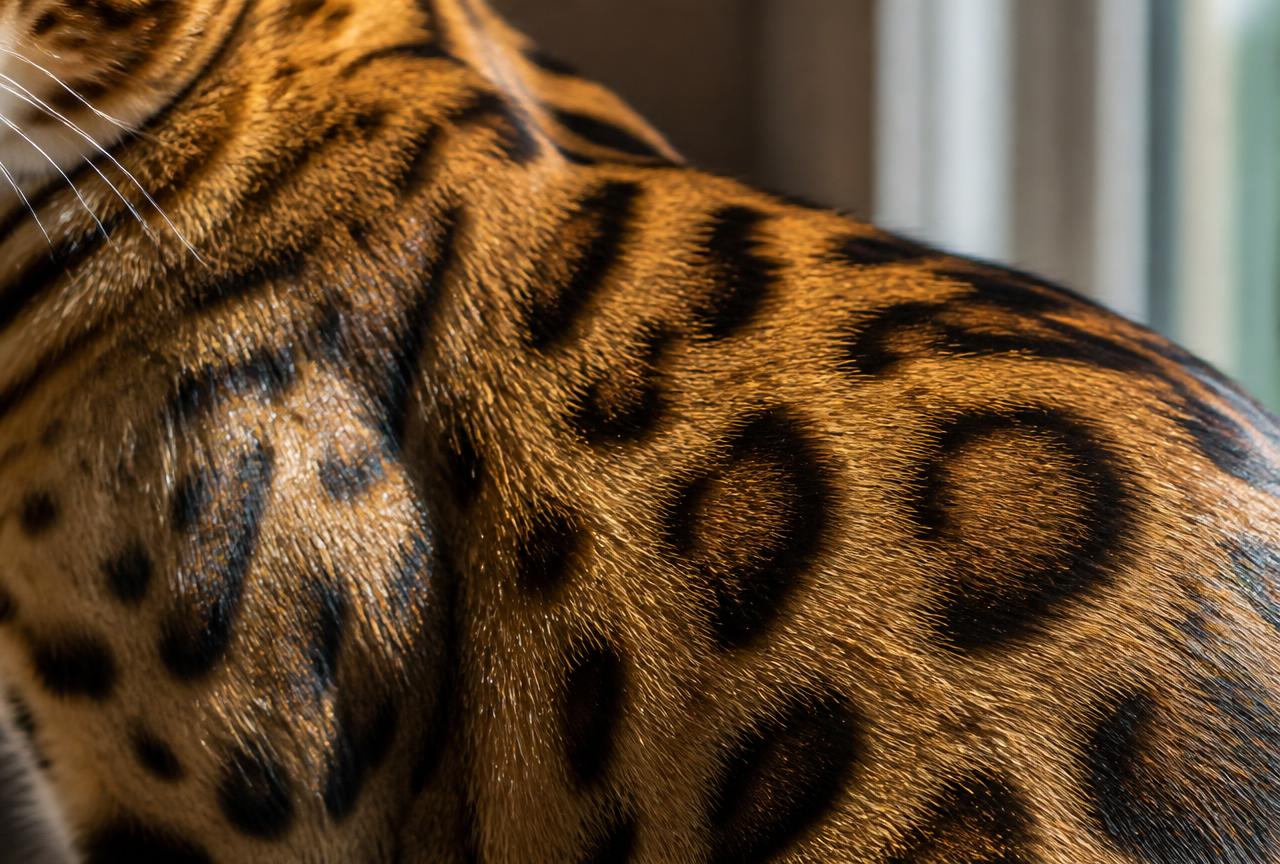
Start with what everyone notices: the coat. Bengals carry rosettes, two-tone spots shaped like little doughnuts or arrowheads, inherited from the Asian leopard cat several generations back, and many lines carry a glitter gene that makes the whole coat sparkle in sunlight. It is genuinely startling in person. Visitors will ask whether it is real. But the coat is the one thing about a Bengal that asks nothing of you: it is short, tight, sheds modestly and needs a weekly once-over at most. People choose the breed for the coat and then discover the cat, and the cat is the part that needs planning for.
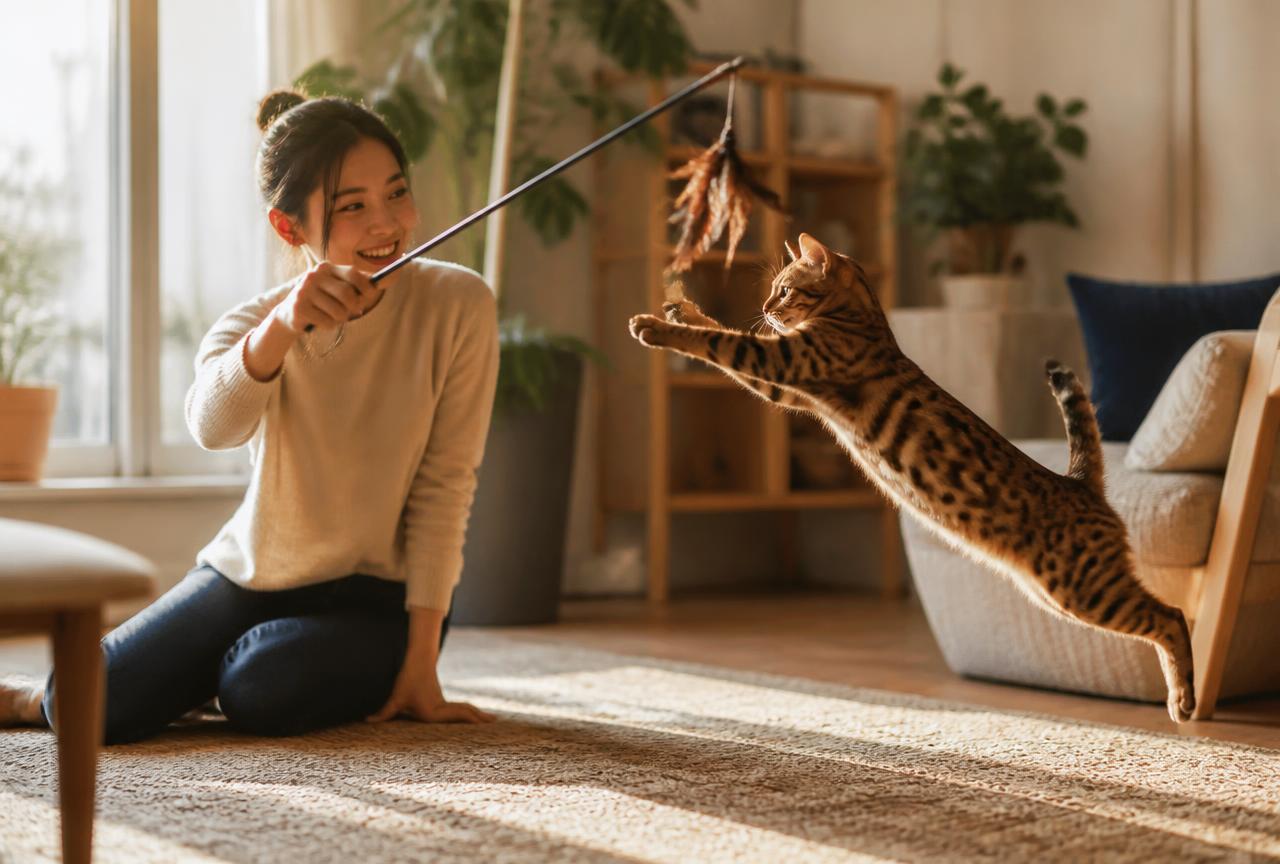
The defining trait is energy, sustained, athletic, intelligent energy that does not fade after kittenhood. A Bengal at five plays like most cats play at one. They leap horizontally across rooms without apparent preparation, learn door handles, and treat the top of the wardrobe as their rightful territory. This is not misbehaviour; it is the breed functioning exactly as bred. The practical consequence is that a Bengal is a time commitment in the way a dog is a time commitment. Two proper play sessions a day, wand toys, fetch (many fetch naturally), puzzle feeders, is the baseline for a sane household. A bored Bengal does not sulk. It redecorates, loudly, at speed.
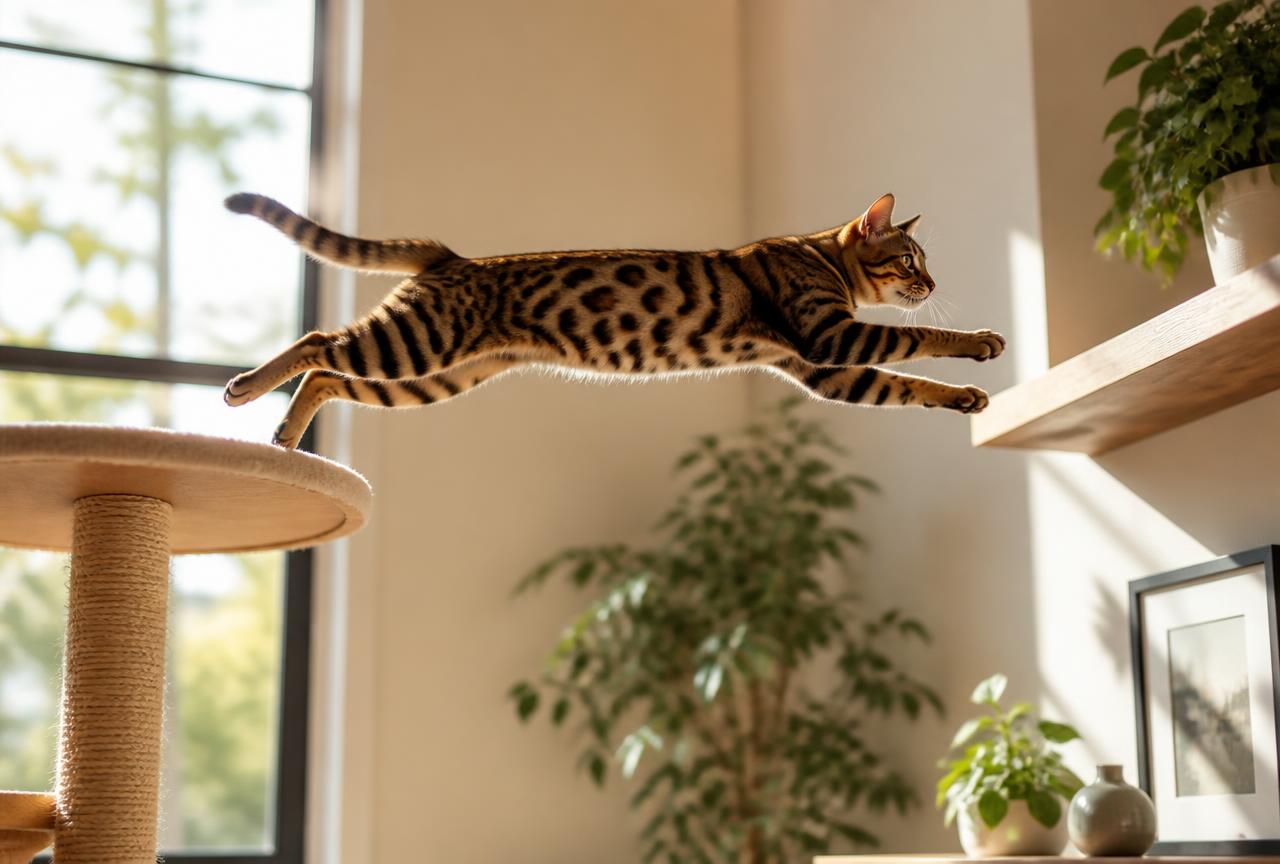
Then there is the voice. Bengals talk, and the vocabulary runs from chirps to a full-throated yowl that carries through doors. They comment on meals, on closed doors, on the injustice of an empty food bowl, on nothing discernible at all. Owners mostly come to love it; neighbours in thin-walled flats may feel differently. If you need a silent cat, this is not your breed, and no training will make it one.
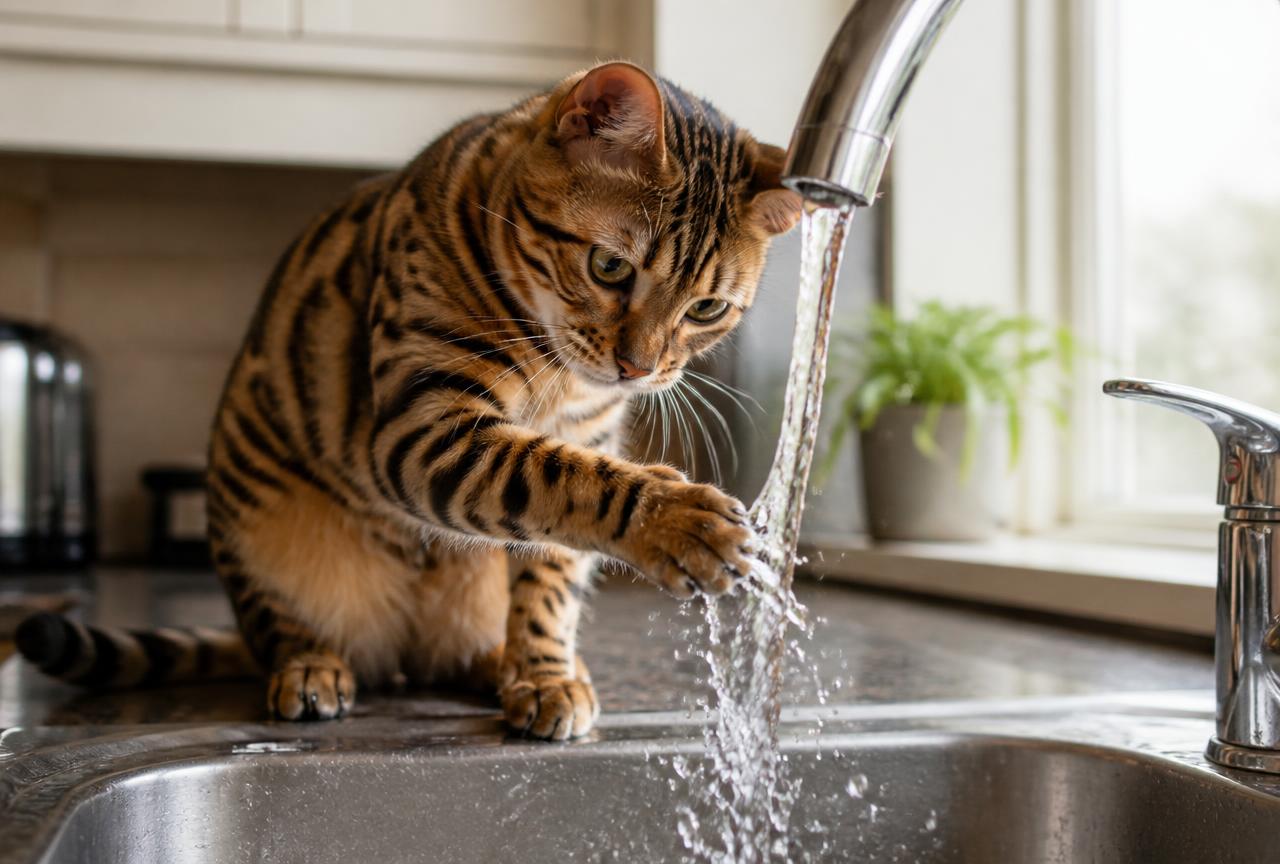
The water thing is real. A substantial share of Bengals are fascinated by running water, taps, fountains, the occasional ill-advised attempt to join a shower. It is charming on day one and slightly less charming on day four hundred, so a hard-wearing cat fountain is a sensible early purchase. Many also learn to swim if introduced young, which tells you something about the confidence level you are dealing with.
Socially, Bengals bond hard with their people and tend to pick a favourite, while remaining friendly with the household generally. They are usually good with children who can match their pace, and famously good with dogs, the energy levels align. With other cats the picture is mixed: a playful resident cat is the single best piece of Bengal equipment you can buy, while a quiet senior cat may find the newcomer's attentions a form of persecution. Introductions need to be done properly and slowly.
What surprises most new owners is the intelligence, and specifically its direction. A Bengal does not use its brain to please you; it uses its brain to get what it wants, which may be a cupboard you thought was latched. This makes them trainable in the technical sense, clicker training works beautifully, and many learn to walk on a harness, but the training cuts both ways, because the cat is also training you. Owners who thrive with Bengals are the ones who find this funny rather than exhausting.
Who should not get one: anyone out of the house ten hours a day with no other animal home; anyone who wants a decorative lap cat; anyone whose furniture arrangements are precious. Who should: active households, people who wanted a dog but rent, experienced cat owners ready for the hard mode, and anyone prepared to build vertical territory and schedule play the way dog owners schedule walks. Done right, it is one of the most rewarding relationships in the cat world. Done casually, it is a leopard-print wrecking ball.
Spectacular, but not a beginner cat. Give them vertical space, puzzle feeders and a schedule, or they will renovate your kitchen.
Grooming, realistically
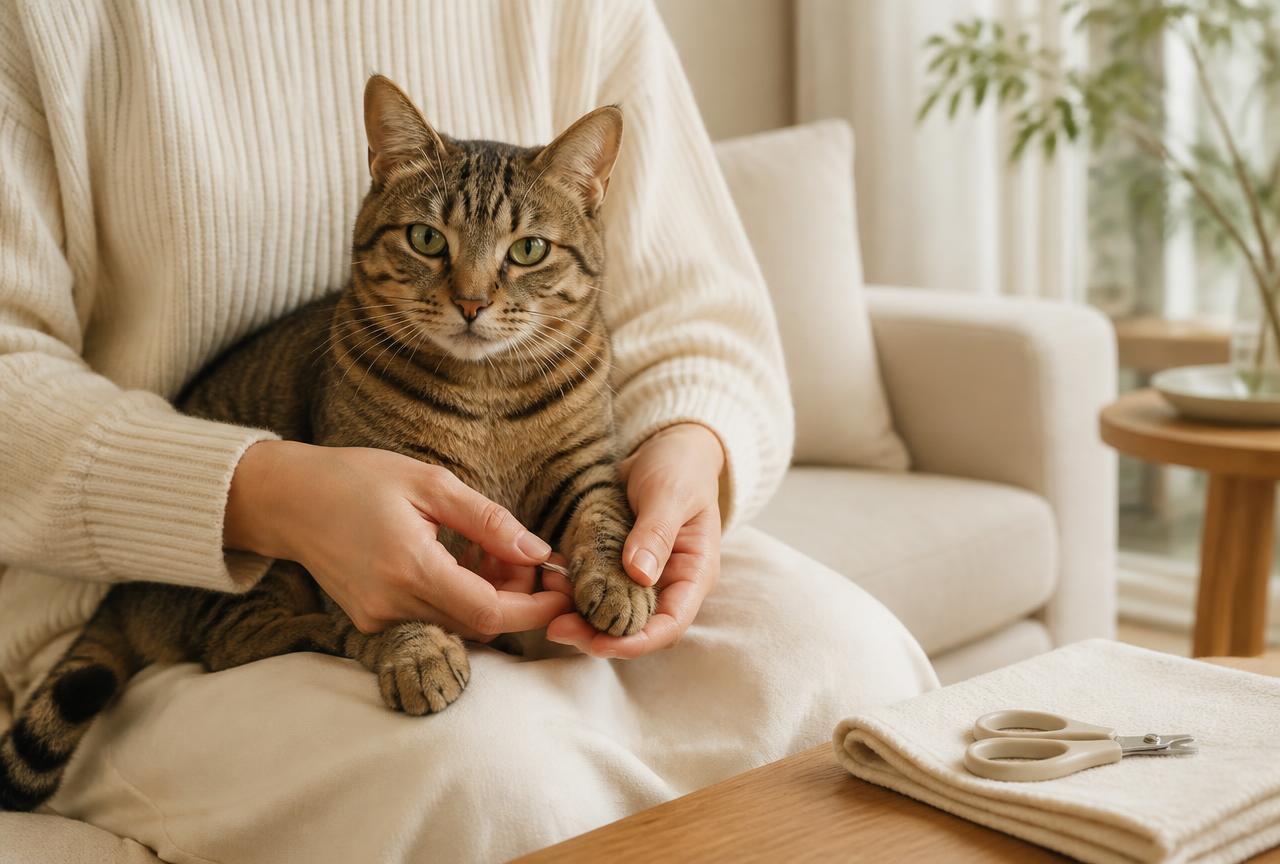
- 1Weekly: five minutes with a rubber curry brush or grooming mitt. The coat is short and pelt-like; this is for bonding and shedding control, not coat health.
- 2Weekly: check ears for wax and claws for length; active cats that climb still wear claws unevenly.
- 3Fortnightly: claw trim if the cat is not a committed scratcher-post user, most Bengals are, but check.
- 4Monthly: a proper look at teeth and gums. Get the cat used to a finger on the gums early; dental care matters in this breed.
- 5Ongoing: no baths needed. The coat is self-maintaining; the water obsession is play, not hygiene.
What you actually need
- Rubber curry brush or grooming mitt
- Cat claw clippers
- Cat toothbrush and enzymatic paste
- A sturdy water fountain (this is grooming-adjacent: it saves your taps)
Kitten to adult
| Age | Male | Female | What is happening |
|---|---|---|---|
| 8 weeks | Ready to leave the breeder. Already climbing; kitten-proof the height, not just the floor. | ||
| 3 months | Peak chaos window. This is when harness training and the scratch-post habit are easiest to establish. | ||
| 6 months | Leggy and relentless. Rosettes continue to develop; the adult pattern is not fully set until about a year. | ||
| 12 months | Near adult height, still filling out. Energy has not peaked, it plateaus here and stays. | ||
| 2 years | Fully grown, fully muscled. Males sit at the top of the range and carry real weight in the shoulders. |
Ranges are typical, not targets. Judge condition by ribs and waist, and check with the ideal weight checker.
What to ask a breeder
- Are the parents screened for HCM by echocardiogram, and how recently? Ask to see the cardiology report, not a verbal assurance.
- Are the cats tested for PRA-b and PK-Def? Both are simple DNA tests and a responsible breeder will have results for every breeding cat.
- What generation are the kittens? F1–F3 cats are not pets in any normal sense; you want SBT (stud book tradition), several generations from the wild ancestor.
- How are the kittens socialised? A Bengal raised underfoot in a busy home copes with life; one raised in a pen may not.
- Can I meet the mother, and is she the sort of cat I want to live with? Temperament runs strongly in lines.
Health watch-list
What to ask a breeder about, and what to watch for over a lifetime. This is orientation, not veterinary advice, anything you notice belongs in front of a vet.
Hypertrophic cardiomyopathy (HCM)
Watch-itemThe most common feline heart disease, present in Bengal lines. Reputable breeders screen breeding cats by echocardiogram; ask for dated reports, and have your vet listen annually.
Progressive retinal atrophy (PRA-b)
Screened forA hereditary blindness gene specific to the breed, identifiable by a simple DNA test. Kittens from tested-clear parents are safe; there is no excuse for an untested litter.
Pyruvate kinase deficiency (PK-Def)
Screened forAn inherited anaemia, again DNA-testable. A breeder who cannot produce PRA and PK-Def results for both parents is not one to buy from.
Sensitive digestion
Common reportBengals are widely reported to have touchy stomachs, loose stools with rich diets or sudden food changes. Transition foods slowly and keep the diet consistent.
Dental disease
As for all catsNot a breed-specific weakness, but a long-lived, long-fed athletic cat accumulates dental disease like any other. Gum handling from kittenhood pays off.
What it costs to keep one
Realistic running cost
€96 / month
About €1,152 a year, or roughly €16,128 across a 14-year life, before purchase price, neutering and one-off vet events.
Before the cat arrives. Budget roughly €280–700 for trays, carrier, posts, bowls, bedding and grooming kit sized for this breed. Figures throughout are indicative and vary a good deal between countries.
Interactive · built for this breed
Is a Bengal right for your home?
Five honest answers. The verdict updates as you go, and the notes tell you what to change before a kitten arrives.
Verdict
An excellent match
Time, height and company, the three things a Bengal cannot do without, and you have all of them. Choose the breeder on health testing, not on rosettes.
What to sort out first
- Bengals live in three dimensions. Floor space matters less than height: a wall of shelves is worth more than a spare room.
For the energy this breed burns, read how much play a cat actually needs, and compare temperaments with the breed matchmaker.
The verdict, by household
Flat dweller
Workable with effort
Family with young children
Good match
First-time owner
Think hard
Multi-cat home
Depends on the resident
Allergy-conscious
Anecdote, not evidence
When to call your vet
- A cat this athletic that stops jumping, or hesitates before leaps, get hips, heart and joints looked at rather than assuming mood.
- Any new bumpiness in the coat, grooming neglect, or weight loss in a breed whose coat should gleam.
- Changes in the voice: a talkative cat that goes quiet, or a quiet patch in a loud cat, is information.
- Squinting, night-time bumping into furniture, or visible eye cloudiness, PRA is screened for in good lines but not extinct.
- Rapid breathing at rest or a sudden intolerance of exercise, heart disease is the breed watch-item and it is worth an annual listen.
Nothing here is a diagnosis. Breathing difficulty, sudden hind-leg weakness and straining to urinate are emergencies, go the same day.
Bengal vs the closest alternatives
| Breed | Weight | Energy | Grooming | € / month |
|---|---|---|---|---|
| Bengal | 4.5–9 kg | 10/10 | 3/10 | €96 |
| Egyptian Mau | 3–5 kg | 9/10 | 3/10 | €80 |
| Toyger | 3–6.5 kg | 9/10 | 3/10 | €88 |
| Turkish Angora | 2.5–5 kg | 9/10 | 5/10 | €86 |
Bengal questions, answered
Are Bengals good house cats?
Yes, indoors is where most Bengals live, and the breed does well inside provided its two requirements are met: daily interactive play and vertical territory. A Bengal with tall shelves, a routine and a tired-out evening is an excellent house cat. A Bengal left alone all day with nothing to climb is a renovation project. Harness training is a popular way to add safe outdoor stimulation.
Are Bengals aggressive?
No, but they play hard, and the distinction matters. A Bengal plays at full intensity, grabbing, bunny-kicking, pouncing, which can read as aggression to someone expecting a placid cat. It is not temper; it is arousal without an off-switch. The fix is structured play with toys, never hands, so the cat learns what skin is for. Boredom, not temperament, is behind most reported behaviour problems.
Do Bengals get along with dogs?
Frequently, yes, better than most breeds. The energy levels align, and a confident Bengal often ends up running the dog. Introductions still need to be slow and managed, and the dog needs a reasonable temperament, but as cross-species matches go this is one of the easiest in the cat world. A playful resident cat is an equally good companion.
Why is my Bengal obsessed with water?
Nobody knows for certain, but the behaviour is common enough in the breed to be a trait: taps watched, paws dabbed in bowls, occasional attempts to join showers. The likely root is the high prey drive, moving water triggers the same circuitry as moving prey. Practical answer: buy a sturdy cat fountain, keep toilet lids down, and accept that the kitchen tap now has two users.
How much does a Bengal kitten cost?
Pet-quality kittens from health-tested parents typically run from about 1,000 to 2,500 EUR equivalent depending on region and line; show-quality rosettes cost more. Price is a proxy for almost nothing by itself, the meaningful questions are the HCM, PRA and PK-Def test results. A cheap untested Bengal is the most expensive kind.
Do Bengals shed a lot?
Less than most cats. The coat is short, dense and close-lying, more pelt than fur, and sheds modestly all year rather than blowing seasonally. A weekly five-minute session with a rubber brush keeps on top of it. This is one of the breed’s genuine practical advantages, and the main reason the low-grooming reputation is deserved.
Can a Bengal be left alone during the day?
Not happily, and not daily. A full working day alone is the single most common cause of destructive Bengal behaviour, the cat has energy, intelligence and no outlet. If the household is out all day, the honest solutions are a second playful animal, a cat sitter or walker mid-day, or a different breed. Puzzle feeders take the edge off; they do not solve it.