United States
Maine Coon
The biggest domestic cat most people will ever share a sofa with, and one of the easiest to live with, provided you have the floor space, the comb, and a tolerance for being followed from room to room.
Reviewed against International Cat Care and Cornell Feline Health Center guidance
The gentle giant of the northeast
The short version
- Expect a long cat rather than a heavy one: most males settle at 6–8 kg, females 4.5–6 kg, and both keep filling out until roughly three to four years old.
- The coat is semi-long and self-maintaining in theory, high-maintenance in practice: two or three thorough combing sessions a week prevent the mats that need clipping out.
- Temperament is the selling point, sociable, biddable, quietly chatty rather than loud, and unusually tolerant of children, dogs and handling.
- Hypertrophic cardiomyopathy and hip dysplasia are the two conditions to raise with a breeder; ask for screening evidence rather than reassurance.
- Everything costs more because the cat is bigger: food portions, litter volume, tray size, carrier size, scratching post height. Budget accordingly before the kitten arrives.
- Weight
- 4.5–8.5 kg
- Lifespan
- 12–15 yrs
- Coat
- Semi-long
- Size
- Large
- Grown male
- 6–8.5 kg
- Grown female
- 4.5–6.5 kg
- Years to full size
- about 3.5
- One-off setup
- €220–450
Get one if…
- Families with children or dogs
- Owners who want a sociable, follow-you-around cat
- Homes with space for a large cat tree
- People happy to comb twice a week
Think again if…
- Very small flats with no vertical space
- Anyone unwilling to groom regularly
- Tight budgets, food and insurance run high
- Owners wanting a small, low-shedding cat
Trait profile
Read the bars as daily life, not trivia. Energy in the middle means bursts of play rather than constant motion, two ten-minute sessions usually settles a Maine Coon. High affection means presence: this is a cat that supervises. Moderate vocality means a repertoire of trills and chirps rather than the Siamese air-raid siren. High grooming and shedding are the real cost of the coat, and the numbers that most often surprise new owners.
Space & setup. Needs a large, stable cat tree and oversized litter trays; a studio flat will feel cramped.
Allergies. Heavy seasonal shedding; a poor choice for allergy sufferers despite the myth that longhairs shed less.
The review
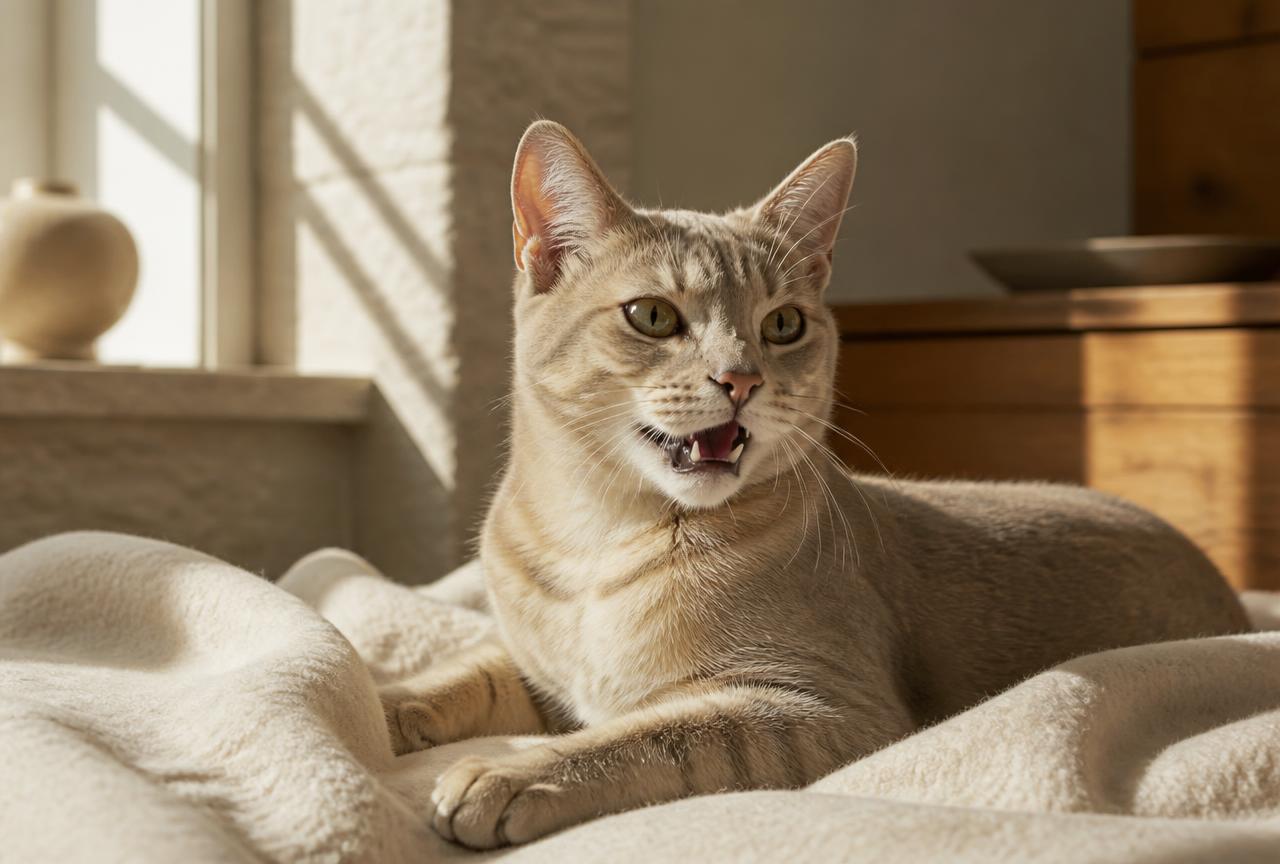
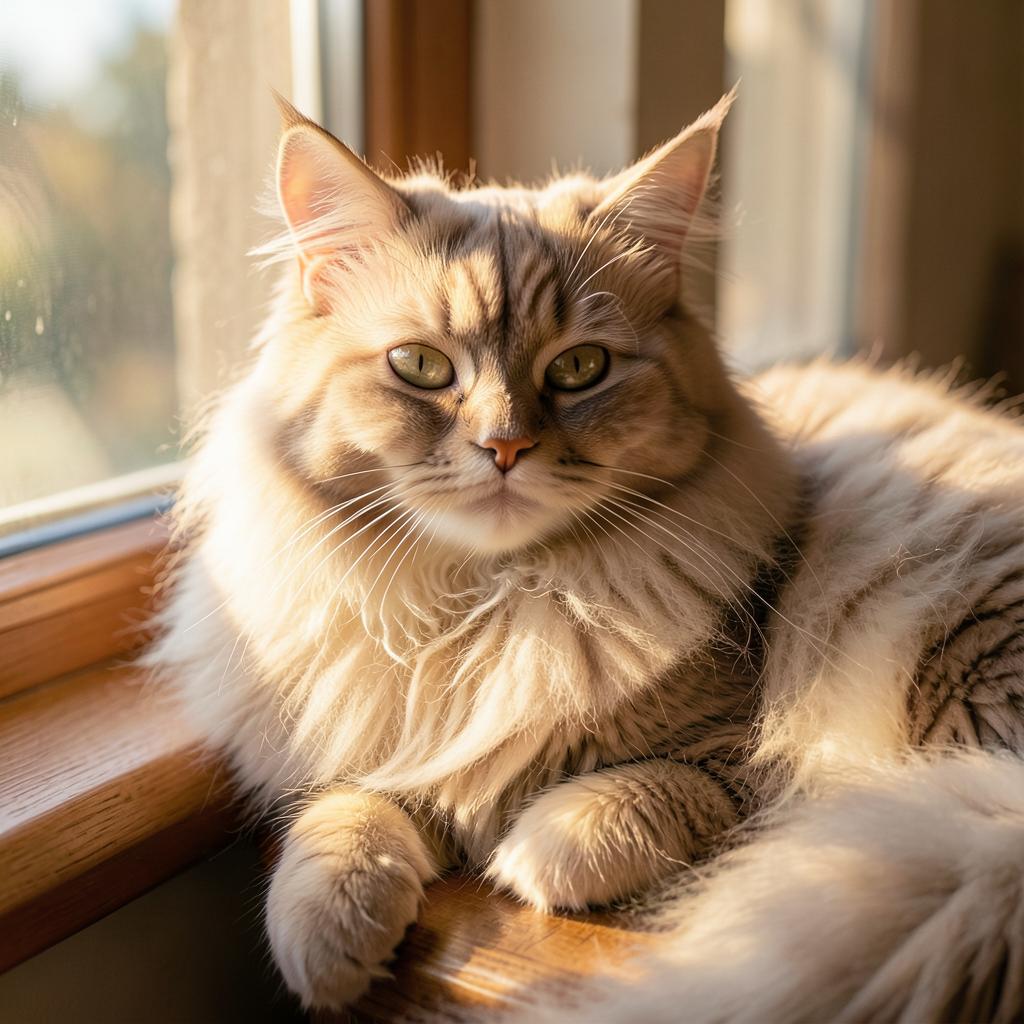
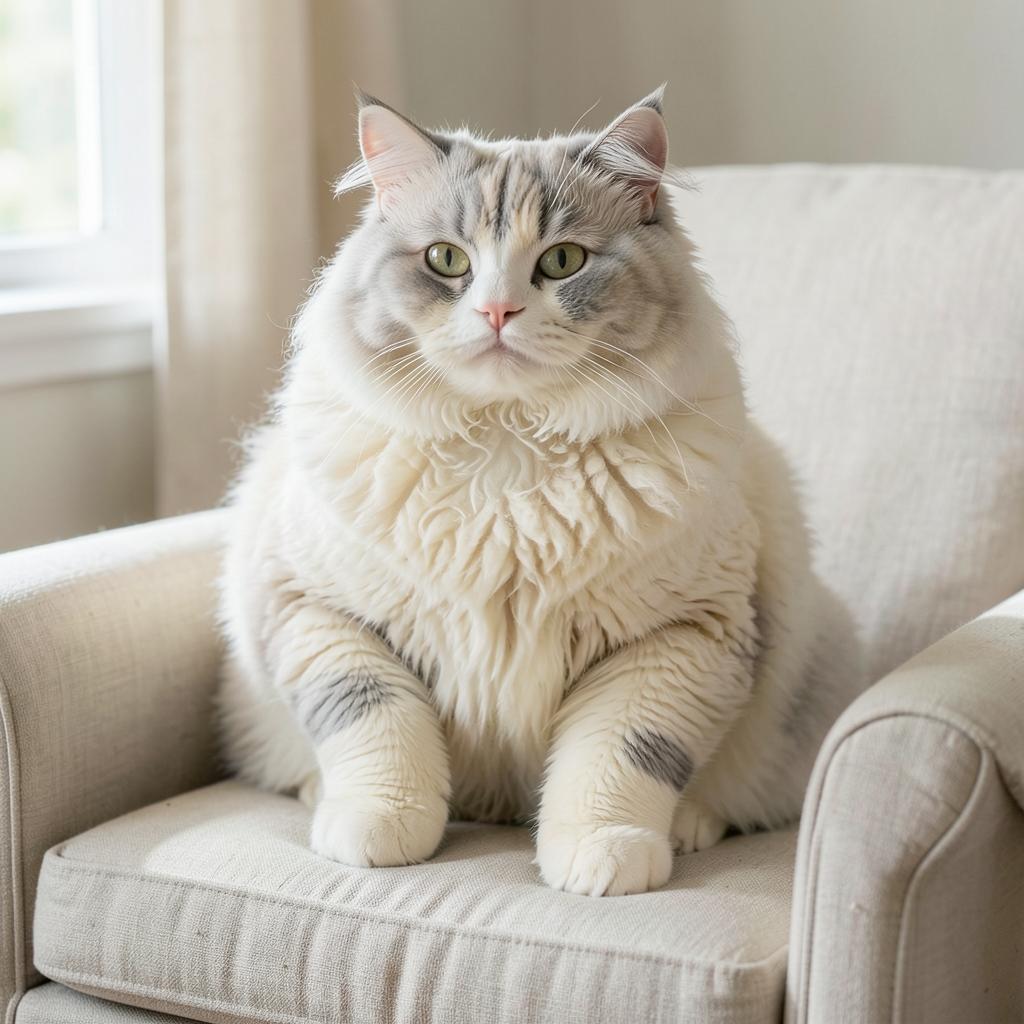
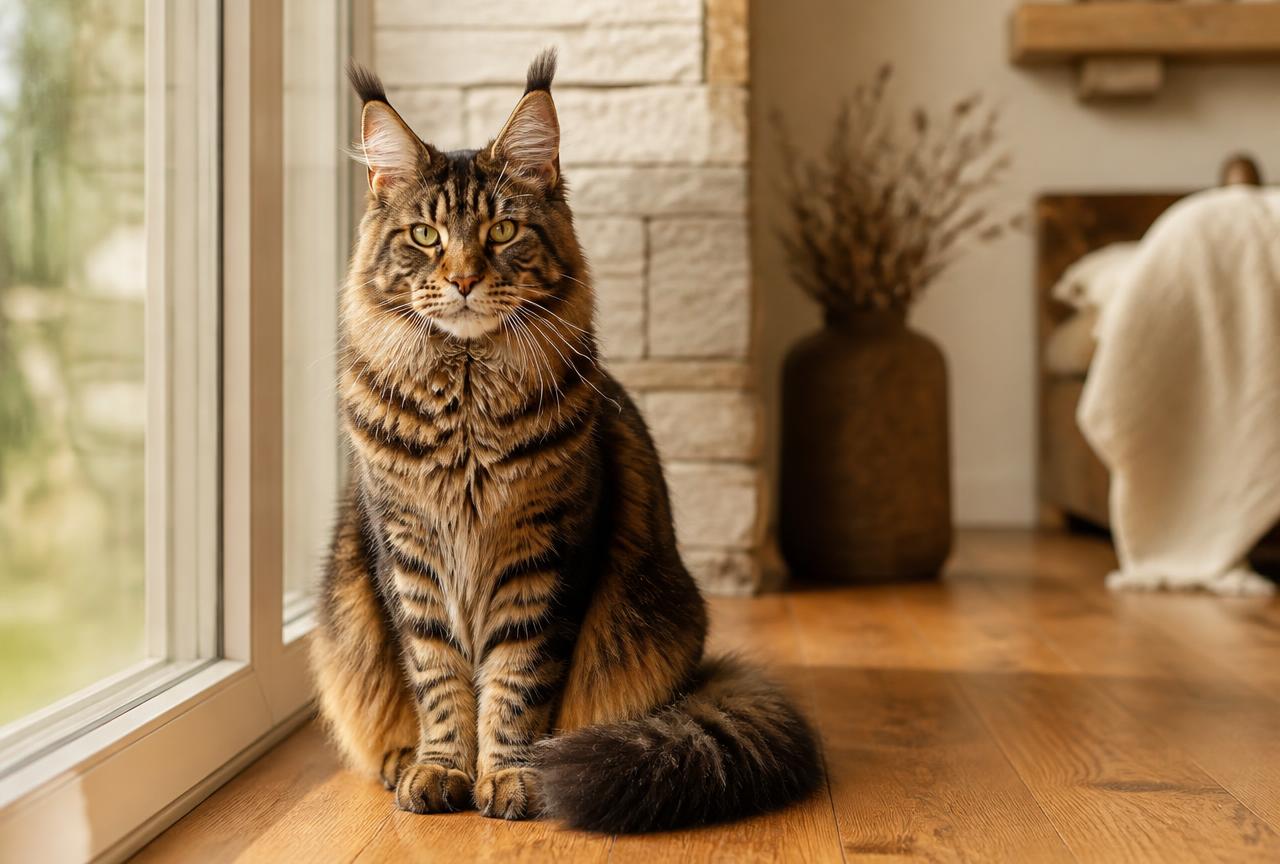
Maine Coons are the largest domesticated cat breed, built for cold winters with a shaggy water-resistant coat, tufted ears and a plumed tail. Despite their size they are famously easygoing, dog-like companions who follow their humans room to room and chirp rather than meow.
Nobody buys a Maine Coon by accident. You see one crossing a room, the long body, the deliberate walk, the tail carried like a plume behind it, and the decision is made somewhere below the level of argument. What follows is the part nobody tells you: the cat is not simply a larger cat. It is a larger cat with a longer adolescence, a coat that keeps its own schedule, and a habit of treating you as its assigned project.
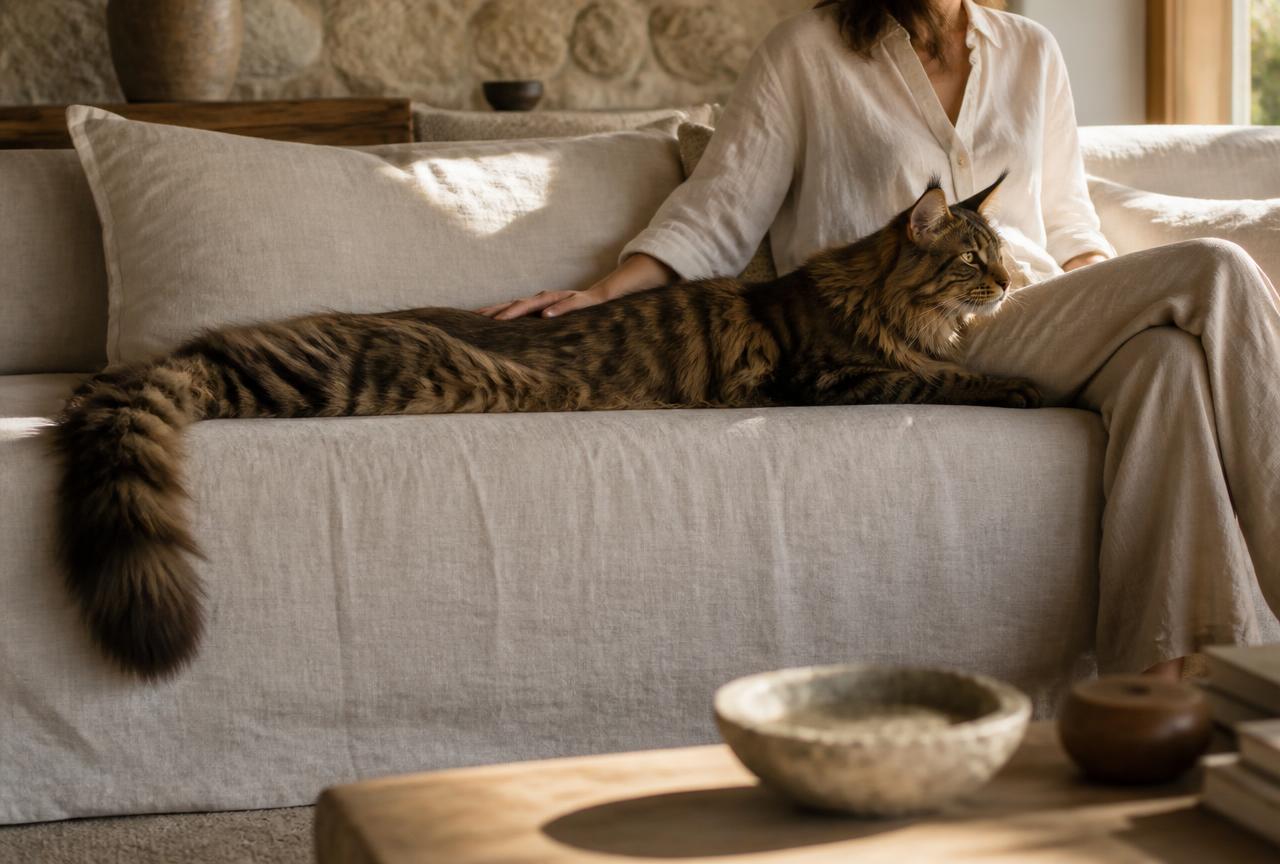
Start with the size, because it is the most exaggerated thing about the breed. Adult males in most lines settle between 6 and 8.5 kg, females between 4.5 and 6.5 kg. The record-holders that circulate online are outliers, and a good number of the 10 kg cats in photographs are simply overweight. What is genuinely unusual is length: a Maine Coon measured nose to tail-tip is often over a metre, and that length is what dictates your shopping list. A standard litter tray is too short. A standard carrier is a bad joke. A 60 cm scratching post is a footstool.
The second surprise is the timeline. Most cats are physically finished at a year. A Maine Coon at twelve months looks like a leggy teenager and keeps developing until three or four, filling out through the chest, broadening across the head, and growing the ruff that gives the breed its lion-ish outline. It is worth knowing because it changes how you read the cat: the gawky, slightly awkward one-year-old is not the finished animal, and the feeding decisions you make in that window matter more than they would in a smaller breed.
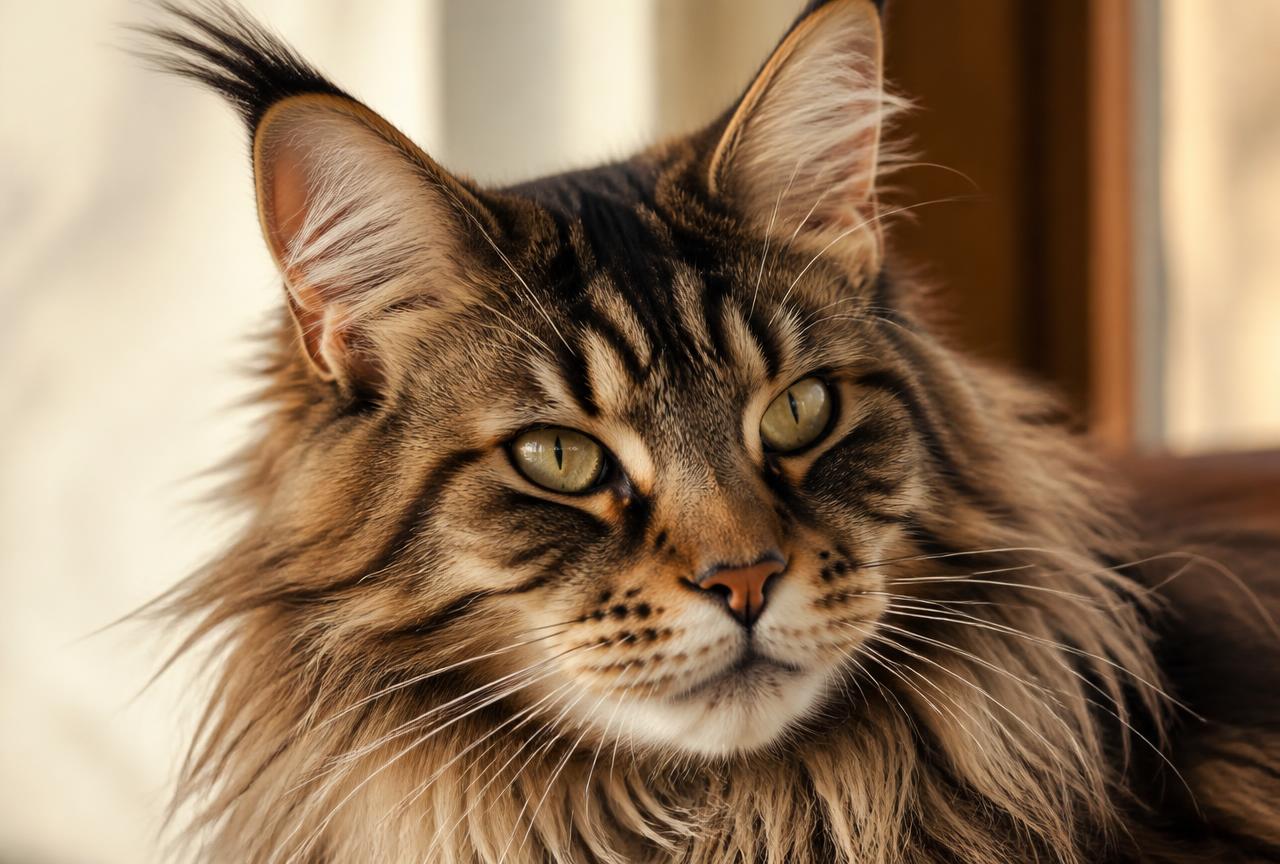
Then the coat. Breed literature describes it as semi-long and low-maintenance, which is true in the sense that it does not need the daily intervention a Persian does. In practice, it is a coat with four specific traps: behind the ears, the ruff, the armpits, and the britches at the back of the thighs. Skip a fortnight and you find a mat; skip a month and the mat needs cutting out. Two thorough combing sessions a week, ten minutes each, keep the whole problem away, and because these are unusually biddable cats, most of them come to accept it, which is not something you can say about every long-coated breed. On shedding: it is real, it is seasonal, and it is a large surface area of cat.
What redeems all of it is the temperament, which is the actual reason the breed has spent decades near the top of every popularity list. Maine Coons are sociable without being clingy, confident without being pushy, and remarkably tolerant of the things that offend other cats, being picked up, being shared with a dog, being investigated by a four-year-old. They are trainable in the modest sense that cats are trainable: harness, carrier, recall for food, the occasional retrieved toy. And they talk, though not in the Siamese register. The Maine Coon voice is a chirp, a trill, a rising interrogative delivered from the doorway. It is one of the more charming things about living with one, and it is quieter than most people expect.
They also, for reasons nobody has adequately explained, take an interest in water. Dipping a paw in the bowl, sitting in the empty bath, supervising a running tap. It is not universal, but it is common enough to be part of the breed's folklore, and it makes a circulating fountain a reasonable purchase rather than an indulgence.
The honest reservations are three. First, the grooming commitment is not optional, and a household that cannot promise twenty minutes a week should choose a short-haired breed instead. Second, the health picture requires you to shop carefully: hypertrophic cardiomyopathy and hip dysplasia both appear in the breed, and the difference between a well-screened line and a badly bred one is the difference between a fifteen-year cat and a heartbreaking one. Ask for echocardiogram results and genetic test reports, and walk away from anyone who bristles at the question. Third, the cost of everything scales with the cat: more food by weight, more litter by volume, bigger equipment, and insurance premiums that reflect a known cardiac risk.
Set against that: a large, calm, funny, sociable animal that generally wants to be wherever you are, copes well with family life, and looks, even at the age of twelve, asleep on a radiator, like something that ought to be photographed. If you have the floor space and the comb, there are very few better cats to live with.
The Maine Coon is the closest a cat comes to a co-worker: present, opinionated, and unbothered by chaos. Budget for grooming time and a very large litter box.
Grooming, realistically
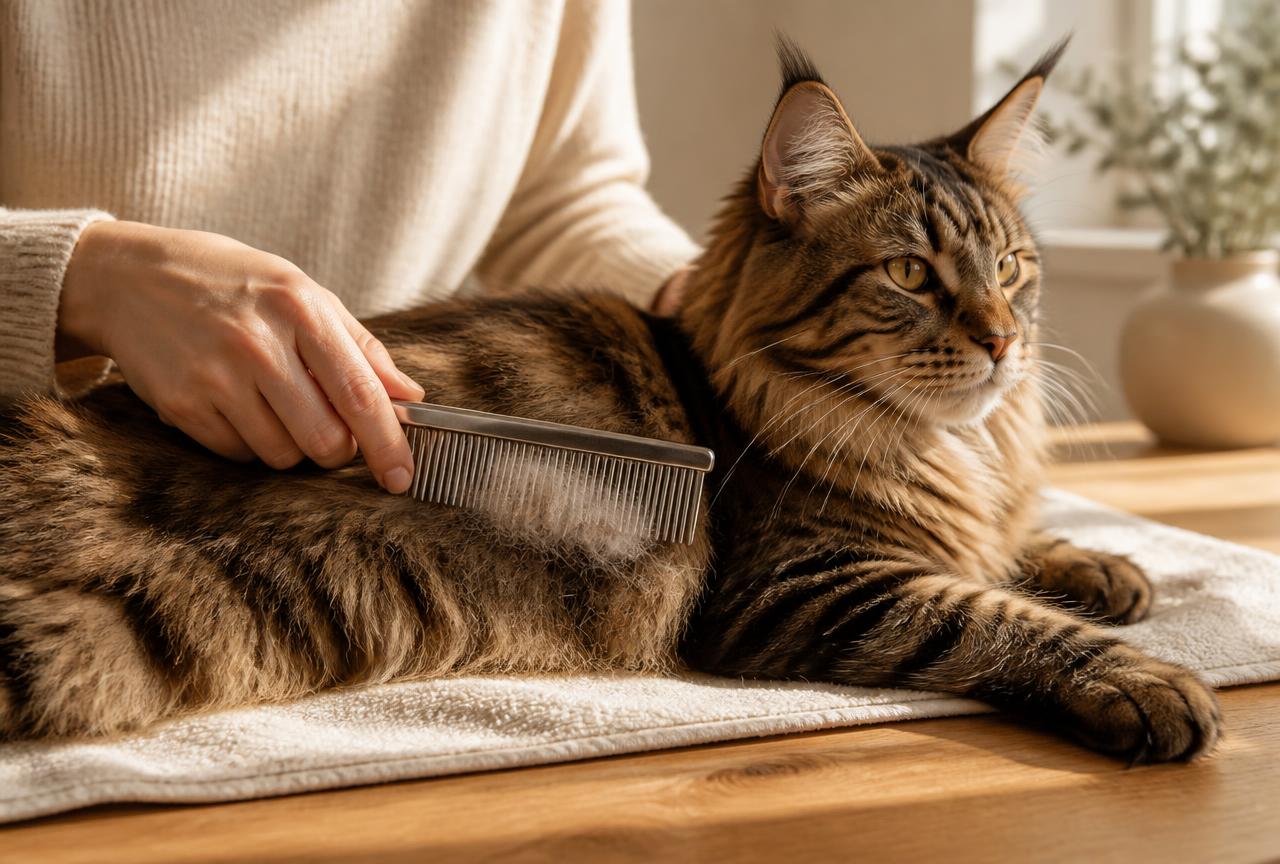
- 1Comb twice a week as a baseline, three times through the spring and autumn coat changes. Ten minutes each time is enough if you never skip.
- 2Start at the shoulders with a wide-tooth metal comb, then work down the flanks in short strokes, lifting rather than dragging.
- 3Give the four mat-prone zones their own pass: behind the ears, the ruff, the armpits, and the britches at the back of the thighs.
- 4Finish the tail last and gently, the plume is the part a cat objects to most, so keep it short and end on a good note.
- 5Check for mats with your fingers, not the comb. Anything you cannot separate by hand needs scissors held flat to the skin, or a groomer.
- 6Trim claws every three to four weeks and look inside the ears while the cat is already sitting still.
What you actually need
- Wide-tooth stainless steel comb, the single most useful tool for a semi-long coat
- Fine-tooth comb for the ruff and behind the ears
- Blunt-nosed scissors for mats, used flat against the skin
- Claw clippers sized for a large cat
- A tray at least 55–60 cm long, and a carrier rated well above the cat''s weight
Kitten to adult
| Age | Male | Female | What is happening |
|---|---|---|---|
| 8 weeks | 0.9–1.3 kg | 0.8–1.1 kg | Still with the breeder; should be litter-trained and handled daily |
| 3 months | 1.7–2.3 kg | 1.5–2.0 kg | Growth spurt begins; feed to appetite, four small meals |
| 6 months | 3.2–4.3 kg | 2.8–3.6 kg | Already the size of an adult small breed; neutering usually discussed |
| 12 months | 4.5–6.0 kg | 3.6–4.8 kg | Frame nearly full length, chest and ruff still thin |
| 2 years | 5.5–7.5 kg | 4.2–5.8 kg | Coat reaches adult density; males broaden through the head |
| 3–4 years | 6.0–8.5 kg | 4.5–6.5 kg | Final weight. Anything beyond this range is usually fat, not frame |
Ranges are typical, not targets. Judge condition by ribs and waist, and check with the ideal weight checker.
What to ask a breeder
- Can you show me heart screening for both parents, done by echocardiogram rather than a stethoscope check?
- Have the parents been genetically tested for the Maine Coon HCM variant and for spinal muscular atrophy?
- Has either parent been hip-scored, and can I see the report?
- At what age do the kittens leave, and what have they already been socialised with, children, dogs, vacuum, carrier?
- What are the adult weights in this line, honestly? Anyone promising a 12 kg cat is selling a story.
Health watch-list
What to ask a breeder about, and what to watch for over a lifetime. This is orientation, not veterinary advice, anything you notice belongs in front of a vet.
Hypertrophic cardiomyopathy (HCM)
NotableThe thickening of the heart muscle that is the best-documented concern in the breed. A specific genetic variant is associated with Maine Coons, but a negative genetic test does not rule the disease out, echocardiogram screening of breeding cats is the meaningful evidence. Watch for fast or effortful breathing at rest and sudden hind-leg weakness, both of which are emergencies.
Hip dysplasia
CommonLarge, heavy-framed cats are more prone to a poorly formed hip joint than small ones. Many affected cats are mildly affected and live normally; some develop stiffness, a reluctance to jump, or a bunny-hopping gait. Ask whether the parents were hip-scored, and keep the adult cat lean, weight is the one variable you control.
Spinal muscular atrophy
UncommonAn inherited condition causing muscle wasting in the hindquarters, usually visible by four months. A reliable genetic test exists and responsible breeders use it, so this should be a solved problem in any line you buy from.
Polycystic kidney disease
UncommonMore strongly associated with Persian lines but reported in outcrossed pedigrees. Genetic testing is straightforward; ask if the line has any Persian ancestry.
Obesity and joint strain
Very likelyThe most likely thing to shorten a Maine Coon''s life, and the most preventable. A big frame hides gained weight well, so judge by ribs and waist rather than the number, and portion by measured amounts rather than a filled bowl.
Dental disease
Common with ageAs in every breed, plaque becomes gingivitis becomes tooth loss. Home brushing plus a professional check-up as the cat ages is the whole strategy.
What it costs to keep one
Realistic running cost
€118 / month
About €1,416 a year, or roughly €19,824 across a 14-year life, before purchase price, neutering and one-off vet events.
Before the cat arrives. Budget roughly €220–450 for trays, carrier, posts, bowls, bedding and grooming kit sized for this breed. Figures throughout are indicative and vary a good deal between countries.
Interactive · built for this breed
Is a Maine Coon right for your home?
Five honest answers. The verdict updates as you go, and the notes tell you what to change before a kitten arrives.
Verdict
A good match, with one thing to fix
Work through the notes below before the kitten arrives rather than after. Most are equipment or routine, not deal-breakers.
What to sort out first
- Two ten-minute combing sessions is the working minimum, and it genuinely is enough.
This weighs fit, not welfare or health. For portions once a big cat arrives, use the portion calculator, and compare temperaments with the breed matchmaker.
The verdict, by household
Small flat, no outdoor access
Workable, with conditions
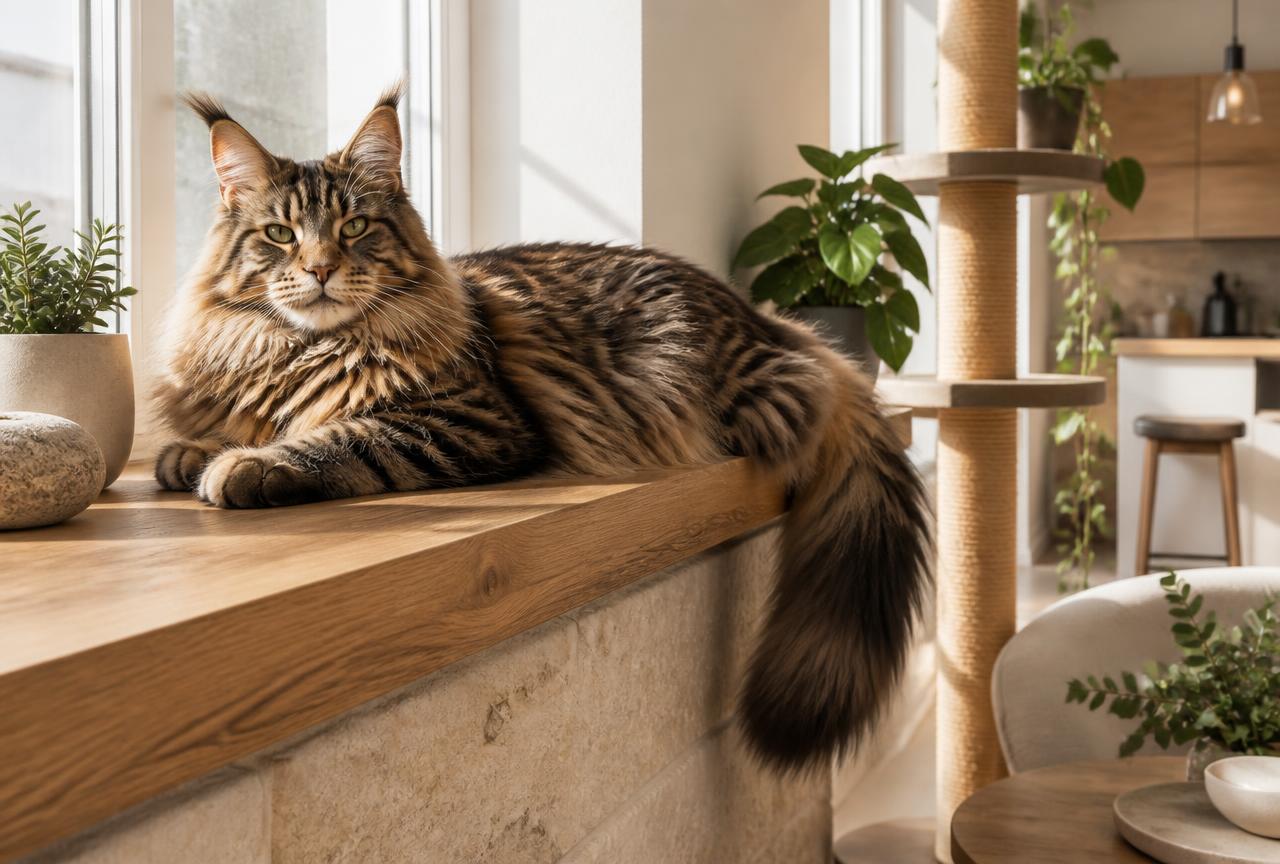
Space matters less than height and layout: one tall post, one wide window perch and a long tray beat an extra room. A bored Maine Coon becomes a heavy Maine Coon, so play twice daily.
Family with young children
One of the best choices there is
Tolerance for handling and noise is genuinely high. Still teach children to sit beside the cat rather than carry it, nobody carries 7 kg well.
First-time owner
Yes, if you commit to the comb
Temperament is forgiving; the coat is not. Owners who fall behind on grooming end up paying a groomer to clip out mats twice a year.
Multi-cat or dog household
Strong fit
Usually confident without being pushy. Introduce slowly anyway, and feed separately, a big cat quietly eats everyone else's dinner.
Allergy-conscious home
Think again
No cat is hypoallergenic, and a large semi-long-haired cat spreads more Fel d 1 around the room than a small short-haired one.
Away from home all day
Only in pairs
This is a sociable breed that follows people. Alone from eight in the morning until seven at night is a poor arrangement for it.
When to call your vet
- Breathing that is fast or effortful at rest, or open-mouthed breathing after mild activity
- Sudden weakness or dragging in the hind legs, which can signal a clot associated with heart disease
- A change in gait, reluctance to jump up, or a bunny-hopping run in a young adult
- Straining in the tray, or repeated visits with nothing produced, urgent in males
- Steady weight loss on an unchanged appetite, or a drop in appetite lasting more than 24 hours
Nothing here is a diagnosis. Breathing difficulty, sudden hind-leg weakness and straining to urinate are emergencies, go the same day.
Maine Coon vs the closest alternatives
| Breed | Weight | Energy | Grooming | € / month |
|---|---|---|---|---|
| Maine Coon | 4.5–8.5 kg | 7/10 | 8/10 | €118 |
| Ragamuffin | 4.5–9 kg | 5/10 | 7/10 | €100 |
| Selkirk Rex | 3.5–7 kg | 5/10 | 7/10 | €96 |
| Ragdoll | 4.5–9 kg | 4/10 | 7/10 | €90 |
Maine Coon questions, answered
How big does a Maine Coon actually get?
Males usually finish between 6 and 8.5 kg, females between 4.5 and 6.5 kg, and both are often over a metre long from nose to tail-tip. Length, not weight, is the striking part. Cats advertised as reaching 10 kg or more are either exceptional individuals or, more often, overweight ones.
How long do Maine Coons take to grow?
Roughly three to four years, against about one year for most cats. The frame lengthens first, then the chest broadens and the ruff fills in. A gangly-looking eighteen-month-old is entirely normal and should not be fattened up to look more impressive.
Do Maine Coons need daily grooming?
No, but they need consistent grooming. Two thorough combing sessions a week, three during the spring and autumn coat changes, keep the coat mat-free. Concentrate on behind the ears, the ruff, the armpits and the britches, which are where mats form first.
Are Maine Coons good with children and dogs?
Unusually so. Tolerance for handling, noise and other animals is one of the breed's defining traits, which is why it appears on so many family shortlists. Introduce any new animal gradually regardless of breed, and teach children to sit with the cat rather than carry it.
Are Maine Coons hypoallergenic?
No cat is. The allergen is a protein in saliva and skin secretions, not the hair itself, so coat length does not remove it, and a large semi-long-haired cat distributes more of it around a room than a small short-haired one. If allergies are a factor, spend hours with adults of the breed before committing.
What health tests should a Maine Coon breeder have done?
Echocardiogram screening of breeding cats for hypertrophic cardiomyopathy, genetic testing for the Maine Coon HCM variant and spinal muscular atrophy, and ideally hip scoring. Ask to see the reports rather than accepting a verbal assurance. A breeder who is uncomfortable with the question is answering it.
Can a Maine Coon live happily in a flat?
Yes, if you build upwards. Height, a wide window perch, a tall sturdy post and a tray at least 55–60 cm long matter more than total floor area. Two play sessions a day keep the weight off, which is the real risk of indoor life for a big-framed cat.
Sources
- Hypertrophic cardiomyopathy in cats, International Cat Care
- Hypertrophic cardiomyopathy, Cornell Feline Health Center
- Nutritional guidelines for complete and complementary pet food, FEDIAF
- WSAVA global nutrition guidelines and body condition tools, WSAVA
- Grooming and coat care, International Cat Care