Wet vs dry cat food: settling the argument with actual numbers
A desert-evolved carnivore drinks badly and eats often. That single fact decides most of this debate, and the rest comes down to calories, cost and your cat's teeth.
Nadia Ferreira
Feline nutrition writer, ten years reporting on pet food formulation
Published 4 August 2026 · Updated 4 September 2026
Reviewed against ISFM and WSAVA feeding guidance, September 2026
The short version
- Cats evolved in deserts and have a weak thirst drive: wet food supplies roughly 75-80% water, dry food about 8-10%.
- Dry food is not a dental treatment. Most kibble shatters rather than scrapes, so brushing and vet checks still do the work.
- Feeding both is legitimate. A common, workable pattern is 1-2 wet meals a day plus a measured dry allowance, counted inside the same calorie budget.
- Count calories, not cups or pouches. Two brands with identical portion sizes can differ by 40% in kcal.
- Cats with a history of urinary blockage, kidney disease, diabetes or chronic constipation should be moved towards wet-heavy feeding with vet input.
Ask ten cat owners whether to feed wet or dry and you will get ten confident answers, most of them inherited from a vet nurse, a breeder or a forum post from 2011. The argument is winnable, but only if you start where the cat starts: with an animal that evolved in arid country, gets most of its water from prey, and has a thirst drive so unreliable that it will happily walk past a full bowl while mildly dehydrated.
Everything else in this debate, cost, teeth, convenience, fussiness, sits downstream of that.
The moisture gap is the whole argument
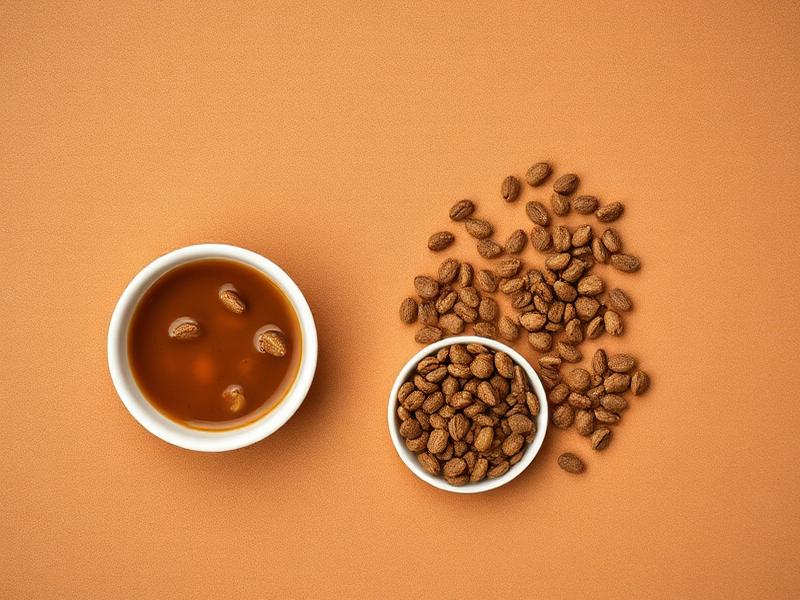
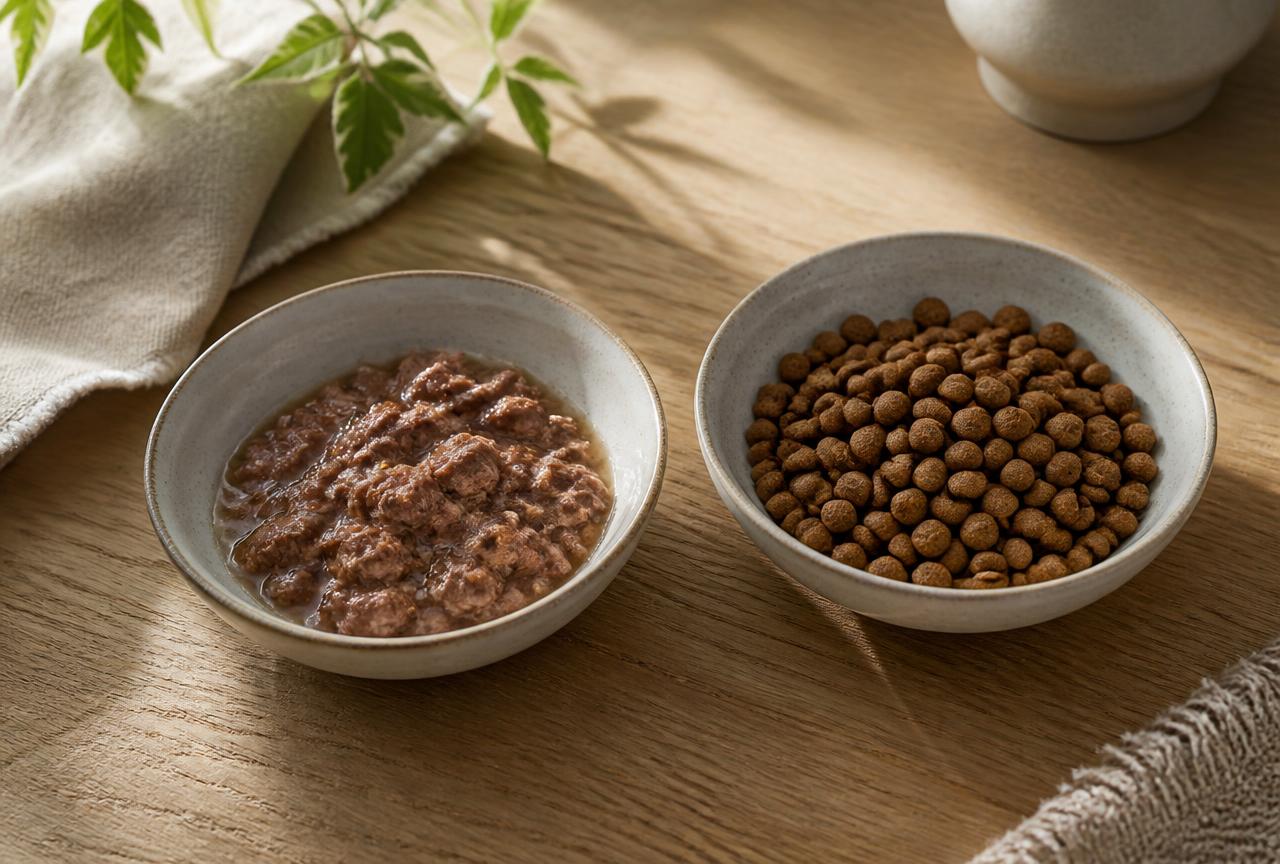
A mouse is about 70% water. Wet cat food, whether pouch, tray or tin, lands between 75% and 80%. Dry food sits at 8% to 10%.
A cat eating only dry food has to make up that difference by drinking, and cats are poor compensatory drinkers compared with dogs. Studies of total water turnover consistently find dry-fed cats take in less fluid overall than wet-fed cats, even when they visibly drink more. The practical result is more concentrated urine, which matters for any cat with a history of crystals, cystitis or blockage, and for elderly cats whose kidneys are already working harder for the same output.
If you remember one thing: dry food is not dangerous, but a dry-only cat has a smaller margin for error on hydration.
That margin is why the rest of this article treats water as the baseline and everything else as optimisation.
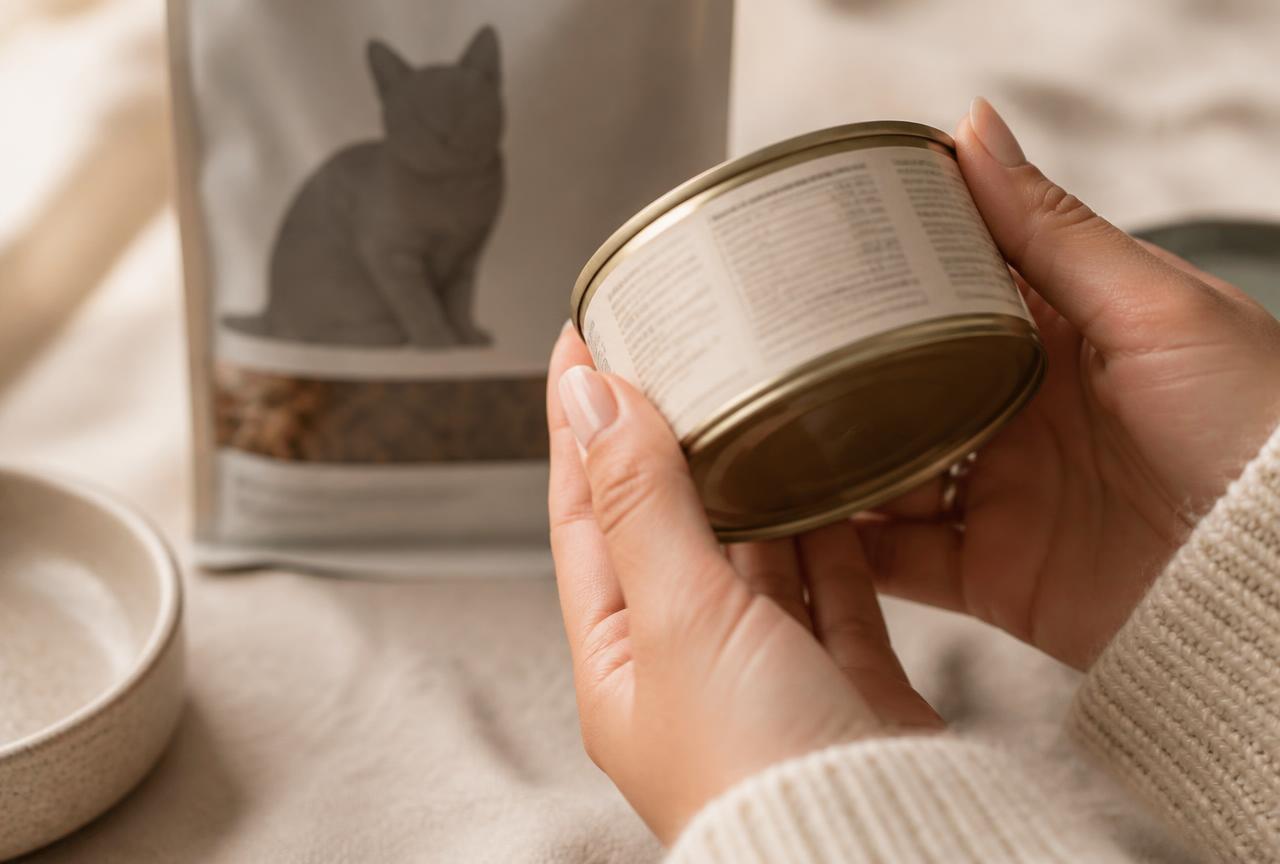
Read the label properly: dry matter basis
Comparing the protein number on a pouch with the protein number on a bag is meaningless, because one of them is mostly water. Convert both to dry matter basis.
- 1Take the moisture percentage and subtract it from 100 to get dry matter.
- 2Divide the nutrient percentage by the dry matter figure.
- 3Multiply by 100.
A wet food listing 10% protein at 78% moisture is 10 ÷ 22 × 100 = 45% protein on a dry matter basis, comfortably ahead of a kibble listing 34% protein at 8% moisture, which works out at 37%.
| Metric | Typical wet food | Typical dry food |
|---|---|---|
| Moisture | 75-80% | 8-10% |
| Protein, dry matter | 40-55% | 30-40% |
| Carbohydrate, dry matter | 3-12% | 25-45% |
| Energy density | 70-110 kcal per 100 g | 330-420 kcal per 100 g |
| Cost per 100 kcal | Higher, wide range | Usually lower |
The energy density row is the one that catches people out. Kibble carries roughly four times the calories per gram, which is why eyeballed handfuls quietly create overweight cats. Two brands of dry with the same recommended cup size can differ by 40% in kcal.
Build your split, then price it
The useful question is not "wet or dry" but "what proportion, at what cost, for my cat". Set that below, the calculator sizes the daily portions from your cat's weight and life stage, splits them the way you choose, and prices your actual products.
Interactive · built for this article
Wet / dry split & cost calculator
Set your cat, choose a split, then enter the numbers from your own packaging. Everything is worked out in calories, which is the only fair way to compare the two.
Daily target
260kcal
- Wet food
- 2.3 pouches · 169 kcal
- Dry food
- 24 g · 91 kcal
- Cost per day
- €2.14
- Cost per month
- €65.14
Suggested day
- Morning · wet meal96 g
- Evening · wet meal96 g
- Across the day · measured dry24 g
- Treat allowance (10% max)26 kcal
Cost per 100 kcal
Wet food costs 4.5× more per calorie than your kibble.
Estimates for healthy cats, based on standard resting-energy formulas. Weight-loss, pregnancy and illness need veterinary targets. Want the full plan? Open the portion calculator.
Two habits make those numbers real. Weigh dry food on a kitchen scale rather than scooping, and re-weigh your cat every two weeks; a shift of more than 2% of body weight in a fortnight is your signal to adjust intake by about 10% and hold for another two weeks.
For a fuller plan across the day, including treat allowance and weight-loss targets, use the full portion calculator, and check the healthy range for your cat's frame with the ideal weight tool.
Teeth: the myth worth retiring
The belief that kibble cleans teeth is the most persistent claim in cat feeding, and it is largely wrong. Standard biscuits shatter on first contact instead of wiping the tooth surface, and a great deal of kibble is swallowed with little chewing at all. Prescription dental diets are different: they use a larger, fibre-aligned biscuit that resists fracture and does produce measurable plaque reduction, which is why they carry independent dental accreditation and ordinary kibble does not.
Real dental care for cats is unglamorous:
- Daily or near-daily brushing with a cat-specific enzymatic paste, introduced gradually over weeks.
- Annual oral checks, moving to twice yearly after about age eight.
- Professional scaling under anaesthetic when your vet says so, not when the tartar is already visible from across the room.
- Accredited dental products rather than anything marketed loosely as "helps teeth".
Feeding dry food is not a substitute for any of the above, and feeding wet food does not doom a cat to dental disease. Genetics and gingivitis history matter more than texture, brachycephalic breeds such as the Persian start with crowded jaws and need earlier, closer attention.
Cost, honestly
Wet feeding is usually more expensive per calorie, but the gap is smaller than the internet suggests, and it reverses at the edges: a supermarket own-brand wet tray can undercut premium grain-free kibble per 100 kcal. Category averages are useless here, which is why the calculator above asks for your own prices.
Three ways owners genuinely reduce the bill without moving to dry-only:
- Buy wet in larger tins and portion it. Single-serve pouches carry a heavy packaging premium.
- Use a mid-priced complete wet as the base and reserve the expensive product as topper or medication cover.
- Keep the dry allowance small and measured, and use it as the puzzle-feeder and slow-release portion rather than as the main meal.
Also count the costs that do not appear on the receipt. One episode of urinary obstruction, most common in young to middle-aged male cats, routinely costs more than a year of the difference between wet and dry, before considering what it does to the cat.
Cats who should lean wet
Move deliberately towards wet-heavy feeding, with your vet involved, if your cat:
- has had cystitis, crystals or any urinary blockage;
- has chronic kidney disease, at any stage;
- is diabetic or at risk of it, where lower carbohydrate intake helps glycaemic control;
- is constipated regularly, or has had a megacolon diagnosis;
- is an older cat losing condition, where palatability and water both matter;
- barely drinks, in a household where you never see them at a bowl.
Cats who tolerate dry perfectly well are typically young, well hydrated, at a healthy weight, and drinking normally. Even then, one wet meal a day is cheap insurance.
Switching a dry-only cat: a seven-day plan
Cats imprint on food texture early, so a cat raised on kibble may treat a pouch as an insult. Patience beats pressure, and pressure is genuinely risky: cats that stop eating for a few days can develop hepatic lipidosis.
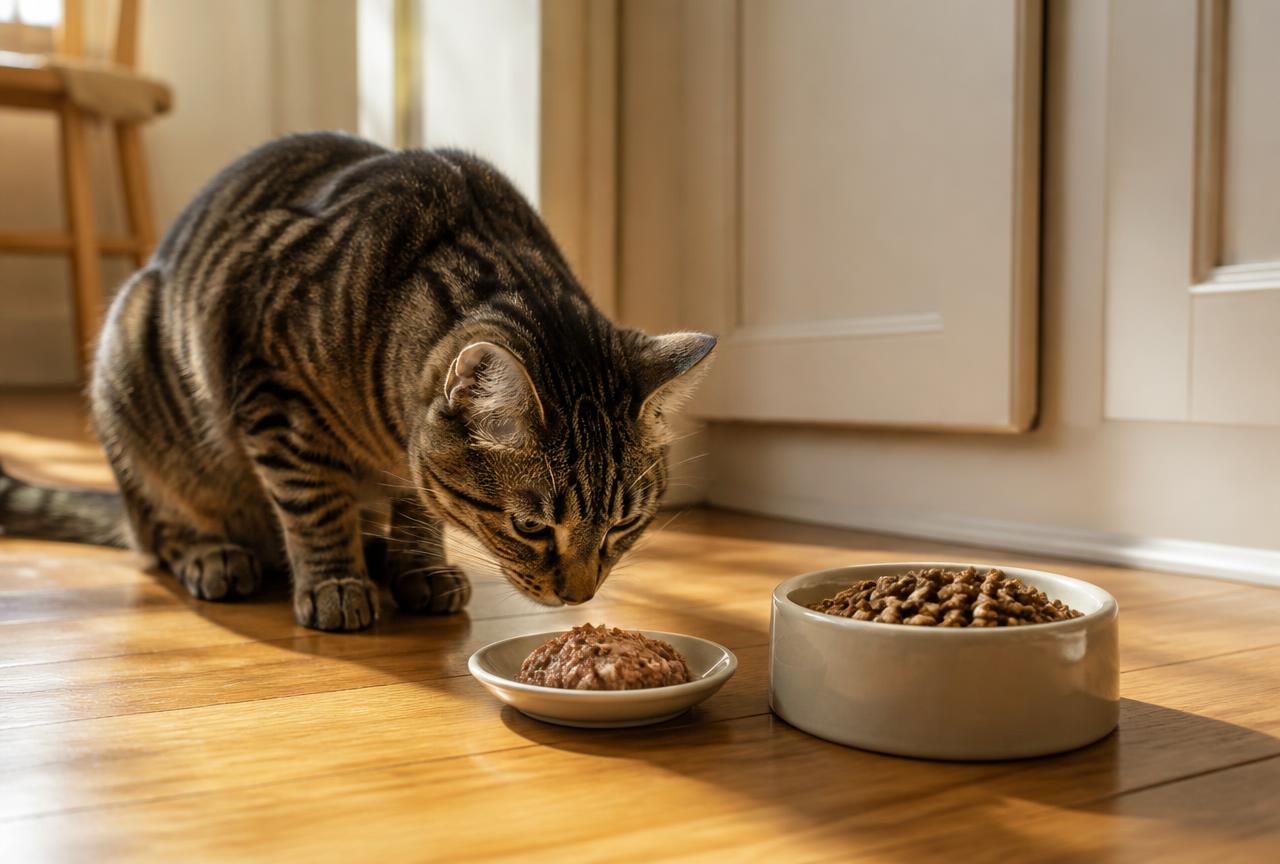
- 1Days 1-2. Keep meals exactly as they are. Put half a teaspoon of wet food on a separate saucer next to the bowl. No comment, no coaxing.
- 2Days 3-4. Warm the wet food to just below body temperature to lift the aroma. Offer a full teaspoon. Remove it after 20 minutes.
- 3Day 5. Serve the wet portion first, when your cat is hungriest, then the measured dry.
- 4Day 6. Increase the wet portion to about a quarter of daily calories and cut the dry by the same amount.
- 5Day 7 onwards. Add roughly 10% more wet each week until you reach your target split. Stall for a week if intake drops.
If a cat refuses every wet food after a month of this, try a different texture rather than a different flavour: many kibble-raised cats accept a mousse or a flaked-in-jelly product long before they accept a chunky loaf.
The bowl, the water, and the small stuff
- Serve wet food at room temperature and discard uneaten food after two hours; refrigerate an opened tin for no more than 24 hours.
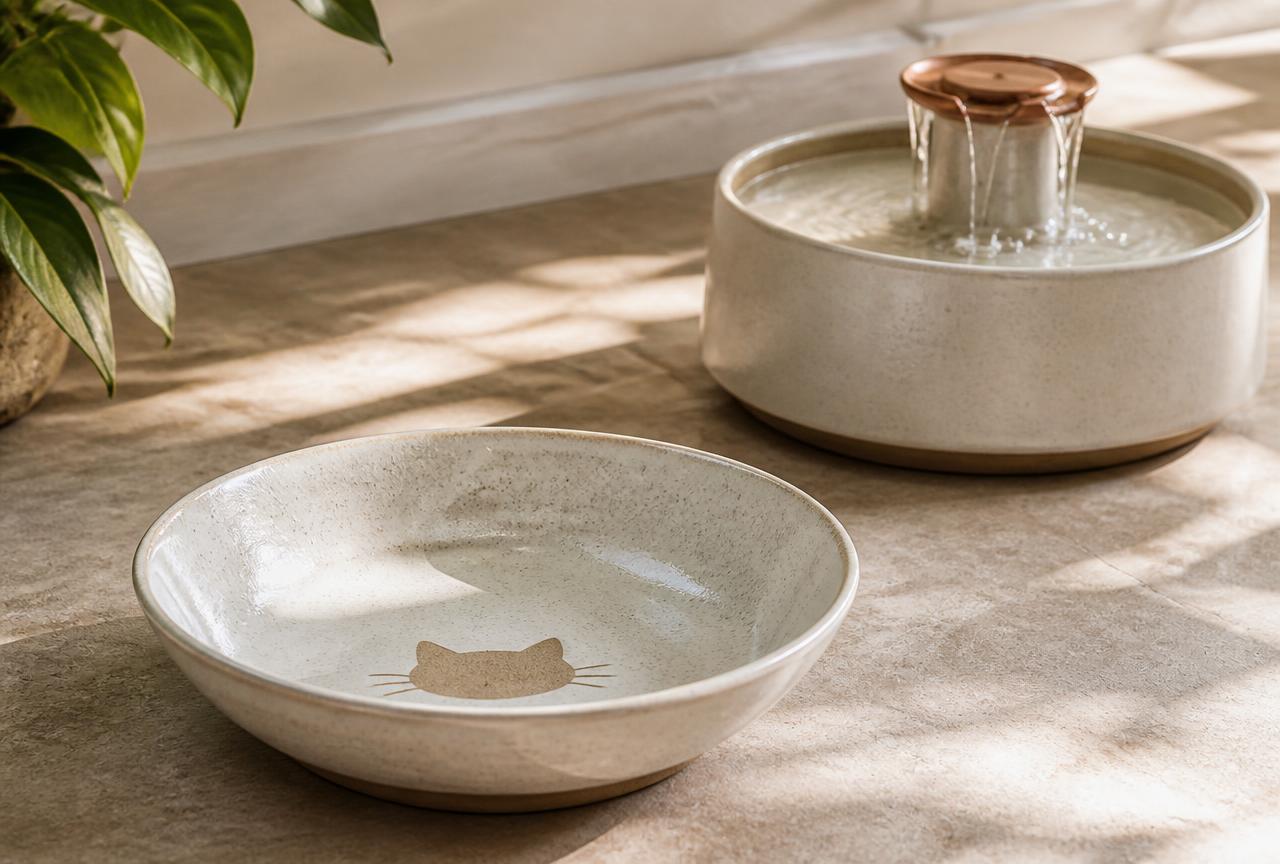
- Use shallow, wide ceramic or glass bowls. Deep bowls press on whiskers and cats leave food behind because of it.
- Wash bowls daily. Plastic scratches, holds bacteria and taints food.
- Feed several small meals. Cats free-fed from prey would eat eight to twelve times a day, and a timed feeder handles this better than an open bowl of kibble.
- Keep water away from food and litter, offer more than one source, and try a fountain, running water raises intake in many cats.
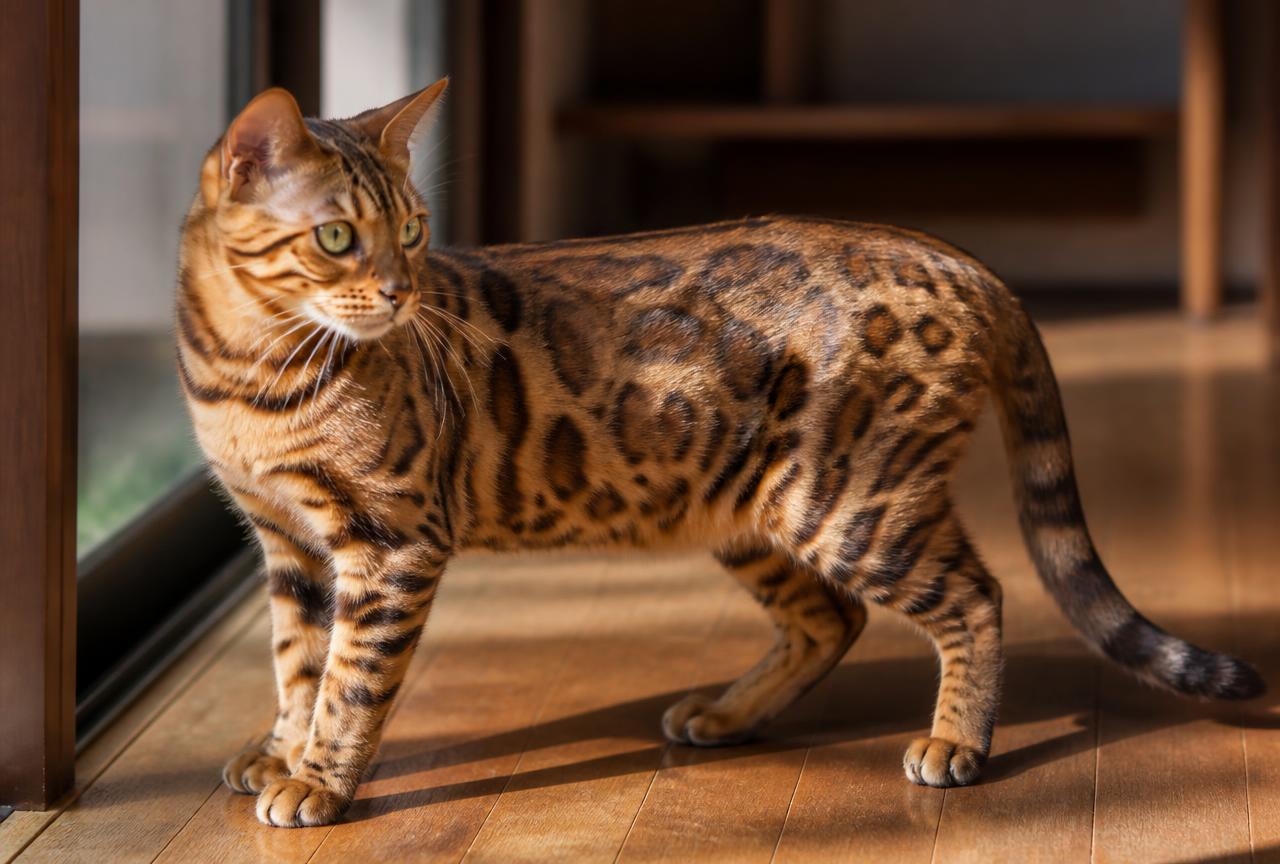
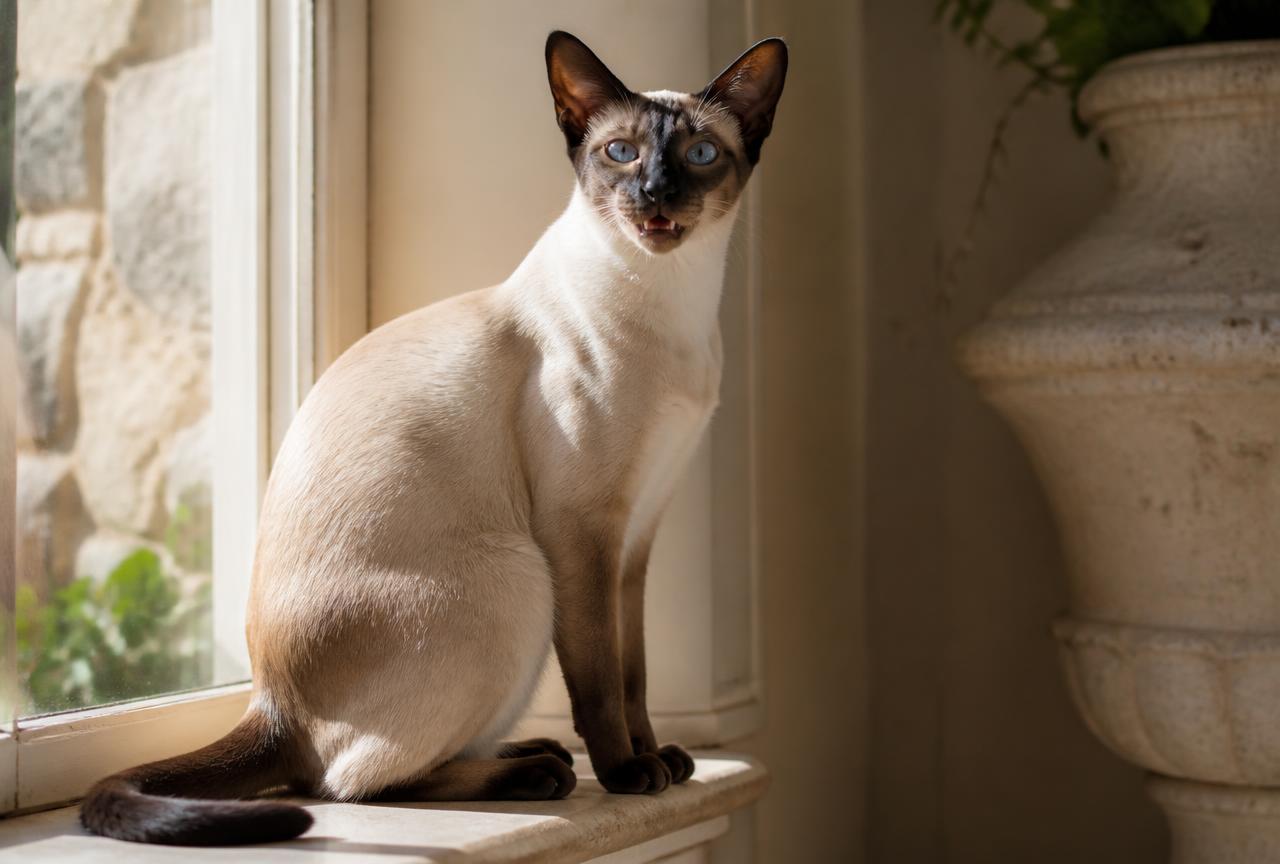
Vocal, food-focused breeds will lobby against portion control with real commitment. If you live with a Siamese or a Bengal, scheduled meals and a puzzle feeder will save your evenings.
Our verdict, by household
- One healthy young indoor cat, average budget. Two wet meals a day plus a measured dry allowance in a puzzle feeder. Simple, affordable, well hydrated.
- Multi-cat household. Wet as separated, supervised meals, it is the only reliable way to know who ate what, with dry used sparingly and never left as a shared open bowl.
- Cat with any urinary or kidney history. Wet-led, ideally close to all-wet, water in several places, vet-directed.
- Long hours away from home. Timed wet feeder with an ice pack plus a small dry portion, rather than an open bag of kibble all day.
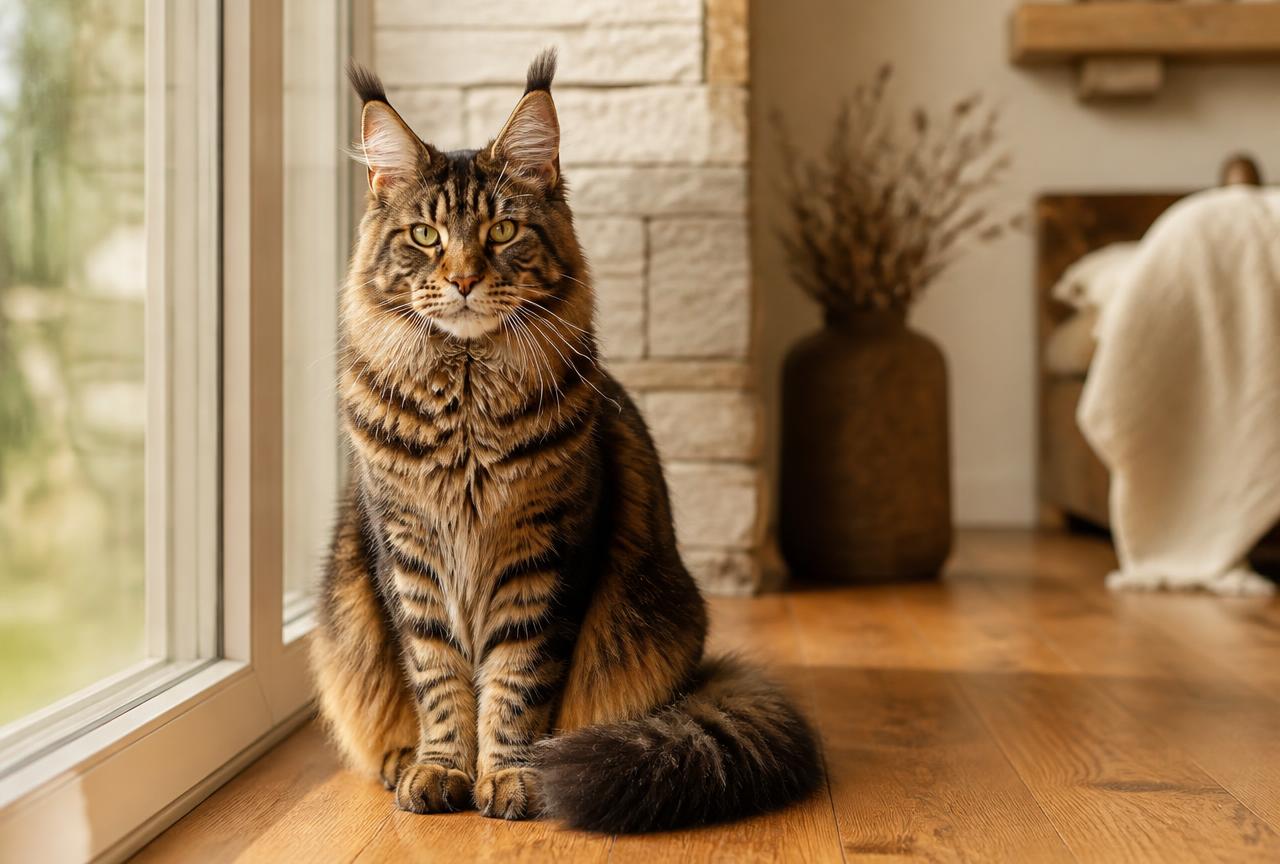
- Large slow-maturing breeds. Growth-appropriate calories matter more than texture; see the Maine Coon review for the frame this feeds.
When to stop reading and call your vet
Book an appointment if your cat is straining in the litter tray, passing little or no urine, vomiting repeatedly, refusing food for more than 24 hours, drinking noticeably more than usual, or losing weight while eating normally. A male cat straining without producing urine is an emergency, that is a same-hour call, not a tomorrow call.
Feeding is one of the few daily decisions where you get to reduce risk continuously. Getting the water right is most of it.
Questions people actually ask
Is wet food better for cats than dry food?
For water intake, yes. Wet food is roughly 75-80% moisture, which puts a cat close to the intake it would get from prey; dry food sits around 8-10%. On nutritional completeness both can be excellent or poor depending on the product, so the honest answer is that wet food has one built-in advantage and everything else depends on the specific formula and your cat.
How much wet food should I feed my cat per day?
Work from calories, not pouches. An average neutered indoor adult of 4.5 kg needs roughly 200-220 kcal a day. A typical 85 g pouch carries 65-85 kcal, so three pouches often lands close to target. Use the portion calculator, then weigh your cat every two weeks and adjust by about 10% if the trend is wrong.
Can I mix wet and dry food in the same day?
Yes, and most owners in practice do. Serve them as separate meals rather than mixed in one bowl: wet food spoils within a couple of hours and mixing shortens the safe window for the dry too. Split the daily calorie budget between them, for example two thirds wet and one third dry.
Does dry food clean my cat's teeth?
Standard kibble does not do meaningful cleaning. It usually fractures on contact instead of wiping the tooth surface, and cats swallow much of it whole. Specific dental diets with a larger fibre-matrix biscuit have measurable effects, but brushing, dental chews designed for cats and professional scaling remain the real interventions.
My cat will only eat dry food. What now?
Move slowly. Keep the usual dry meals, add one teaspoon of wet alongside, warm it slightly to release smell, and increase over two to three weeks. Never starve a cat into accepting a new food: cats can develop hepatic lipidosis after only a few days of poor intake.
Is wet food more expensive?
Per calorie it usually is, though the gap is narrower than people assume once you compare kcal instead of weight. Supermarket wet trays can cost less per calorie than premium kibble. The cost calculator in this article compares your actual products rather than category averages.
Sources
- WSAVA Global Nutrition Guidelines, World Small Animal Veterinary Association
- Nutritional Guidelines for Complete and Complementary Pet Food, FEDIAF
- Feline lower urinary tract disease and water intake, International Cat Care (ISFM)
- Nutrient Requirements of Dogs and Cats, US National Research Council
- Veterinary Oral Health Council accepted products, VOHC
Breeds mentioned

Put it into practice
Read next
How to bathe a cat: when it is needed, and how to survive it
How to bathe a cat without bloodshed: when a bath is genuinely needed, the setup, the step-by-step, and when to call a groomer instead.