
The first 90 days: a kitten socialisation timetable
A kitten's character is largely settled before it is four months old. Here is what to do in each of those weeks, and what quietly costs you later if you skip it.
Nadia Ferreira
Feline behaviour writer, ReMews. desk
Published 28 July 2026 · Updated 4 September 2026

Reviewed against ISFM and AAFP kitten guidance
The short version
- The sensitive period runs from roughly two to seven weeks. Most of it happens before you collect the kitten, which is why the breeder or rescue matters more than anything you do later.
- Homecoming is not socialisation. For the first 72 hours the job is one quiet room, predictable meals and the freedom to hide.
- Handle paws, ears and mouth daily from the start. It is the difference between a two-minute nail trim and a lifetime of sedated vet visits.
- Two short play sessions a day, ending in food, cut almost every complaint people have about kittens at six months.
- Feed meals inside an open carrier from week nine. A carrier that means dinner does not mean fear.
- Kittens need four to five small meals a day until about four months, then three, then two.
Cats are not made at home. By the time a kitten arrives in your hallway in a borrowed carrier, most of the work that decides whether it will be a confident cat or a nervous one has already happened, in someone else's spare room, between the ages of two and seven weeks.
That is the uncomfortable part. The comfortable part is that the remaining weeks still matter enormously, and that almost every problem people bring to a behaviourist at eighteen months, hand biting, carrier terror, hating strangers, refusing nail trims, is traceable to something that took ten minutes a day and did not get done.
This is the timetable we would follow. It assumes a kitten homed somewhere between eight and thirteen weeks, which is the normal European window, and it assumes you would rather do slightly less, consistently, than a heroic first fortnight followed by nothing.
What the sensitive period actually is
Between roughly two and seven weeks of age, a kitten's brain treats novelty as information rather than threat. New people, textures, sounds and species get filed as normal. Outside that window the same experiences have to be argued for, with food and distance and repetition.
International Cat Care puts the practical figure at contact with at least four different people during that period, ideally including men, children and anyone whose voice and movement pattern differs from yours. Kittens raised in a quiet single-adult household and homed at nine weeks are frequently fine and frequently not: they simply have a narrower definition of normal.
You cannot extend the sensitive period. You can only make sure the weeks you do have are spent on things the cat will meet for the next fifteen years.
So the single highest-leverage decision is where the kitten comes from. Ask to see the room the litter is raised in. A kitchen with a television, a hoover and traffic outside beats a spotless outbuilding, every time.
The week-by-week timetable
| Age | Phase | What matters most | Your job |
|---|---|---|---|
| --- | --- | --- | --- |
| 0-2 weeks | Neonatal | Warmth, weight gain, the queen | Nothing, unless you are the breeder |
| 2-7 weeks | Sensitive period | People, sounds, surfaces, other animals | Brief daily handling; household noise at low volume |
| 7-9 weeks | Homecoming | Security, predictable food, hiding places | One room, four to five meals, first vet visit |
| 9-12 weeks | Expansion | Second room, carrier, scratching post | Meals in the open carrier; booster vaccination |
| 12-16 weeks | Confidence | Car trips, nail trims, brief separations | Short rehearsals ending in food |
| 16 weeks+ | Consolidation | Neutering, measured meals, routine | Keep the habits you want at twelve months |

Homecoming: the first 72 hours
Resist the urge to introduce the kitten to the house, the neighbours and the other cat on day one. Almost every difficult first fortnight we hear about starts with too much room and too many people.
- 1Set up before collection. One room, ideally not the busiest. Litter tray at one end, water and food at the other, a bed, and two hiding places at floor level.
- 2Arrive and leave the carrier open. Put it on the floor, open the door, and sit on the floor a few feet away. Let the kitten come out on its own clock. Do not lift it out.
- 3Offer a small meal within the hour. Whatever it was eating at the breeder, unchanged. Diet changes and house moves in the same week produce diarrhoea and nothing useful.
- 4Keep the first day to two visitors: you, and whoever else lives there. Sit, read, ignore the kitten. Being boring is a social skill.
- 5Night one, stay in the room if you can. A folded blanket on the floor is enough. Isolation on the first night is where a lot of long-running crying habits begin.
- 6Vet within 48 to 72 hours. Weight, heart, ears, teeth, a faecal check and a plan for vaccination and worming.
- 7Open the second room on day three or four, and only if the kitten is eating, using the tray and playing. Keep the safe room exactly as it was for another fortnight.
Handling that pays off at the vet
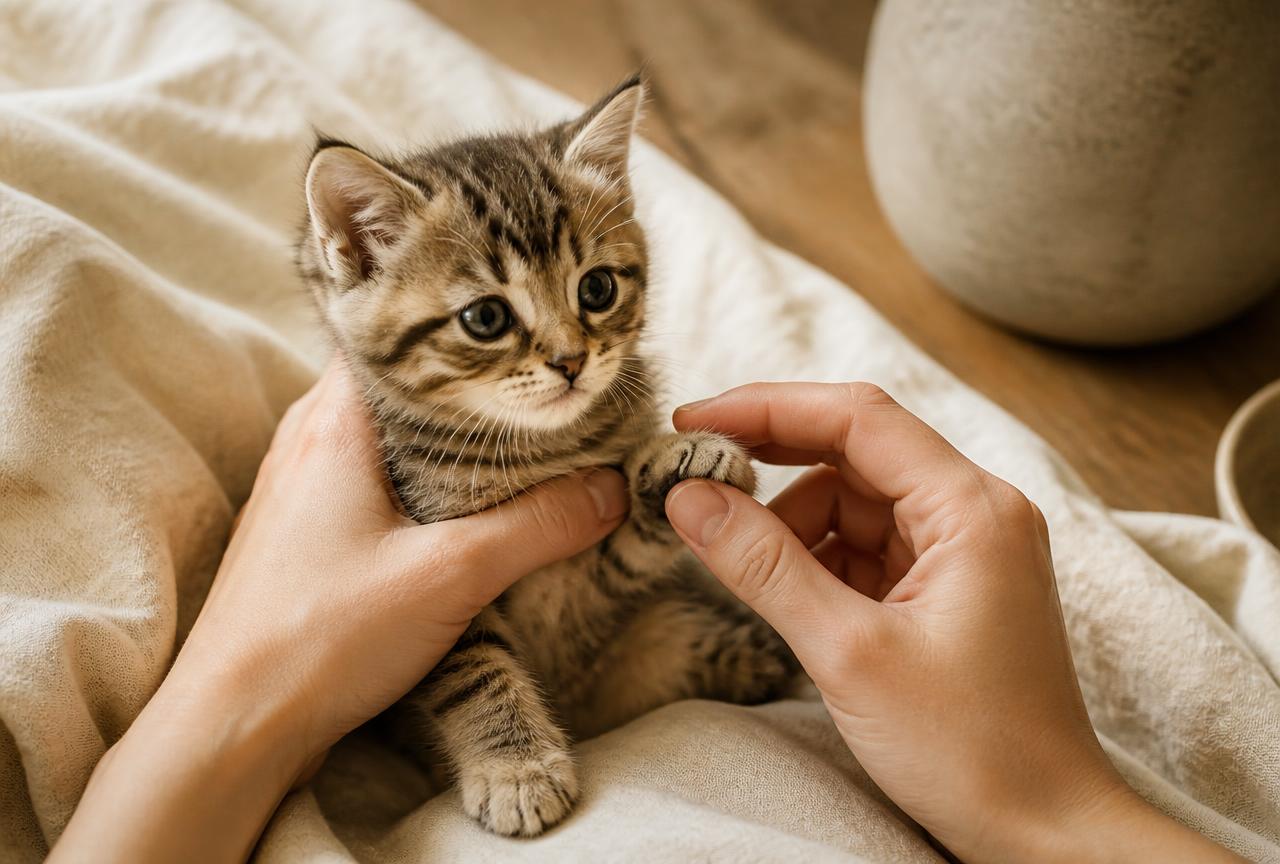
The most valuable ten minutes in a kitten's day are the dull ones. Sit with the kitten on your lap or a blanket. Touch a paw, press very lightly between the toes, let go. Look in an ear. Lift a lip. Run a hand down the tail base. Every single touch is followed by something good, a piece of food or a return to play.
Do this daily and by four months you own a cat that tolerates nail trims, ear drops and a stethoscope. Skip it and you own a cat that needs two nurses and gabapentin for a routine check. The AAFP's cat-friendly handling work is blunt about this: the handling a cat accepts is the handling it rehearsed young.
Use the planner below to see where your kitten sits and what this week should contain. It is built from the timetable above, and it also gives a rough daily energy figure so you can sanity-check meal sizes.
Interactive · built for this article
Kitten week planner
Tell it how old your kitten is and it returns the phase you are in, what to work on this week, and what is coming next.
Where that puts you
Expansion
Room by room, and the carrier becomes furniture rather than a threat.
- Age
- 9 weeks · about 2 months
- Typical weight
- ≈ 1.0 kg
- Rough daily energy
- 189 kcal
This week's work
- Open a second room; keep the safe room exactly as it was
- Feed occasional meals inside the open carrier
- Booster vaccination, plus worming on your vet's schedule
- Introduce a scratching post taller than the kitten's full stretch
Next, from week 12
Confidence
Resilience work: brief separations, car trips, nail trims, brushing.
Weights and energy figures are population averages for healthy kittens; vaccination and neutering dates belong to your vet, not to a table. For measured meals, open the portion calculator.
Play, the prey sequence and the biting problem
Kittens do not play for fun in the way we mean it. They rehearse a fixed sequence: stalk, chase, pounce, kill, eat, groom, sleep. Interrupt that sequence halfway and you get an overstimulated kitten looking for another target, which is usually your hand or your ankle at the top of the stairs.
Run it properly instead. A wand toy dragged away from the kitten, never towards it. Let it catch the target several times. Wind down rather than stopping abruptly. Then feed. The sleep that follows is the whole point.
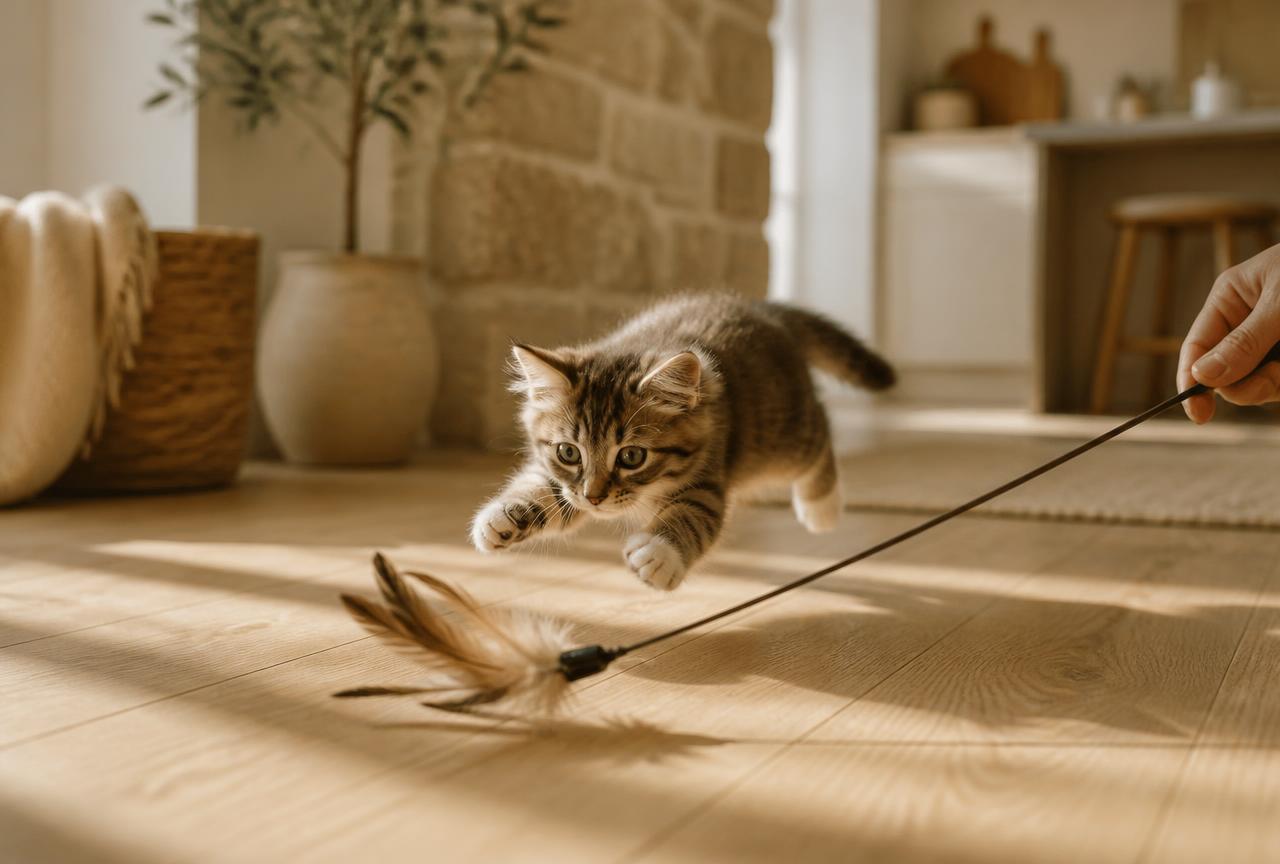
Two sessions of ten to fifteen minutes is the working minimum, and it is a great deal easier than retraining a six-month-old who has learned that human skin moves satisfyingly. If your kitten already bites hands, the fix is not punishment: it is removing hands from the game entirely and keeping a toy within arm's reach of wherever you sit.
The carrier, the car and the world outside
A carrier used twice a year, both times to go somewhere unpleasant, becomes a reliable predictor of unpleasantness. Break the association early and it stays broken for life.
From week nine, leave the carrier out permanently with the door pinned open and a blanket inside. Feed occasional meals in it. Throw treats into it while walking past. Once the kitten sleeps in it voluntarily, close the door for ten seconds, then open it. Then lift it and put it down. Then a two-minute drive that ends at home.
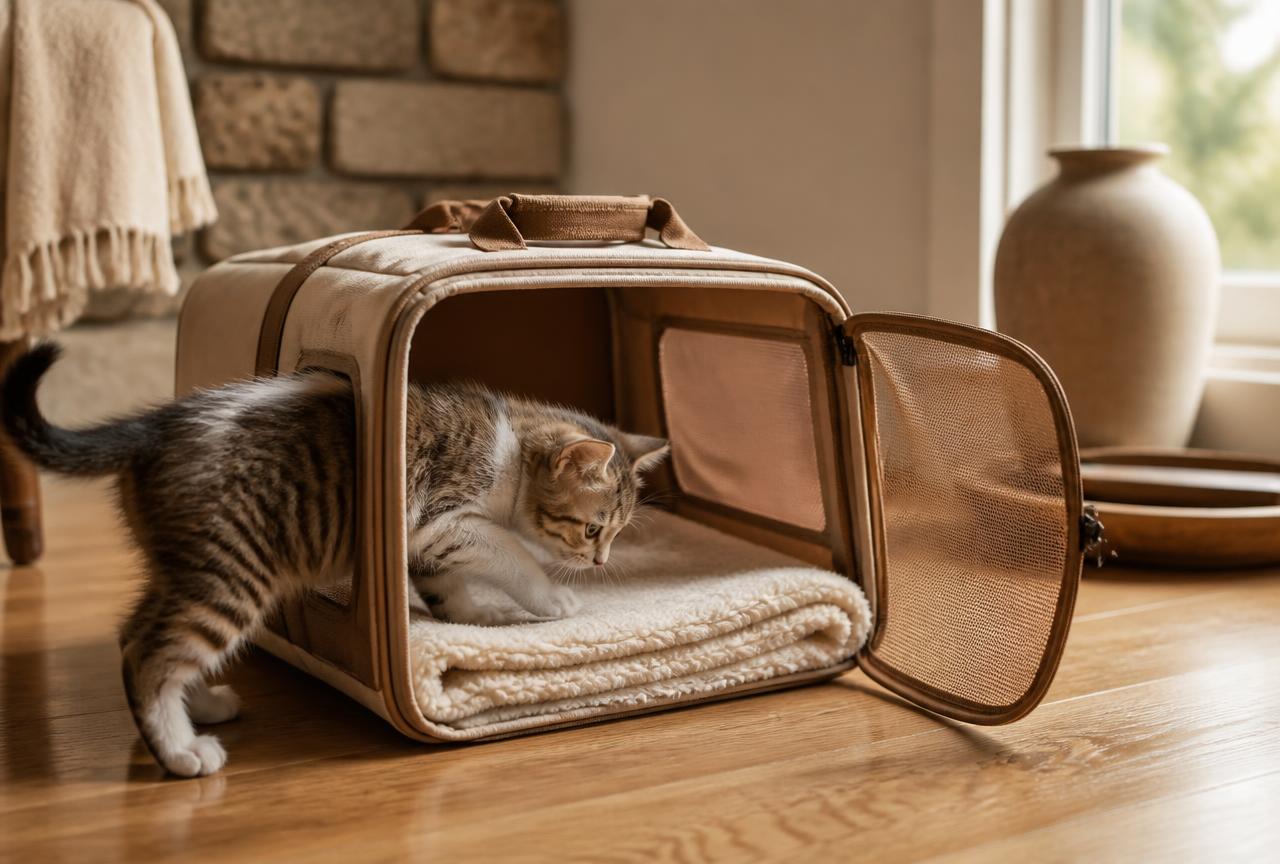
Aim for two or three short car journeys before sixteen weeks that end somewhere neutral or pleasant. If every trip ends at a clinic, the cat is doing perfectly reasonable maths.
Food, litter and the boring infrastructure
- Meals: four to five small ones a day to about four months, three to six months, then two. Kitten-specific complete food, unchanged for the first fortnight after homecoming.
- Water: a wide, shallow bowl away from the food, plus a second one elsewhere. Some kittens strongly prefer moving water.
- Litter: one tray per cat plus one, low-sided, unscented, no lid, never beside the food. Use whatever substrate the breeder used and change it later if you must.
- Scratching: a post taller than the kitten's full stretch as an adult, so at least 80 cm, sisal, and stable enough not to wobble. Place it where the cat already scratches, not where it suits you.
- Vertical space: one climbable route by twelve weeks. A shelf, a cat tree, a cleared bookcase. Kittens that learn to go up rarely learn to go on the worktop.
For measured portions rather than eyeballed scoops, our portion calculator works in calories, and our wet versus dry comparison explains why the moisture argument matters more for kittens than for anyone else.
Vaccinations, worming and neutering
WSAVA protocols typically begin core vaccination at six to eight weeks, repeat every three to four weeks until sixteen weeks or later, and boost at six or twelve months. Kittens carry maternal antibody that can block early doses, which is exactly why the series runs so long, and why a single injection at eight weeks is not a finished job.
Worming follows a separate schedule, usually fortnightly to twelve weeks then monthly to six months. Neutering, on current European guidance, sits around four to six months, before the first season. Book that conversation at the twelve-week visit rather than the day a female starts calling.
By household
- First-time owner, single kitten: the play commitment is the one thing you cannot skip. Two sessions daily, wand toys only, hands never. Consider a bonded pair if the budget allows.
- Household with children: recruit them for the handling minutes, supervised, and teach the rule that a hiding cat is off limits. A Ragdoll or British Shorthair temperament tolerates this better than most.
- Resident adult cat: slow it down. Scent swapping and a closed door for a week, then a barrier, then supervised minutes. Two weeks of patience prevents two years of tension.
- Small flat, both owners out all day: go vertical, feed part of the ration from puzzles, and be honest about whether one kitten alone for nine hours is fair. A high-energy Bengal or Siamese is the wrong choice here.
- Older, quiet household: you have the routine advantage. Just make sure at least a few different visitors handle the kitten before sixteen weeks.
When to call your vet
Kittens deteriorate quickly, and hesitation is the main risk. Call the same day for: not eating for more than twelve hours, repeated vomiting or diarrhoea, straining in the tray with nothing produced, lethargy that does not lift after a nap, laboured breathing, a swollen or painful abdomen, discharge from eyes or nose, gums that look pale or tacky, or any fall from height followed by lameness.
Weight loss in a kitten is never a wait-and-see finding. Neither is a kitten that stops playing.
What to do this week
Pick the phase you are in, do the four things it lists, and let the rest wait. Consistency at ten minutes a day beats intensity at an hour on Sunday, and the cat you get at twelve months is very largely the cat these weeks build. When you are ready to think about growth targets, our ideal weight tool will tell you whether the numbers are tracking.
Questions people actually ask
At what age should a kitten leave its mother?
Not before eight weeks, and many breeders and rescues sensibly hold on until twelve or thirteen. The extra weeks buy social learning from the queen and littermates that you cannot replicate at home, plus a stronger immune position after weaning. A kitten offered at six weeks is a red flag about the seller, not a bargain.
How long is the kitten socialisation window?
The core sensitive period runs from about two to seven weeks of age, with useful plasticity continuing to roughly sixteen weeks. Novelty introduced gently inside that window tends to be accepted for life. After it, new things are not impossible, only slower, and they need food, distance and patience rather than exposure.
How much should I play with my kitten each day?
Aim for two deliberate sessions of ten to fifteen minutes, plus whatever short bursts the kitten starts itself. Use a wand toy so your hands never become prey, let the kitten catch the target, and finish with a meal. That sequence, hunt then eat then wash then sleep, is why post-play kittens settle instead of escalating.
When should a kitten be vaccinated?
Most protocols start at six to eight weeks with boosters every three to four weeks until sixteen weeks or older, then a booster at six or twelve months. The exact schedule depends on your vaccines, your country and whether the cat will go outdoors, so follow your vet rather than a table on the internet.
When should a kitten be neutered?
Current veterinary guidance in most of Europe favours neutering before the first season, commonly around four to six months, and earlier for rescue populations. Waiting rarely improves anything and can produce an accidental litter or spraying habits that outlive the surgery. Book the conversation at the twelve-week visit.
Should I get one kitten or two?
Two, if the household can afford it and you can take littermates or an already-bonded pair. Kittens teach each other bite inhibition and burn energy on one another rather than on your ankles. A single kitten is perfectly viable, but you become the playmate, and the daily play commitment is not optional.
My kitten bites my hands. Is that aggression?
Almost never. It is normal predatory play aimed at the only moving target available. Stop using hands as toys entirely, keep a wand toy within reach so you can redirect within a second, and end the interaction calmly rather than pulling away sharply. Most hand-biting resolves in two weeks of consistency.
Sources
- Kitten socialisation and the sensitive period, International Cat Care (icatcare)
- AAFP/AAHA Feline Life Stage Guidelines, American Association of Feline Practitioners
- WSAVA Vaccination Guidelines for Dogs and Cats, World Small Animal Veterinary Association
- Nutritional Guidelines for Complete and Complementary Pet Food, FEDIAF
- Cat Friendly Handling and veterinary visits, AAFP Cat Friendly Practice
Breeds mentioned



Put it into practice
Read next
How to bathe a cat: when it is needed, and how to survive it
How to bathe a cat without bloodshed: when a bath is genuinely needed, the setup, the step-by-step, and when to call a groomer instead.