Scotland
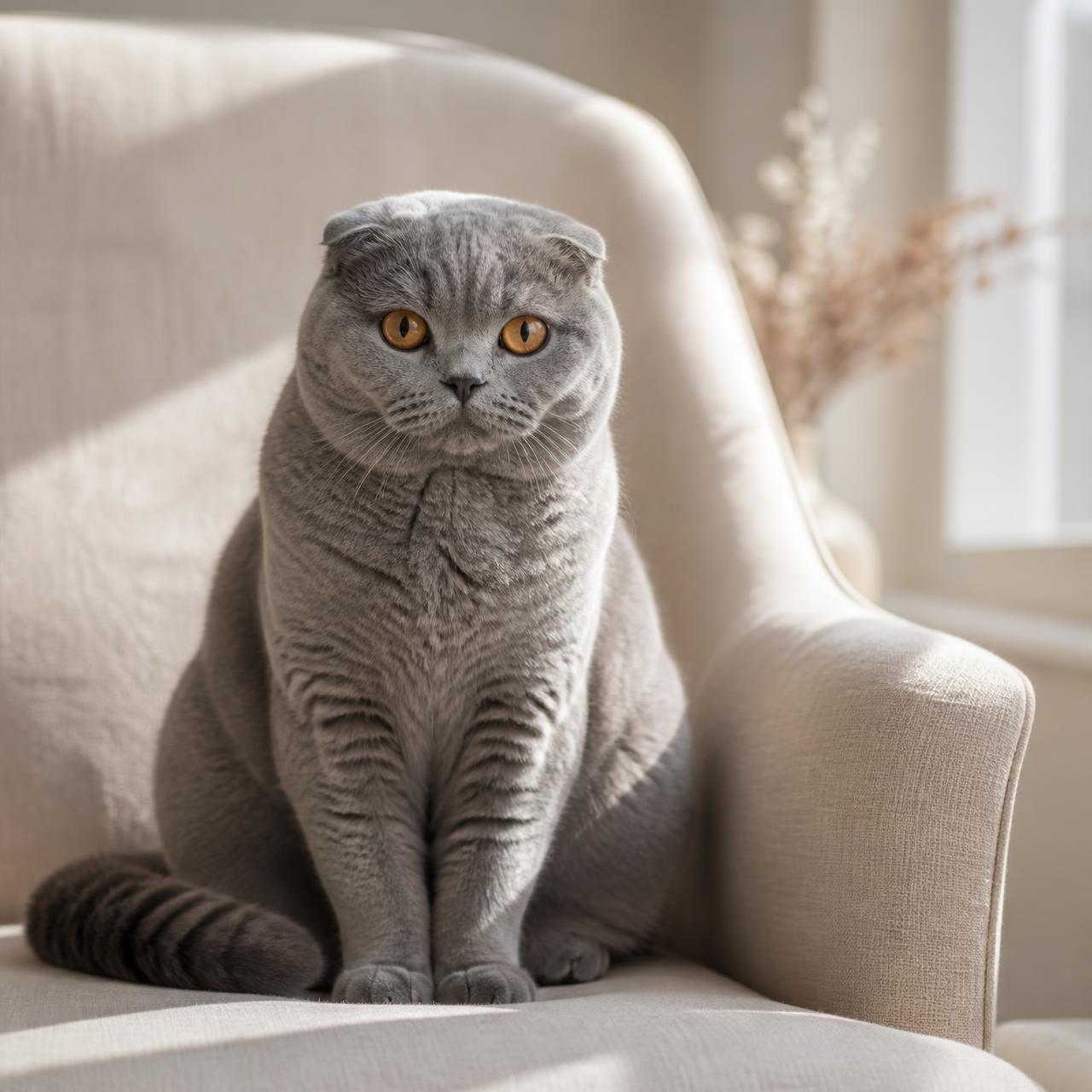
Scottish Fold
The folded ear is a cartilage defect, and the cartilage is everywhere. This is the gentlest cat in the index and the one with the most difficult question attached to it.
The ReMews. desk
Folded ears, folded into your lap
The short version
- The fold is caused by a mutation affecting cartilage throughout the body, not just the ear, and is associated with osteochondrodysplasia, a painful degenerative joint disease.
- Two folded parents produce the severest disease. A responsible breeder outcrosses to straight-eared cats and can show skeletal radiographs.
- Temperament is the breed's real draw: placid, quiet, people-oriented, undemanding of height and space.
- Adopting or rehoming an existing Fold is the least ethically complicated route, and there are plenty needing homes.
- Adapt the home early: low-sided trays, a step to the sofa, soft bedding, nothing that requires jumping.
- Budget for lifelong mobility care rather than hoping it never arrives; ask for a joint assessment at every check-up.
- Weight
- 3–6 kg
- Lifespan
- 11–14 yrs
- Coat
- Short
- Size
- Medium
- Grown male
- 4–6 kg
- Grown female
- 2.7–4.5 kg
- Years to full size
- about 2
- One-off setup
- €220–480
Get one if…
- Quiet flats and gentle households
- Owners committed to lifelong joint care
- People considering a straight-eared sibling instead
- Adopters rehoming a Fold that needs a home
Think again if…
- Anyone buying purely for the folded-ear look
- Homes that cannot budget for arthritis care
- Buyers unwilling to vet a breeder carefully
Trait profile
The scores read gentler than most of the index, and they are honest. A Fold does not demand height, does not shout, and rarely escalates. What the bars cannot show is stiffness: a cat that stops jumping is not calmer, it is sore, and in this breed that distinction is the whole story.
Space & setup. Needs steps or ramps instead of long jumps, soft warm bedding and easy-access litter trays.
Allergies. Average shedding and dander; no allergy advantage.
The review
Recognisable by ears that fold forward due to a cartilage mutation, Scottish Folds are sweet and adaptable. That same mutation carries joint risks, so responsible breeding matters enormously.
There is no polite way around the first paragraph. The folded ear that makes this cat instantly recognisable comes from a dominant mutation in a gene governing cartilage, and cartilage is not confined to the ear. The same mutation is associated with osteochondrodysplasia, a developmental bone and joint disorder that in its clearer forms produces thickened, painful limbs and a cat that moves badly by early adulthood. Every Scottish Fold carries it, that is what makes the ear fold. Severity varies, and much of that variation depends on breeding, but nobody should acquire this cat believing the fold is cosmetic.
That said, we are not writing about a theoretical animal. Folds exist in large numbers, they need homes, and living with one is a genuinely lovely experience. This is among the most placid cats we cover. A Fold tends to sit where the people are, at whatever level the people are, and stay. It is quiet, not silent, but the voice is small and used sparingly, with none of the running commentary a Siamese offers. It tolerates handling well, settles into routine quickly and is markedly unbothered by ordinary household disruption. If you want a cat that is present rather than performing, this is it.
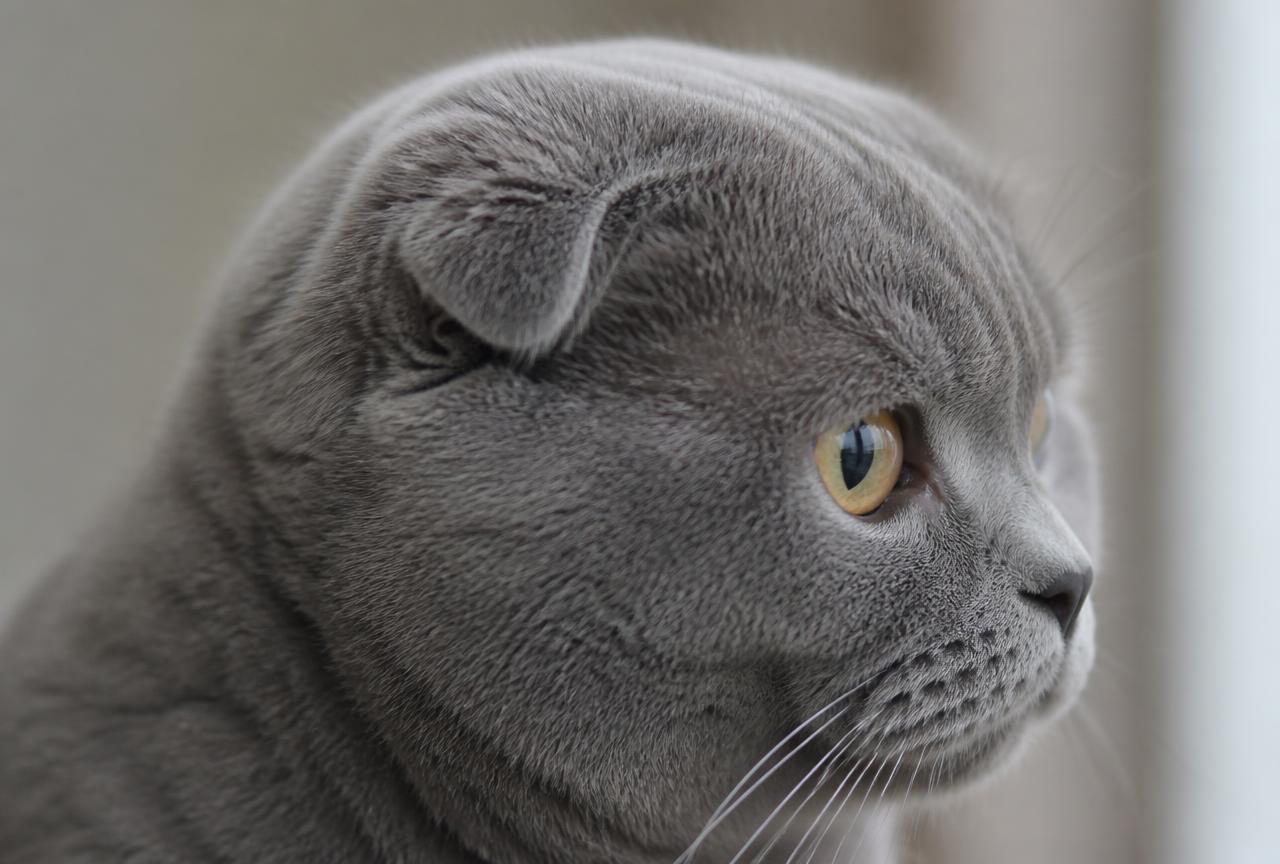
The physical impression is roundness. Round head, round eyes, a body that is compact and surprisingly dense in the hand, and a coat that is short-to-medium, plush and stands slightly away from the body. Kittens are born with straight ears; the fold, when it comes, appears in the first three to four weeks. Some kittens in a folded litter never fold at all, and those straight-eared siblings are the healthier animals, they carry none of the mutation and are, temperamentally, the same cat. If a breeder offers you one, take the offer seriously.
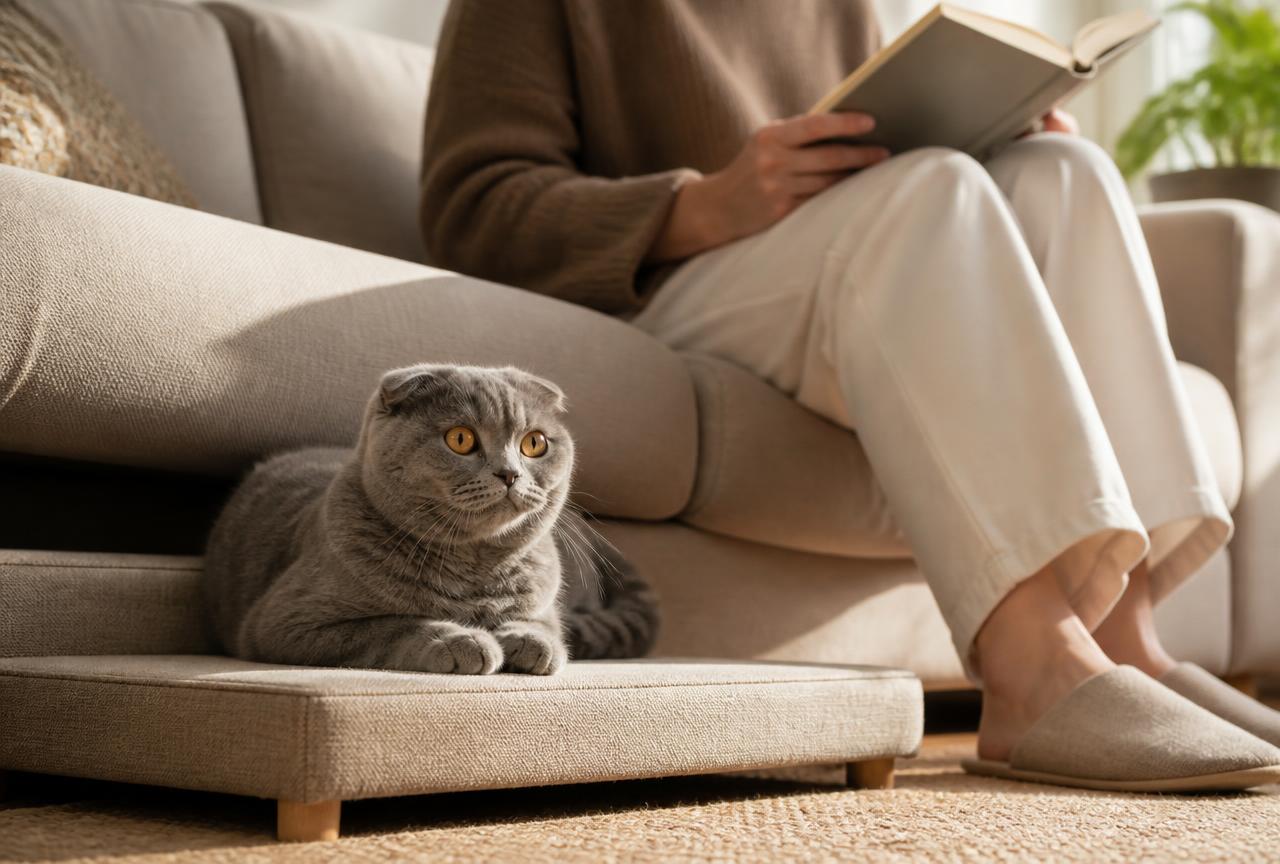
The famous sitting postures, upright on the haunches, legs stretched out in front, the so-called Buddha sit, get shared as charm. Read them more carefully. A cat that repeatedly adopts unusual postures, sits rather than lies, hesitates before jumping down, or stops using height it used to use is telling you its joints hurt. Cats are exceptionally good at concealing chronic pain, and degenerative joint disease is progressive, so the change is gradual enough to be mistaken for maturity or personality. It is not.
Practically, this shapes the home more than any grooming routine would. Bring resources down: a litter tray with a low entry, food and water at floor level, a soft bed somewhere warm that requires no leap to reach, a padded step to the sofa if the sofa is where the cat wants to be. Keep nails trimmed, because a stiff cat grooms and scratches less effectively. Keep weight down, which matters here more than in any other breed we cover, every extra kilogram is loaded onto joints that are already compromised. The portion calculator is not a nicety for a Fold.
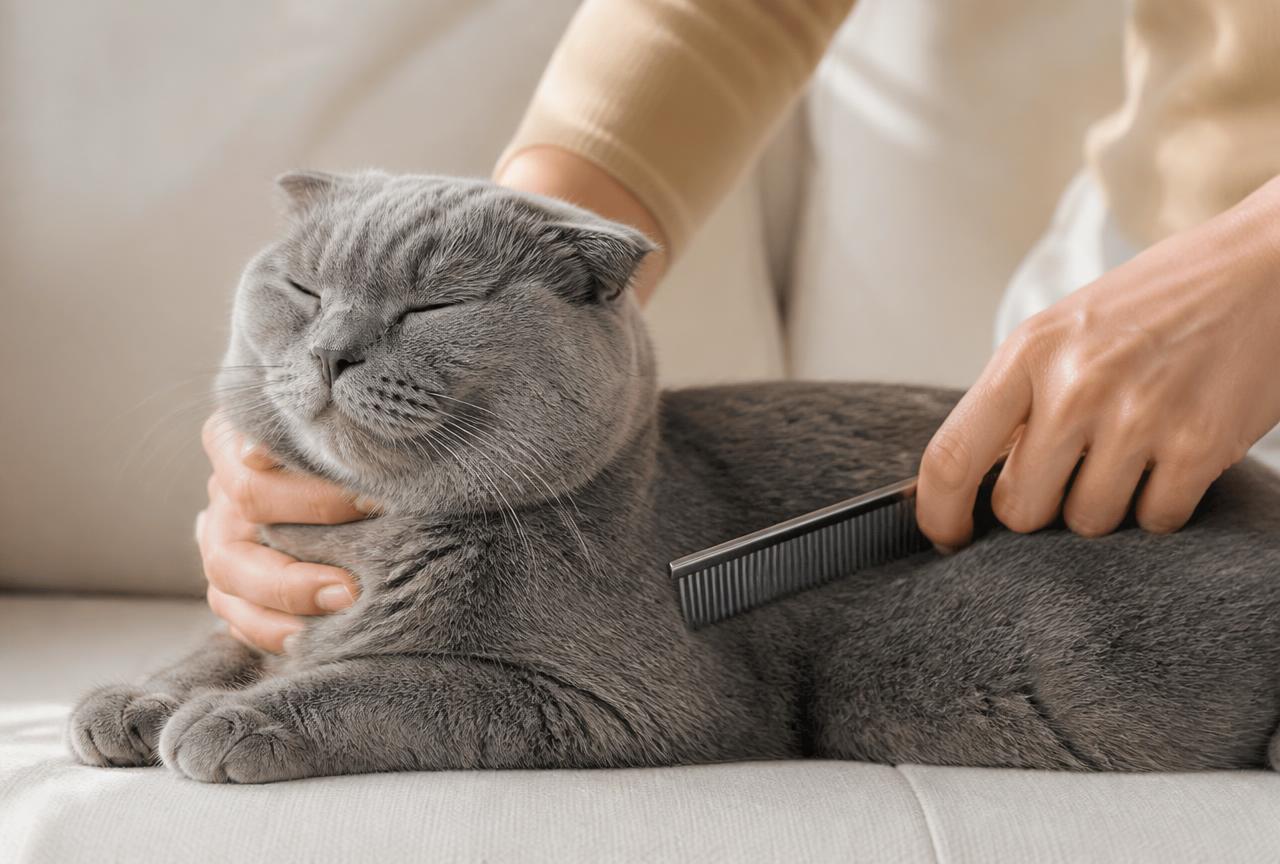
Grooming itself is easy. A plush coat this dense benefits from a weekly comb-through to lift dead undercoat, twice weekly during the spring and autumn moults, and that is close to the whole job. The thicker-coated long-haired variant, sometimes called the Highland Fold, needs the same routine two or three times a week. Check ears rather than clean them habitually: the fold restricts airflow and makes wax and debris easier to miss, so a weekly look is worth the ten seconds. Do not go digging.
On acquisition, the honest advice runs in one direction. Rescue and breed-rehoming organisations carry Folds regularly, often surrendered by owners who did not budget for a cat with mobility problems. Taking one of those cats costs nothing ethically and helps an animal that already exists. If you go to a breeder anyway, the non-negotiables are an outcross policy, Fold to straight-eared cat only, never Fold to Fold, skeletal radiographs of both parents, and a frank conversation about what the line looks like at five and ten years old. A seller who describes the fold as purely cosmetic, or who cannot answer those questions, is selling you a problem.
Where does that leave the recommendation? Roughly here: the Scottish Fold is a delightful cat to live with and a difficult cat to justify creating. Several registries decline to recognise it for exactly that reason. If the round face and the calm, low-key temperament are what draw you, a British Shorthair delivers both without the cartilage question, and if it is specifically a Fold you have fallen for, let it be one that is already here.
Charming, but we score this breed cautiously: osteochondrodysplasia is a real welfare concern. Ask breeders hard questions about joint health.
Grooming, realistically
- 1Comb through with a fine metal comb once a week, twice during spring and autumn moults; the long-haired variant needs two to three sessions a week.
- 2Look inside both ears weekly. The fold hides wax and debris; a glance is enough, and cleaning is only warranted if there is visible discharge or an odour.
- 3Trim nails every two to three weeks, a stiff cat scratches less and overgrown claws make walking worse.
- 4Weigh monthly on the same scales and record it. Creeping weight is the single most damaging thing for these joints.
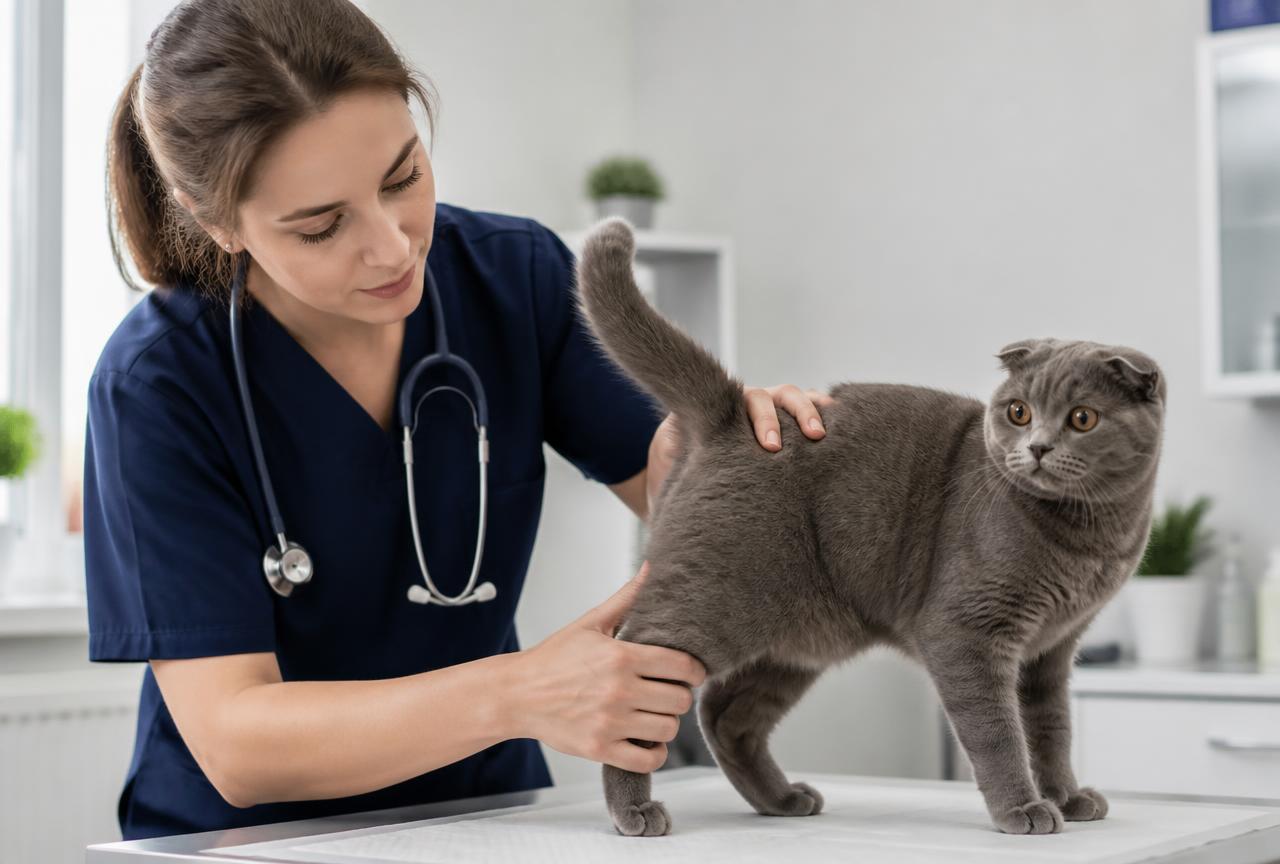
- 5Run a hand slowly down the spine, hips and hind legs once a week, feeling for thickening at the ankles and resistance in the hips.
- 6Brush teeth several times a week; a cat in joint pain grooms less overall and oral care slips first.
What you actually need
- Fine-toothed metal comb
- Soft slicker brush for the plush undercoat
- Nail clippers
- Kitchen or pet scales for monthly weigh-ins
- Litter tray with a low entry, or one side cut down
- A padded step or low ramp to the sofa and bed
Kitten to adult
| Age | Male | Female | What is happening |
|---|---|---|---|
| 8 weeks | Ears have already folded, or never will. Straight-eared littermates are the same cat without the mutation. | ||
| 4 months | Watch the gait during play. Any stiffness, reluctance to jump, or short-striding hind legs deserves a vet's eye now, not later. | ||
| 8 months | Body filling out. Keep condition lean, weight control is joint care in this breed. | ||
| 12 months | Close to adult. Ask for a mobility assessment at the first-year check-up and set a baseline. | ||
| 2 years | Full size. Males at the top of the range, females well below it. Any decline in jumping from here is a clinical sign, not ageing. |
Ranges are typical, not targets. Judge condition by ribs and waist, and check with the ideal weight checker.
What to ask a breeder
- Do you outcross every litter to a straight-eared cat, and can I see the pedigree confirming no Fold-to-Fold pairing?
- Can I see skeletal radiographs of both parents, taken by a vet, showing the limbs and tail base?
- What do the cats in this line look like at five and ten years old, and are any on long-term pain relief?
- Do you have straight-eared kittens from this litter available?
- What is your policy if the kitten develops mobility problems?
- Which health tests do you run beyond the skeletal assessment, and may I see the certificates?
- Can I meet both parents and watch them move around your home?
Health watch-list
What to ask a breeder about, and what to watch for over a lifetime. This is orientation, not veterinary advice, anything you notice belongs in front of a vet.
Osteochondrodysplasia
Universal to some degreeThe defining condition. The same cartilage mutation that folds the ear affects bone and joint development throughout the body, most visibly in the ankles, wrists and tail base. Severity ranges from radiographic changes with little outward sign to a cat that is visibly lame in its first years. Fold-to-Fold pairings produce the severest form. Ask any breeder for skeletal radiographs of both parents.
Degenerative joint disease and chronic pain
CommonFollows from the above and worsens with age. Signs are quiet: less jumping, stiffness after rest, reduced grooming, irritability when handled. Long-term pain relief and weight control are the mainstays, and both work far better when started early.
Hypertrophic cardiomyopathy
UncommonReported across many pedigree breeds. A responsible breeder screens breeding cats by echocardiogram; ask when the parents were last scanned and by whom.
Polycystic kidney disease
UncommonA DNA test exists and is inexpensive. Ask to see the certificates for both parents rather than a verbal assurance.
Ear wax and debris build-up
OccasionalThe fold restricts airflow and hides what is going on. Not a disease in itself, but it makes problems easier to miss. Look weekly; clean only if there is discharge or odour.
Weight gain
CommonA placid, low-activity cat in a home that rewards sitting still. Excess weight loads joints already compromised by cartilage disease, and it is the one risk factor entirely within an owner''s control.
What it costs to keep one
Realistic running cost
€88 / month
About €1,056 a year, or roughly €13,728 across a 13-year life, before purchase price, neutering and one-off vet events.
Before the cat arrives. Budget roughly €220–480 for trays, carrier, posts, bowls, bedding and grooming kit sized for this breed. Figures throughout are indicative and vary a good deal between countries.
Interactive · built for this breed
Is a Scottish Fold right for your home?
This one is as much an ethics check as a fit check. Five honest answers, and the notes tell you what to sort out first.
Verdict
As responsible as this breed gets
An existing cat, an adapted home and a real commitment to mobility care. This is the version of Scottish Fold ownership we can recommend without reservation.
Quiet pain shows up in posture and habit, learn the signals in the senior cat check, or compare temperaments with the breed matchmaker.
The verdict, by household
Flat dweller
Excellent
Family with young children
Good, with rules
First-time owner
Easy cat, hard decision
Multi-cat home
Good
Allergy-conscious
No better than average
Older or less mobile owner
Very good
When to call your vet
- Reluctance to jump up or down, or hesitating at heights it used to take easily
- A stiff, short-striding or bunny-hopping gait, especially after rest
- Thickened, hard or painful ankles, wrists or tail base on gentle handling
- A tail that has become short, rigid or resistant to being lifted
- Sitting in unusual upright postures more often, or lying instead of sitting
- Reduced grooming, matting over the back and hips, or overgrown claws
- Irritability when handled around the hindquarters, or hiding more than usual
- Any lameness that lasts more than a day or two
Nothing here is a diagnosis. Breathing difficulty, sudden hind-leg weakness and straining to urinate are emergencies, go the same day.
Scottish Fold vs the closest alternatives
| Breed | Weight | Energy | Grooming | € / month |
|---|---|---|---|---|
| Scottish Fold | 3–6 kg | 5/10 | 4/10 | €88 |
| Birman | 3.5–6.5 kg | 4/10 | 5/10 | €82 |
| Siberian | 4.5–9 kg | 6/10 | 6/10 | €94 |
| British Shorthair | 4–8 kg | 4/10 | 4/10 | €76 |
Scottish Fold questions, answered
Are all Scottish Folds in pain?
No, but all of them carry the mutation, and all are at risk. Severity varies from radiographic changes with no obvious signs to visible lameness in early adulthood. Because cats conceal chronic pain well, absence of obvious limping is not evidence of comfort. Regular mobility assessments give you a baseline to measure against.
Is it ethical to buy a Scottish Fold kitten?
Several registries decline to recognise the breed precisely because the trait people select for is a cartilage defect. Our editorial position: adopting or rehoming an existing Fold is unproblematic and helpful. Commissioning a new kitten means asking a breeder to reproduce the mutation, and that deserves a harder look than most buyers give it.
Why do some kittens in a Fold litter have straight ears?
Because the fold is a dominant trait and only kittens inheriting the mutated copy fold. Straight-eared littermates carry none of it, share the same gentle temperament, and are healthier animals. If a breeder offers you one, that is the better cat.
How much grooming does a Scottish Fold need?
Not much. One thorough comb-through a week for the short-haired coat, two or three for the long-haired Highland variant, and twice weekly for everyone during spring and autumn moults. Add a weekly ear check, because the fold makes wax easy to overlook, and nail trims every two to three weeks.
Is the Buddha sit a sign of a problem?
It can be. The upright, legs-forward posture is widely shared as charming, but an animal that repeatedly chooses unusual positions may be avoiding a painful one. Taken alone it proves nothing; taken alongside less jumping, stiffness after rest or reduced grooming, it is worth a veterinary conversation.
Are Scottish Folds good with children and other cats?
Generally yes. They are among the most tolerant cats we cover and rarely escalate. The caution is the flip side of that temperament, a Fold absorbs rough handling instead of walking away. Teach children to leave the hind legs and tail alone, and give the cat an easily reachable retreat.
What should a Scottish Fold cost to keep?
Monthly running costs sit close to the index average for a short-coated indoor cat. The variable is veterinary care: long-term pain management, imaging and joint supplements can add meaningfully from middle age onwards. Setting up a home for one costs roughly EUR 220–480 including a low-entry tray, a step and soft bedding.
Sources
- International Cat Care, Scottish Fold and osteochondrodysplasia
- Cornell Feline Health Center, Feline arthritis and degenerative joint disease
- International Cat Care, Recognising pain in cats
- WSAVA, Global Nutrition Guidelines and body condition scoring
- Fédération Internationale Féline, position on the Scottish Fold