Why do cats eat grass? The instinct, the aftermath, and when it matters
Most cats graze, most owners worry, and most of the time the worry is misplaced. Grass-eating is ancient, normal feline behaviour, the skill is knowing which aftermath is routine and which is a symptom.
Helen Marsh
Feline behaviour and welfare writer; volunteer rehoming coordinator for twelve years
Published 4 September 2026
Dr Tomas Reyes, DVM
The short version
- Grass-eating is normal and near-universal, research finds most cats graze weekly
- It is instinctive housekeeping, not a nutritional deficiency
- An occasional grass-vomit containing fur is the mechanism working as intended
- Regular vomiting of food or bile, weight loss or a cat off its food needs the vet
- A pot of home-grown cat grass satisfies the instinct and protects houseplants
- Never let a grazing habit near lilies, any part can cause fatal kidney failure
Your cat, a committed carnivore, an animal whose digestive tract is built for mice, is standing in the garden delicately stripping blades of grass like a small, judgmental cow. It is one of the oldest puzzles in cat ownership, and one of the most studied. The answer turns out to be reassuring: grass-eating is normal, near-universal, and almost certainly instinctive. What deserves your attention is not the grazing but what happens around it.
The short version
- Grass-eating is normal: studies find most cats eat plants regularly, from kittenhood onwards.
- It is not a sign of nutritional deficiency, cats on complete diets graze just as much.
- The occasional grass-vomit is routine: the blades help bring up fur and indigestible material.
- Regular vomiting of food or bile, weight loss, or a cat off its food is a vet conversation, whatever the grass is doing.
- Grow a pot of cat grass: it satisfies the instinct, protects houseplants, and avoids pesticide-treated lawn.
- Houseplants are a separate and serious matter, lilies can be fatal, and the list of toxic ones is long.
What the research actually says
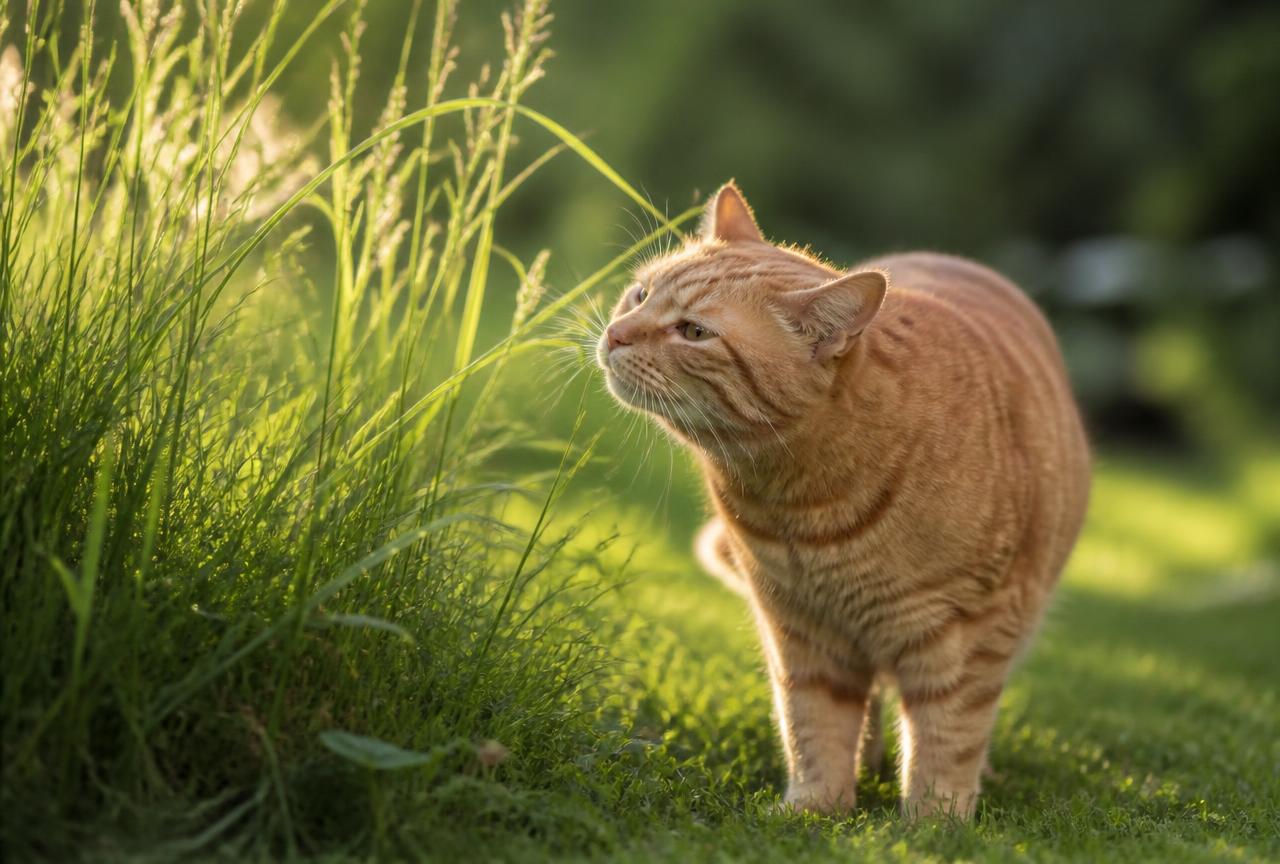
The best data comes from a large owner survey out of the University of California, Davis, which asked over a thousand cat owners about plant-eating. The findings dismantled most folklore. Around seven in ten cats ate plants at least weekly. Only about a quarter vomited afterwards. And, this is the result that surprised everyone, younger cats ate plants *more* often than older ones, and were no more likely to be ill beforehand or sick afterwards.
That pattern does not fit the old theory that cats eat grass to self-medicate an upset stomach. It fits something older: a behaviour inherited from wild ancestors, where eating roughage helped physically expel intestinal parasites. Modern house cats rarely carry those parasites, but the instinct never got the memo, like kneading, grass-eating is an ancient programme running on a modern animal.
The real reasons cats graze
Mechanical housekeeping. Grass blades are indigestible and mildly irritating to the stomach and throat. Swallowed, they can bind around fur and other indigestible odds and ends and bring the bundle back up, a crude but effective clean-out. This is why grass sometimes reappears along with a mat of hair, and why it overlaps with the subject of our hairball guide.
A little fibre. What stays down moves through, and roughage supports transit at the other end too, the same logic, gentler, that sits behind the home levers in our constipation piece.
Micronutrients, marginally. Grass contains folic acid and a few trace compounds. It is a garnish, not a salad, no cat is correcting a dietary shortfall with lawn clippings, and cats on complete commercial diets graze exactly as much as any other.
Because it is there. Cats explore the world mouth-first as much as paw-first. Texture, movement, novelty, a waving blade of grass is, to a cat, legitimately interesting.
The grass is not the message. What comes after the grass is the message.
The vomiting question
Here is the distinction that settles most owners' minds. Bringing up grass shortly after eating it, in a cat that is bright and eating normally, is routine, the mechanism working as designed. The occasional grass-vomit, especially one containing fur, needs nothing but a wipe.
The pattern that matters is different: vomiting that happens whether or not grass was eaten, vomiting that brings up food or yellow bile repeatedly, or any vomiting alongside a quieter cat, a shrinking appetite or a falling weight. In that picture the grass is a bystander, and the gut itself needs a look, our piece on cat vomiting has the full triage, and the companion guide to diarrhoea covers the other end.
Growing a supply: the ten-day plan
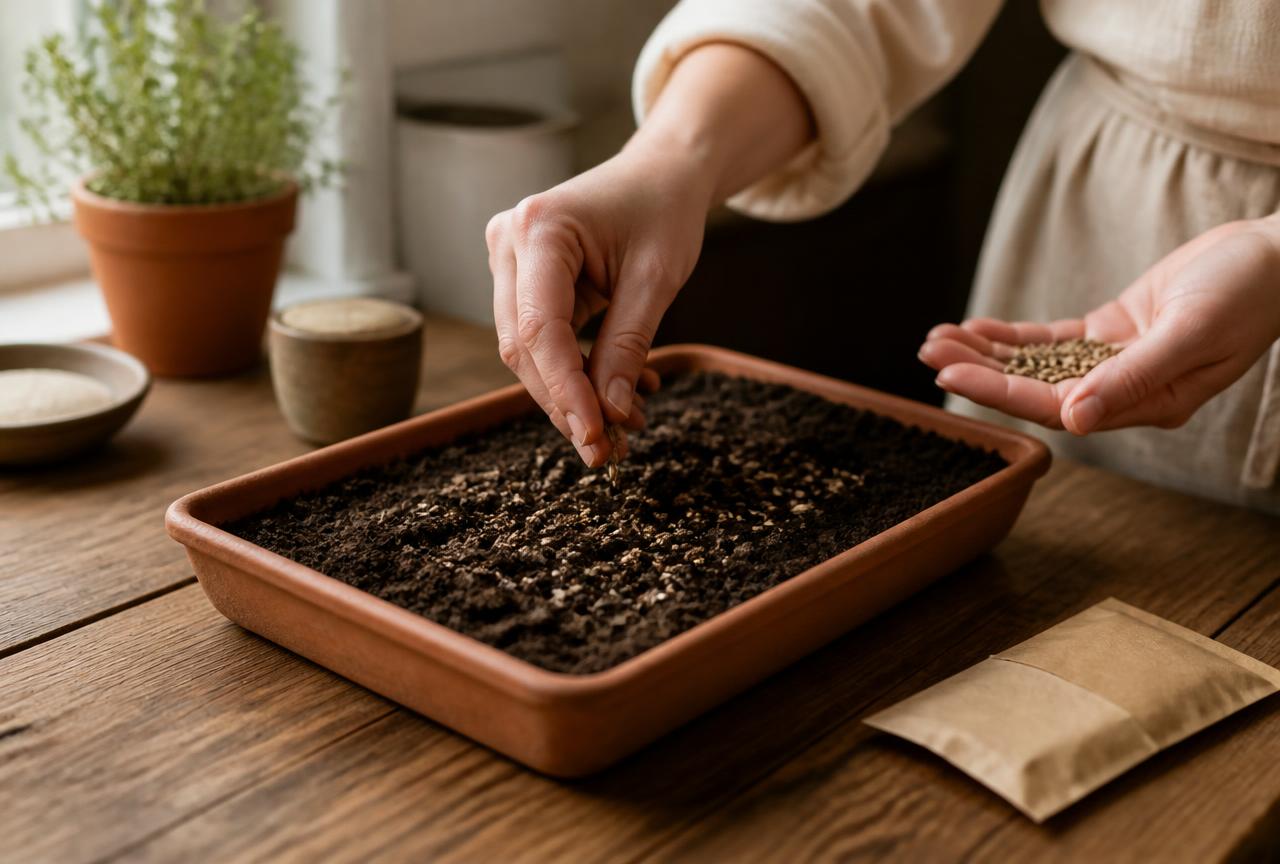
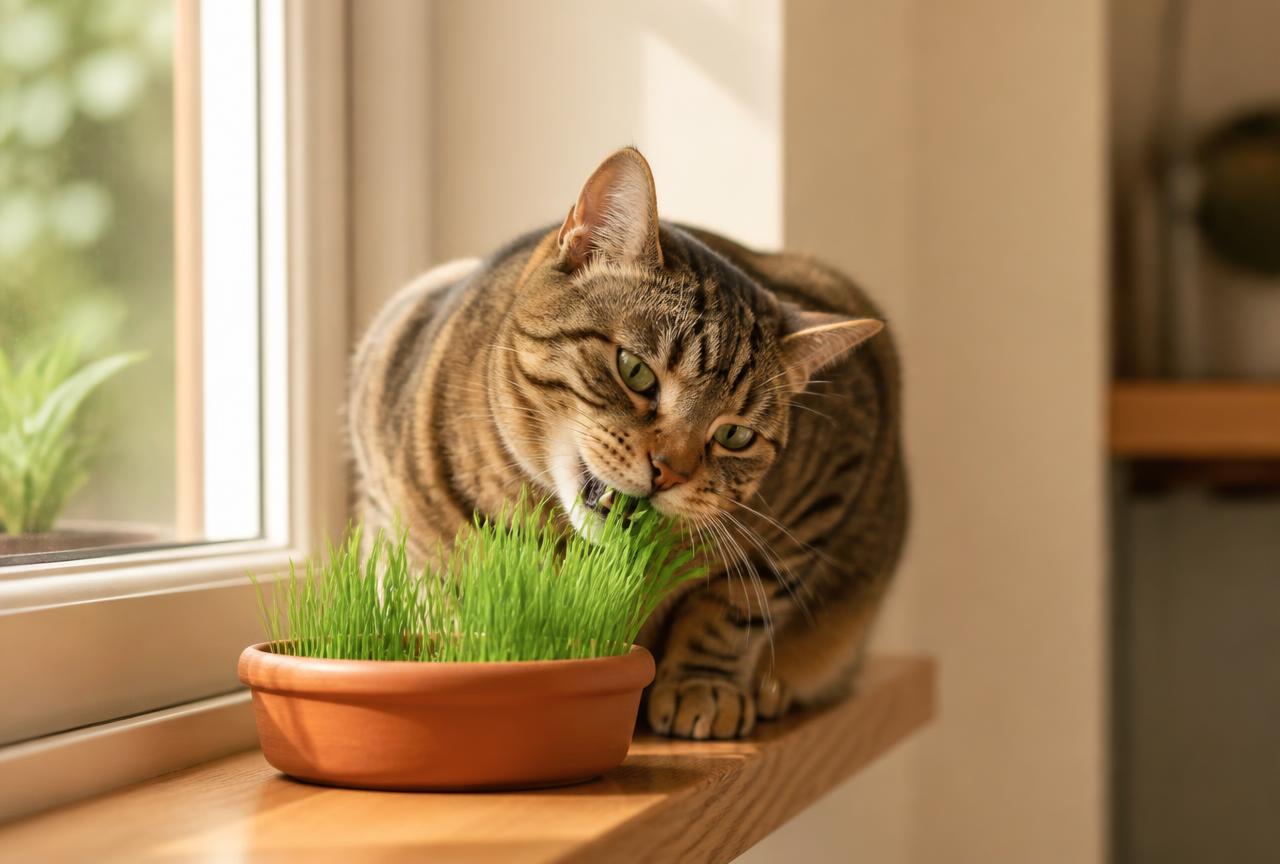
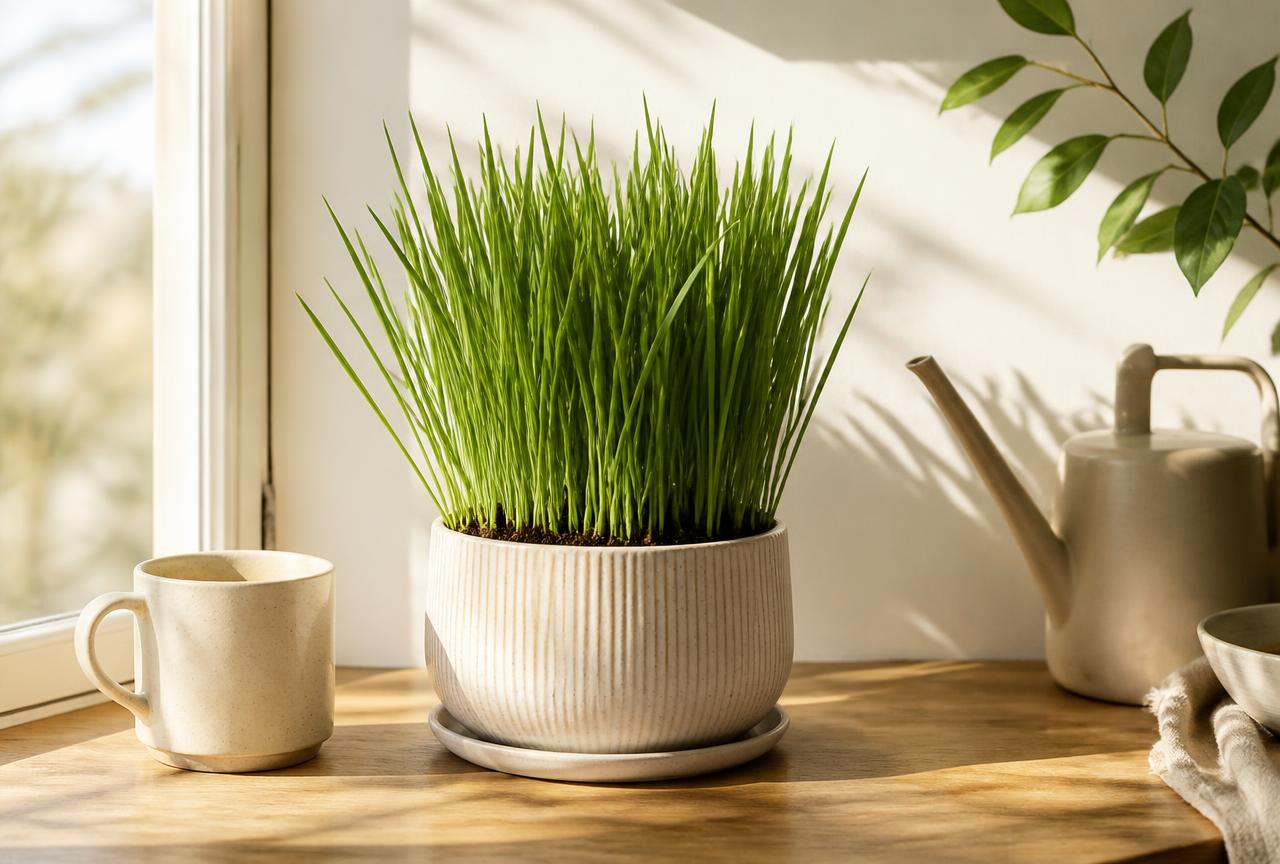
A pot of cat grass, usually wheat, oat, rye or barley seed, is the single best answer to the grazing instinct, and growing it is almost insultingly easy:
- 1Fill a shallow, heavy pot with potting soil. Heavy matters: a cat that can tip the pot will.
- 2Sow thickly, far denser than the packet suggests for lawns. You want a dense mat, not a meadow.
- 3Cover lightly, water gently, and park it somewhere bright.
- 4Shoots in three to five days; grazing height in about ten. Wait until it is 8–10cm tall before serving.
- 5Rotate two pots. One in service, one in recovery or growing. A grazed pot regrows a couple of times; then start fresh, seed costs pennies.
- 6Trim if it gets leggy and refresh the water; a yellowing pot is past its best.
Where to put it: near a favourite window or resting spot, not hidden in a utility room. The point is for the cat to choose it over alternatives.
The safety rules
Outdoor grass is fine with one condition: untreated only. No weedkillers, no fertilisers, no slug pellets, and ideally not the verge beside a busy road. If you are unsure what a lawn has been treated with, it is not a grazing lawn.
Houseplants are where the real danger lives, and the two subjects get dangerously confused. A cat with a grazing habit and no grass pot will experiment, and many common houseplants are toxic. Lilies are the nightmare case: pollen, leaves, even vase water can cause fatal kidney failure in cats, and they should simply never share a home with one. Pothos, dieffenbachia, philodendron, sago palm and cyclamen all make the danger list too. Spider plants, by contrast, are safe, and famously attractive to cats, which is why the ones in cat households look so nibbled.
The strategy is displacement, not discipline: grass pot available and appealing, toxic plants removed or truly out of reach, and a spider plant offered as the legal high.
The verdict, by pattern
Occasional grazer, nothing after: completely normal. Enjoy the pastoral scene.
Regular grazer, occasional grass-vomit: still normal, grow the pot, keep the diary light.
Daily grass-seeking: add play and enrichment alongside the pot; boredom grazes too.
Vomiting food or bile repeatedly, off food, losing weight: the grass is not the story. Phone the vet.
Any cat that has eaten a lily, any part: an emergency, even if the cat looks fine. Do not wait for symptoms.
The bottom line
Cats eat grass because cats have always eaten grass, an inherited housekeeping instinct running happily along in a species that no longer needs it. Give the instinct a pot of its own, keep the household plants safe, and save your worry for the pattern around the grazing rather than the grazing itself.
Interactive
The grazing guide
How often, what happens after, and how the cat is otherwise, the three answers that sort instinct from illness.
Reading
A textbook grazer
An occasional graze with no aftermath is one of the most ordinary things a cat does, surveys suggest most cats eat plants weekly, and the habit shows up in kittens and adults alike. Nothing to fix. If you want to be a good landlord about it, a windowsill pot of cat grass keeps the habit away from houseplants, some of which are genuinely toxic.
Also worth knowing
- Most grass eaten stays down and passes through. It contributes a little fibre and folic acid, but cats are not juicing, the behaviour is largely instinctive, not nutritional deficiency.
Behavioural guidance, not veterinary advice. Regular vomiting of food or bile, weight loss or a cat off its food belongs at the practice, whatever the grass is doing.
Questions people actually ask
Sources
- UC Davis, Characterization of plant eating in cats (owner survey study)
- International Cat Care, Grass eating and plant safety
- Cornell Feline Health Center, Feline behaviour and health topics
- American Veterinary Medical Association, Household hazards for pets
- ASPCA Animal Poison Control, Toxic and non-toxic plant list
Breeds mentioned
Put it into practice
Read next
Why do cats sleep so much? Normal hours, odd habits and the red flags
Why do cats sleep so much? What 12–16 hours a day really means, the light doze vs deep sleep, and the changes that actually matter.