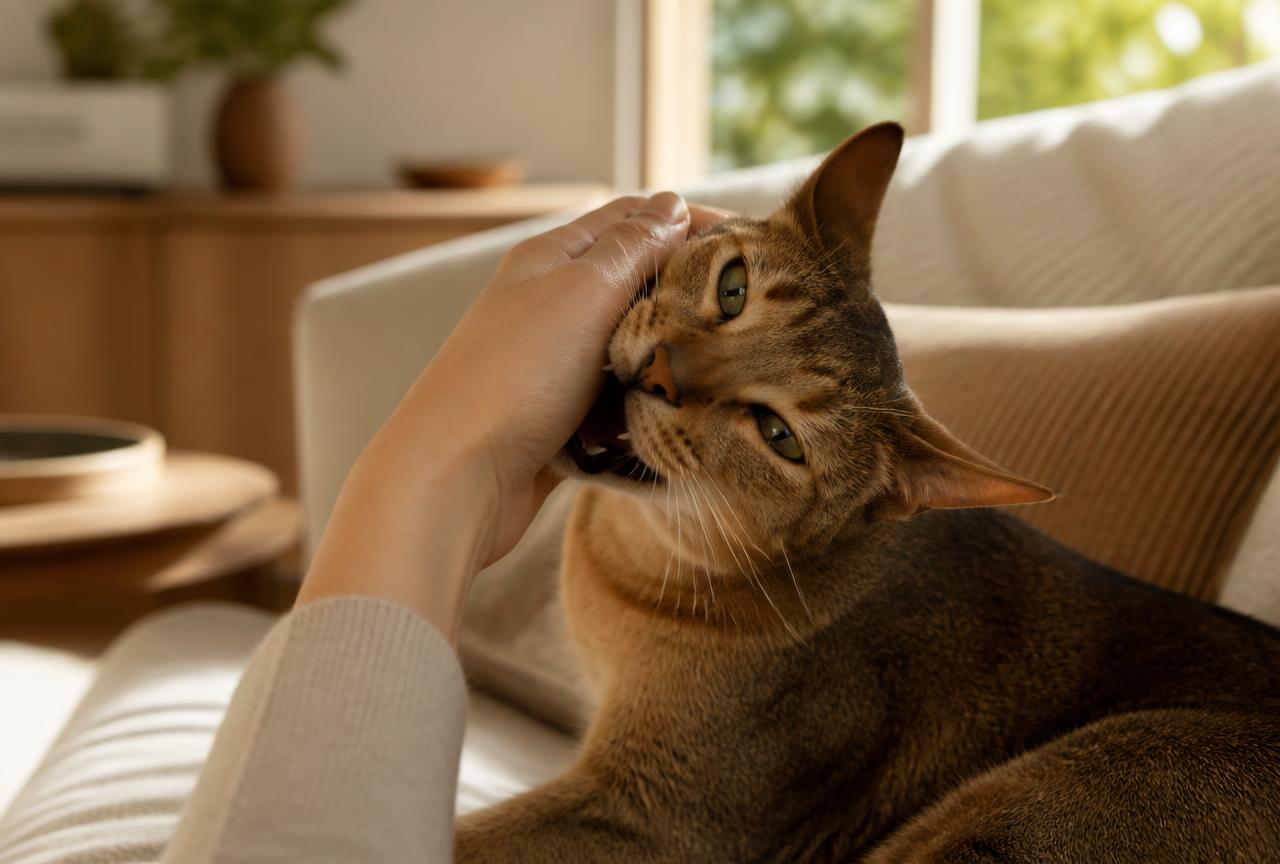
How to introduce two cats without a war
Cats are not pack animals waiting for company. A second cat works when the introduction is slow, staged and boring, and fails when it is rushed.
Nadia Ferreira
Feline behaviour and welfare writer, ten years in rescue and clinic settings
Published 4 September 2026
Written against AAFP and ISFM feline environmental needs guidance
The short version
- A full introduction takes three to six weeks in most homes. Two days is not an introduction, it is a gamble.
- Work in stages with exit conditions, not dates: move on when the current stage is boring, not when the calendar says so.
- Scent comes before sight, and sight comes before contact. Reversing that order causes most failures.
- Resources decide the outcome: one litter tray per cat plus one, separated feeding stations, and vertical space in every shared room.
- Hissing is communication, not disaster. Sustained staring, blocking and silent chasing are the real warning signs.
- A minority of cats never become friends. Peaceful indifference in a well-resourced home is a legitimate and stable outcome.
The domestic cat descends from a solitary, territorial hunter. It is capable of living in groups, and free-living cats form colonies happily enough, but those colonies are built on choice, related females, and enough space to walk away. None of those conditions is met when a carrier arrives in a flat and is opened in the living room.
That is the whole problem in one sentence. A second cat is not a gift to the first one. It is a territorial event, and how you manage the first three weeks determines what the next fifteen years look like.
The good news is that the method is well established and mostly consists of doing less than you want to.
Before the newcomer arrives
Set up a base camp first, and do it a day or two early so the resident cat has already processed the smell of new furniture.
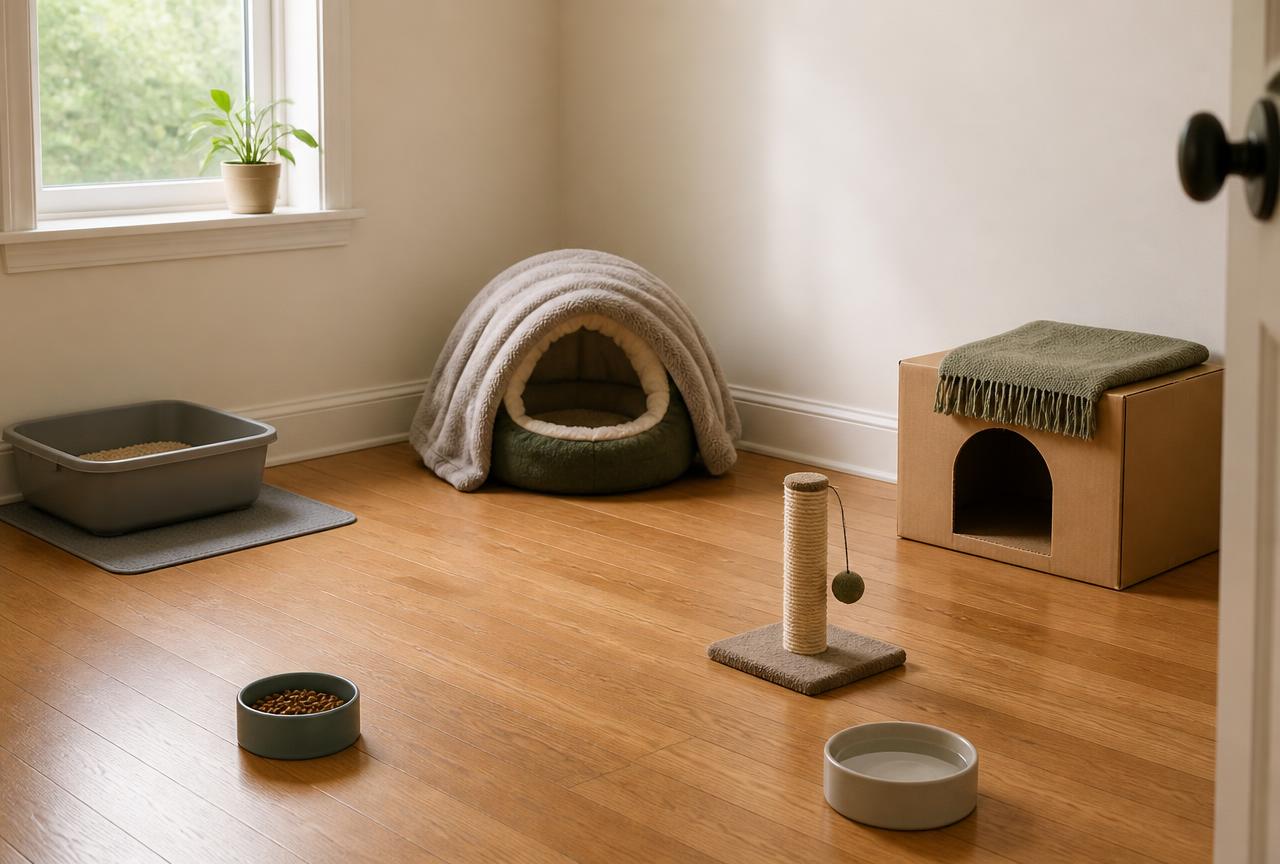
The room needs a tray, food and water placed away from the tray, at least two hiding places, something to scratch, and a door that closes properly. It should not be the room the resident cat sleeps in or the one containing its favourite window.
Then count resources across the whole home: trays, bowls, water points, beds, posts, high perches. The target is one per cat plus one, in separate locations. Doing this before the introduction removes most of the future friction.
The seven stages
Each stage has an exit condition rather than a date. Move on when the current stage has become dull for both cats.
| Stage | What happens | Exit condition |
|---|---|---|
| --- | --- | --- |
| 1. Base camp | Newcomer stays in its room | Eating, sleeping, using the tray normally |
| 2. Scent swap | Exchange bedding and cloths daily | No hissing at the other''s scent |
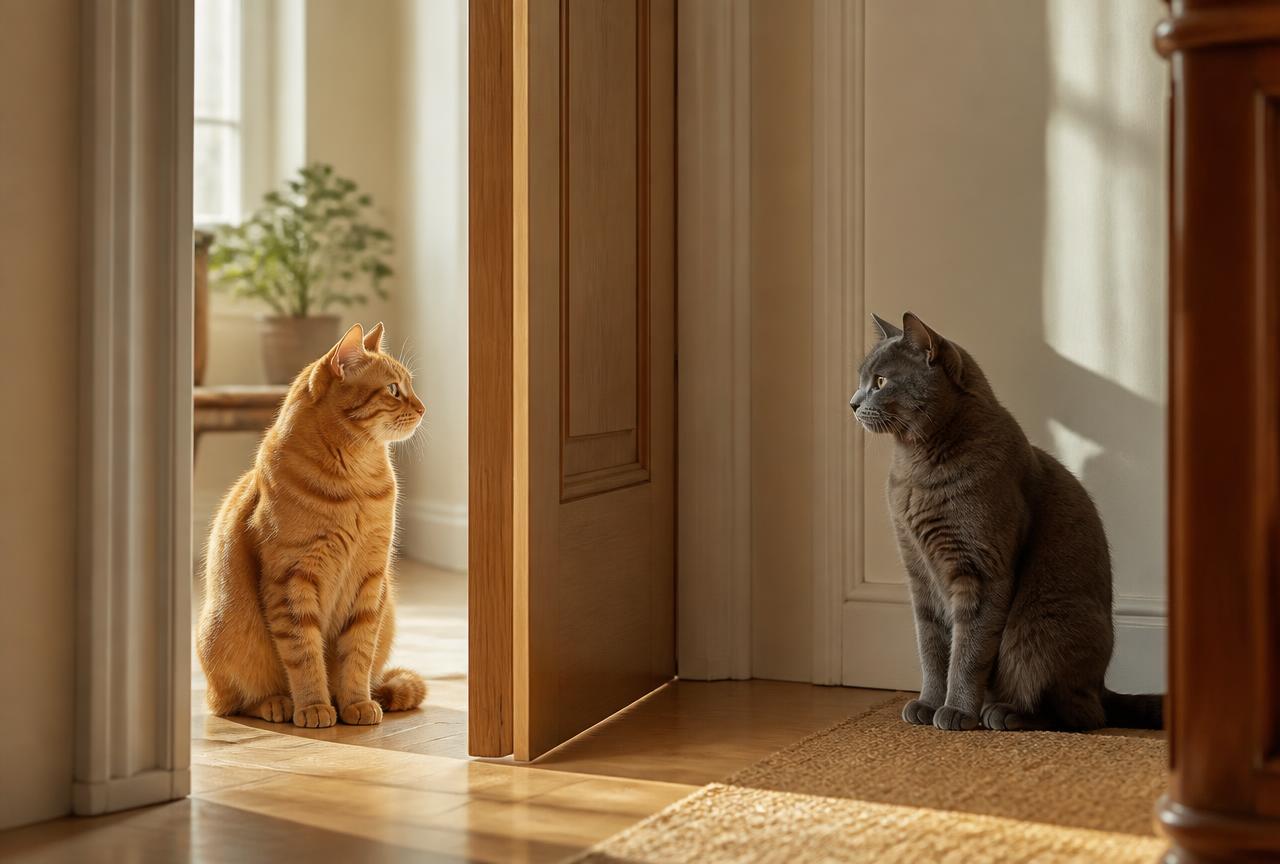
| 3. Door feeding | Meals either side of a closed door | Both eat within a metre of the door |
| 4. Room swap | Each explores the other''s space, alone | Calm exploration, no spraying |
| 5. Barrier visual | See each other through mesh or a gap | Ten relaxed minutes, no staring |
| 6. Short sessions | Supervised time with play or food | Twenty minutes, no blocking or chasing |
| 7. Free access | Shared space, supervised at first | Days pass without incident |
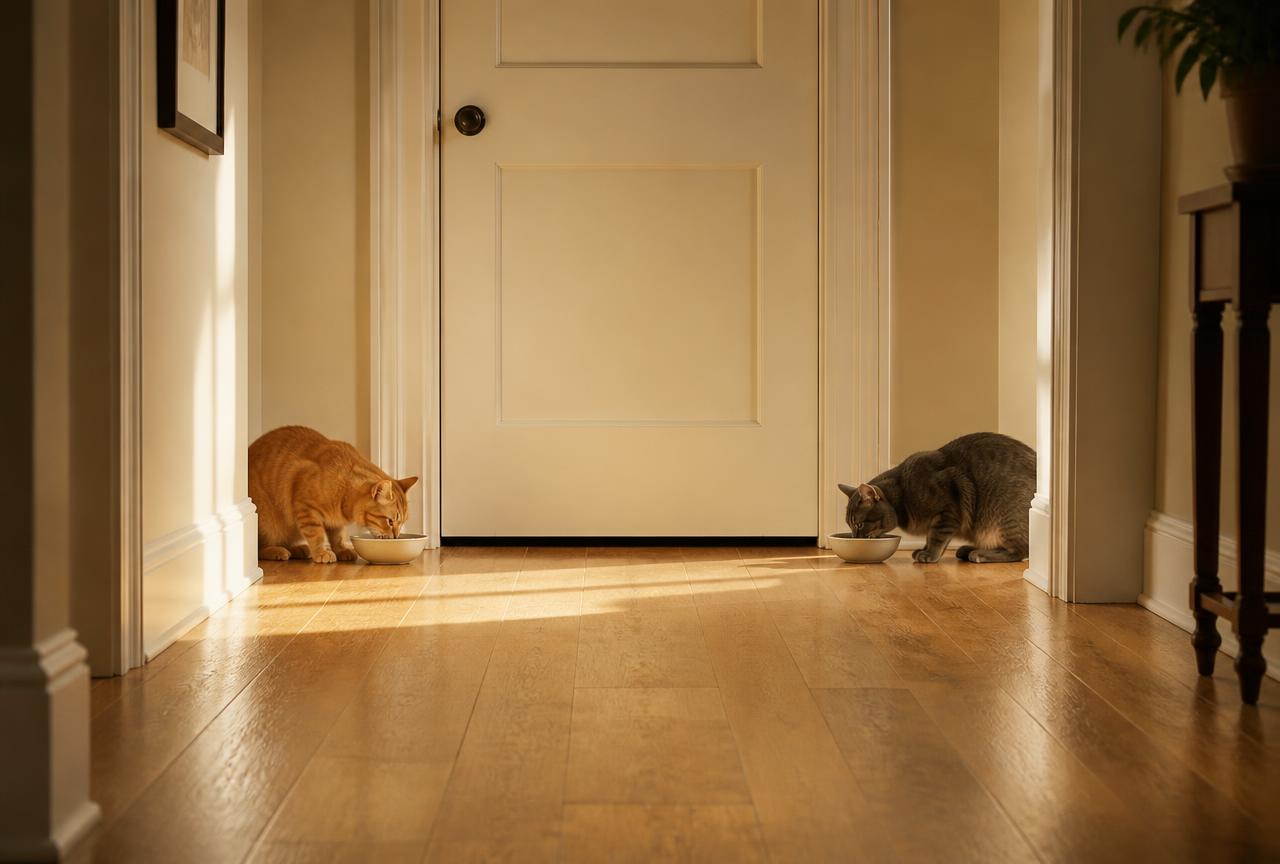
Stage three is the workhorse. Start the bowls far enough apart that both cats eat without hesitation, then move them a hand''s width closer each day. If either stops eating, you moved too fast; go back to yesterday''s distance.
First sight, through something solid
Visual contact deserves its own stage because sight is where introductions most often break. Use a mesh pet gate, a door wedged open a few centimetres, or a screen. Keep the first exposure to a couple of minutes, end it before either cat reacts, and feed both afterwards.
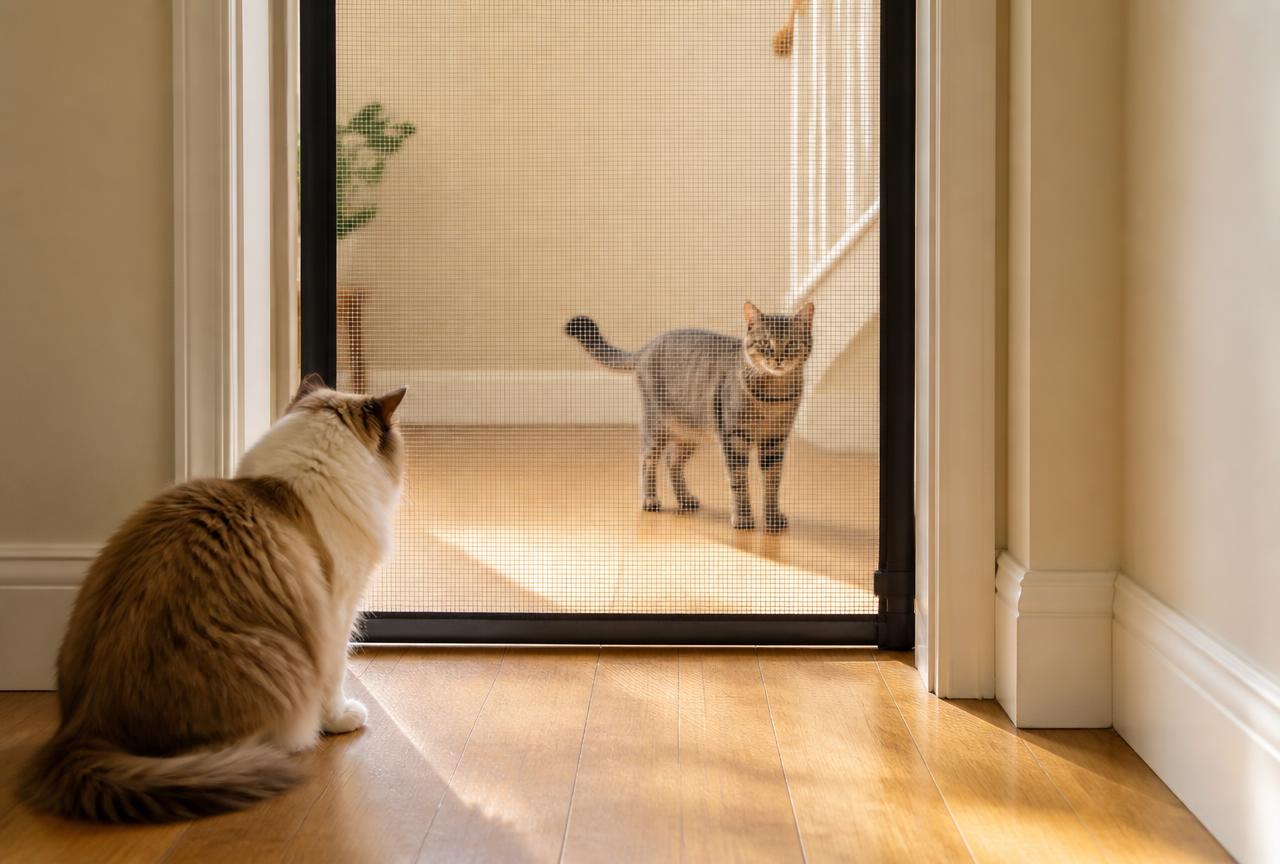
End every session while it is still boring. The cat that walks away calm is the one that comes back tomorrow calm.
Play is the best cover for early meetings. Two wand toys, one person per cat if possible, and the cats spend the session watching a feather rather than each other.
Use the planner below to pace the stages for your particular pair.
Interactive · built for this article
Introduction planner
Seven stages, paced for your two cats and your floor plan. Every stage has an exit condition, not just a date.
Realistic timeline
32 days
To free shared access, if every stage goes to plan. Slipping back a stage is normal and costs less than pushing on.
1. Separation and base camp
day 1–3
Move on when: Newcomer settled in one room, eating and using the tray normally.
2. Scent swap
day 4–6
Move on when: Bedding and cloths exchanged daily, no hissing at the other cat's smell.
3. Feeding either side of a closed door
day 7–10
Move on when: Both eat calmly within a metre of the door.
4. Room swap, no meeting
day 11–13
Move on when: Each cat explores the other's space with the other absent.
5. Visual contact through a barrier
day 14–18
Move on when: Both can see each other and stay relaxed for ten minutes.
6. Short supervised sessions
day 19–25
Move on when: Ten to twenty calm minutes with a distraction such as play or food.
7. Free access, supervised at first
day 26–32
Move on when: Shared space with no blocking, staring or chasing.
A guide, not a rule. Any sustained hissing, blocking or chasing means going back one stage for at least three days. Check the pairing itself with the breed matchmaker.
Reading what you are seeing
- Fine: hissing that fades, brief chases that end without contact, sitting in the same room facing away, mutual grooming, tail-up approaches.
- Slow down: one cat stops eating, hides for a whole day, stops using the tray, or a hard silent stare across the room.
- Stop and separate: flattened ears with dilated pupils on both cats, screaming, fur pulled out, one cat guarding a doorway or tray.
Blocking is the most underrated warning sign. A cat that sits in a hallway, doing apparently nothing, is often controlling access to the tray or the food, and the other cat is paying for it in stress rather than in wounds.
Breed and personality realities
Temperament predicts far more than breed, but breed shifts the odds. Ragdolls and British Shorthairs generally tolerate company well. Maine Coons are usually sociable but large, so an anxious small cat may find the sheer presence intimidating. Bengals bring an activity level that a sedentary older resident will find exhausting, and that mismatch is the actual conflict in many failed pairings.
If you have not yet chosen the second cat, the breed matchmaker is a better place to start than a rescue listing, and our indoor enrichment guide covers the vertical space a two-cat home needs.
The verdict, by household
Kitten joining a calm adult. Usually the easiest pairing. Run the full sequence anyway, and give the adult high places the kitten cannot reach.
Two adults, both with unknown histories. Assume six weeks. Duplicate everything. Do not shorten stage three, however well it seems to be going.
A territorial resident cat. Expect eight to twelve weeks, and consider whether a second cat is the right decision at all. A cat that reacts to other cats through the window is telling you something.
A small flat. Space is the constraint, so build upwards: shelves, tall posts, cleared windowsills. Two cats in one room need two exits from every resting place.
An elderly resident cat. Weigh it carefully. Bringing a kitten into the life of a fifteen-year-old is usually a decision made for the human, and the senior signals guide explains why an older cat''s tolerance for change is genuinely lower.
When to call your vet
Any injury from a fight needs attention, because cat bites abscess reliably and often within forty-eight hours. Call sooner rather than later if either cat stops eating for more than a day, stops using the tray, starts spraying indoors, or over-grooms to the point of bald patches.
It is also worth ruling out pain in a resident cat who suddenly becomes intolerant. Aggression that appears out of character is a common early presentation of arthritis, dental disease and hyperthyroidism, and a cat in pain has a much shorter fuse than the same cat well.
Do the boring version of this, and in six weeks you will have two cats who share a home. Do the fast version, and you may spend years managing two cats who share nothing but an address.
Questions people actually ask
How long does it take to introduce two cats?
Three to six weeks is typical for a straightforward pairing, and two to three months is common where one cat is territorial or has a history of conflict. Kittens often integrate faster because adults treat them as less of a threat. The planner in this article paces the stages against your specific pair.
Should I let them fight it out?
No. There is no evidence that cats resolve a bad introduction through conflict, and considerable evidence that early aggressive encounters set a lasting pattern. Each fight makes the next one more likely because both cats learn the other predicts danger. Separate, go back a stage, and slow down.
Is hissing normal when introducing cats?
Yes. Hissing is a distance-increasing signal and it is how a cat says it needs more room, which is exactly the information you want. What matters is the trend: hissing that reduces over days is progress. Silent hard staring, blocking doorways and stalking are more concerning than noise.
How do I introduce a kitten to an older cat?
The same stages, with two adjustments. Give the resident cat elevated places the kitten cannot reach, so it can opt out, and interrupt the kitten's play attempts before the adult has to. Older cats often tolerate kittens but tire of them quickly, and a kitten that is never told no becomes a problem adult.
How many litter trays do two cats need?
Three, in separate locations rather than in a row. The same logic applies to feeding stations, water, beds and scratching posts. Most multi-cat tension is competition for resources rather than dislike, and resource competition is the part you can fix by shopping.
What if my cats never get along?
A meaningful minority never form a social bond. The realistic goal in that case is peaceful indifference: separate core territories, duplicated resources, no forced contact. That is a stable and humane arrangement. Genuine sustained aggression, where one cat cannot eat, sleep or use a tray safely, needs a behaviourist and sometimes rehoming.
Do pheromone diffusers help?
Feline pheromone products have mixed evidence and are best seen as a small supporting measure. They do not substitute for staged introductions or adequate resources. If you use one, place it in the shared space rather than the newcomer's room, and start it a few days before the newcomer arrives.
Sources
- Feline environmental needs guidelines, AAFP and ISFM
- Introducing cats to each other, International Cat Care
- Feline social behaviour and aggression, Cornell Feline Health Center
- Feline behaviour guidelines, AAFP
Breeds mentioned




Put it into practice
Read next
Why do cats sleep so much? Normal hours, odd habits and the red flags
Why do cats sleep so much? What 12–16 hours a day really means, the light doze vs deep sleep, and the changes that actually matter.