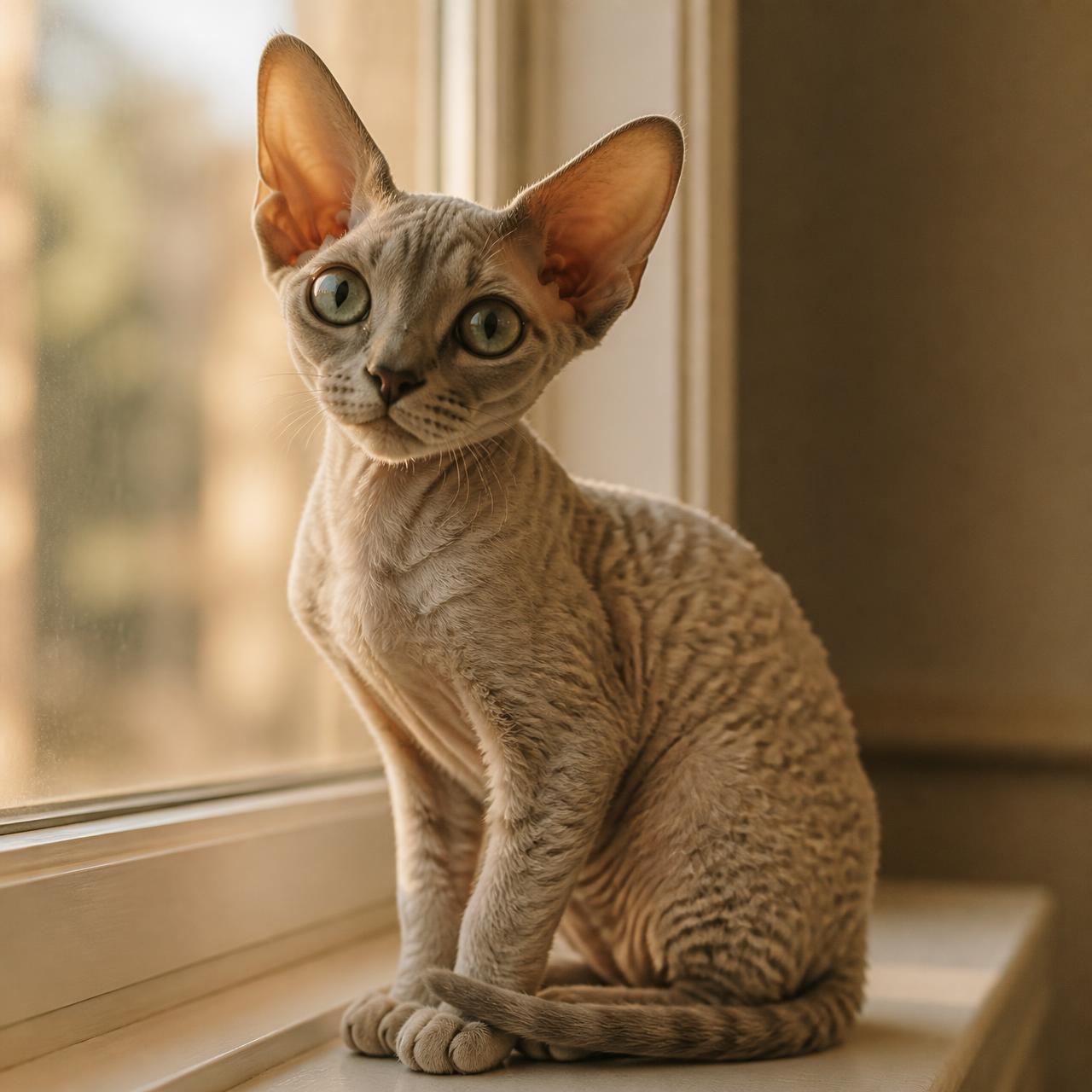
Devon, England, 1959
Devon Rex
A small cat with enormous ears, a coat like crushed suede and no concept of personal space. Almost no grooming, and almost no tolerance for being left out.
The ReMews. desk
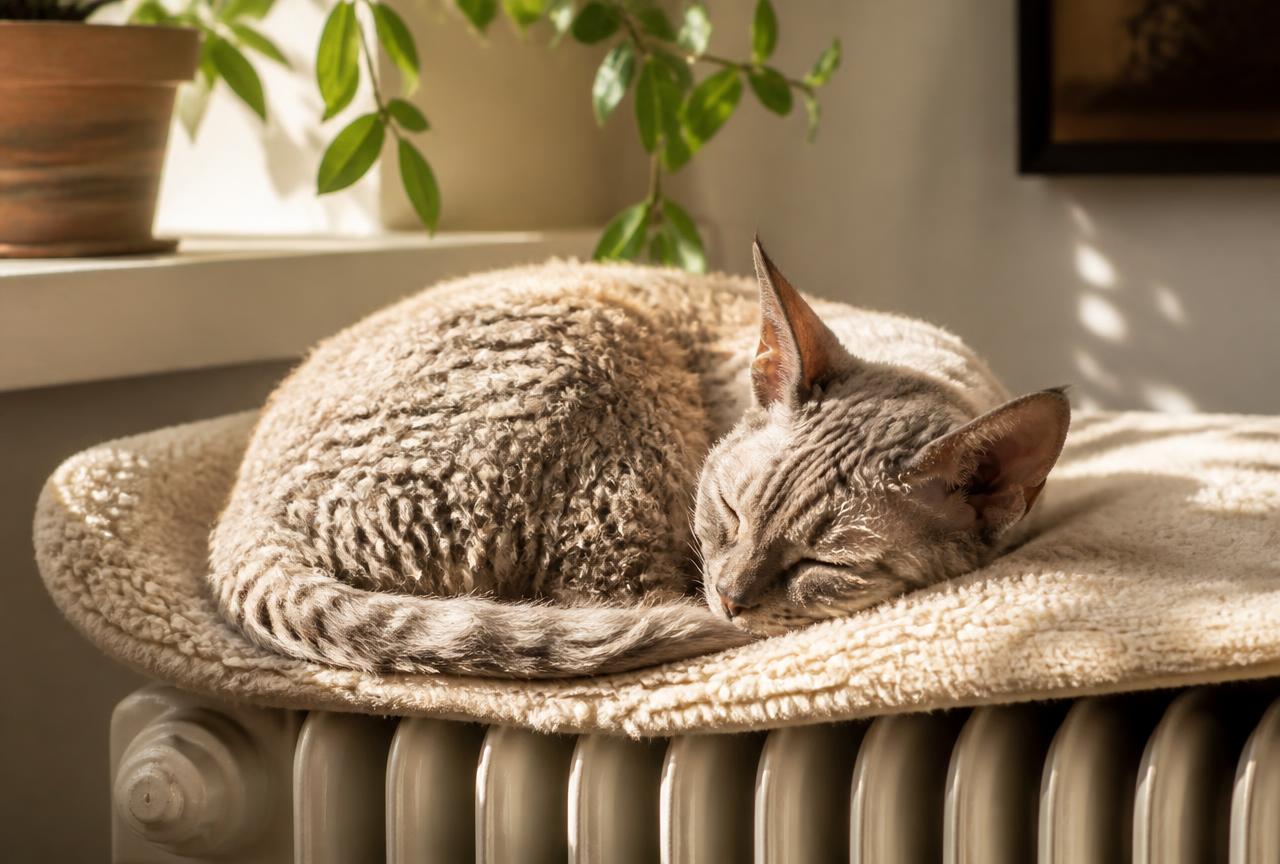
Enormous ears, a suede coat and the shoulder-riding habits of a very small monkey.
The short version
- The most people-dependent breed we cover. Eight-hour empty days are genuinely unsuitable; home two together if the house is out all day.
- Grooming is close to nothing, no brushing needed, but the coat is fragile, so hands and the occasional damp cloth are the tools, never a hard brush.
- Thin, sparse fur means the cat is always looking for heat. Warm beds, heat pads and a warm home are part of the specification.
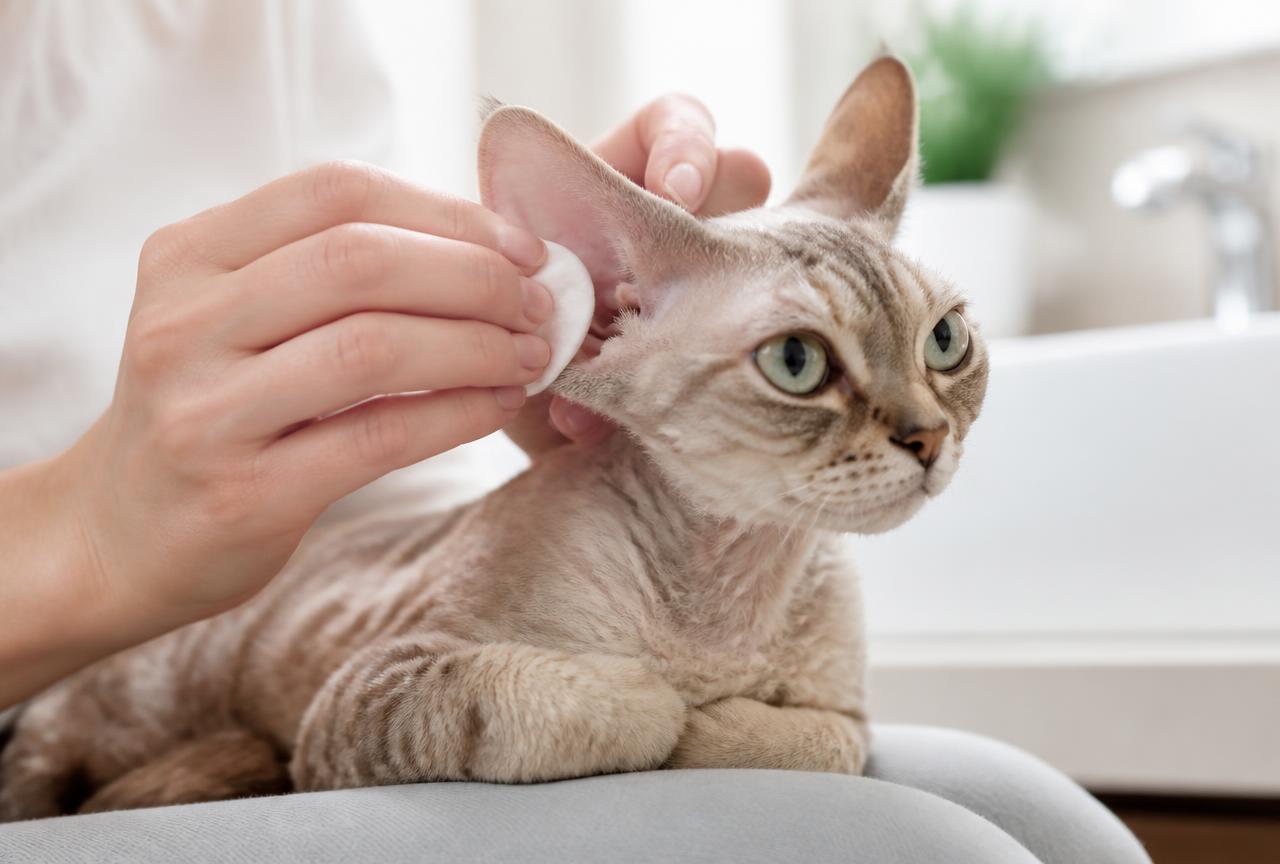
- Skin oils build up in the ear folds, nail beds and skin creases, so a weekly wipe replaces the grooming other breeds need.
- Height matters more than floor space. Without a tall tree the curtains and the fridge become the route up.
- Health watch-list centres on hypertrophic cardiomyopathy and a breed-specific muscle condition; ask breeders for echocardiogram dates and genetic test results.
- Weight
- 2.5–4.5 kg
- Lifespan
- 12–16 yrs
- Coat
- Short curly
- Size
- Small
- Grown male
- 3.2–4.5 kg
- Grown female
- 2.5–3.6 kg
- Years to full size
- about 2
- One-off setup
- €300–620
Get one if…
- Someone is home most of the day
- You want a cat that is physically involved in everything
- The home is warm and you can add tall climbing furniture
- You want long-coat looks with almost no grooming
Think again if…
- The house is empty eight hours a day
- You want a calm, dignified, independent cat
- The home is cool or draughty
- You need a genuinely low-allergen cat
Trait profile
Affection at ten is not a flourish, this breed sits at the top of the scale and defines the upper end of it. Grooming at two is honest: there is almost nothing to brush. The number to plan around is energy at nine in a cat weighing three kilograms, which means vertical routes and two real play sessions a day rather than a bigger flat.
Space & setup. Suits a flat provided it goes upward. Small body, small footprint, but a serious need for climbing routes and warm resting spots.
Allergies. Not hypoallergenic. Sheds very little, which reduces allergen spread around the home, but Fel d 1 output is normal and reactions are common. Meet the breed in person first.
The review
A small, fine-boned cat with a short rippled coat, oversized low-set ears and a pixie face. Relentlessly people-focused, physically inventive and permanently in search of warmth.
The Devon Rex began with one curly kitten found in Devon in 1959, and the breed has never quite lost the impression of being an experiment that went unusually well. Everything about it is slightly wrong in the same charming direction: ears far too large and set far too low, cheekbones too high, a face that reads as impish rather than feline, eyes that are enormous relative to a small wedge head, and a body that is fine-boned and light but startlingly muscular when you pick it up. Three kilograms of cat with the launching power of five.
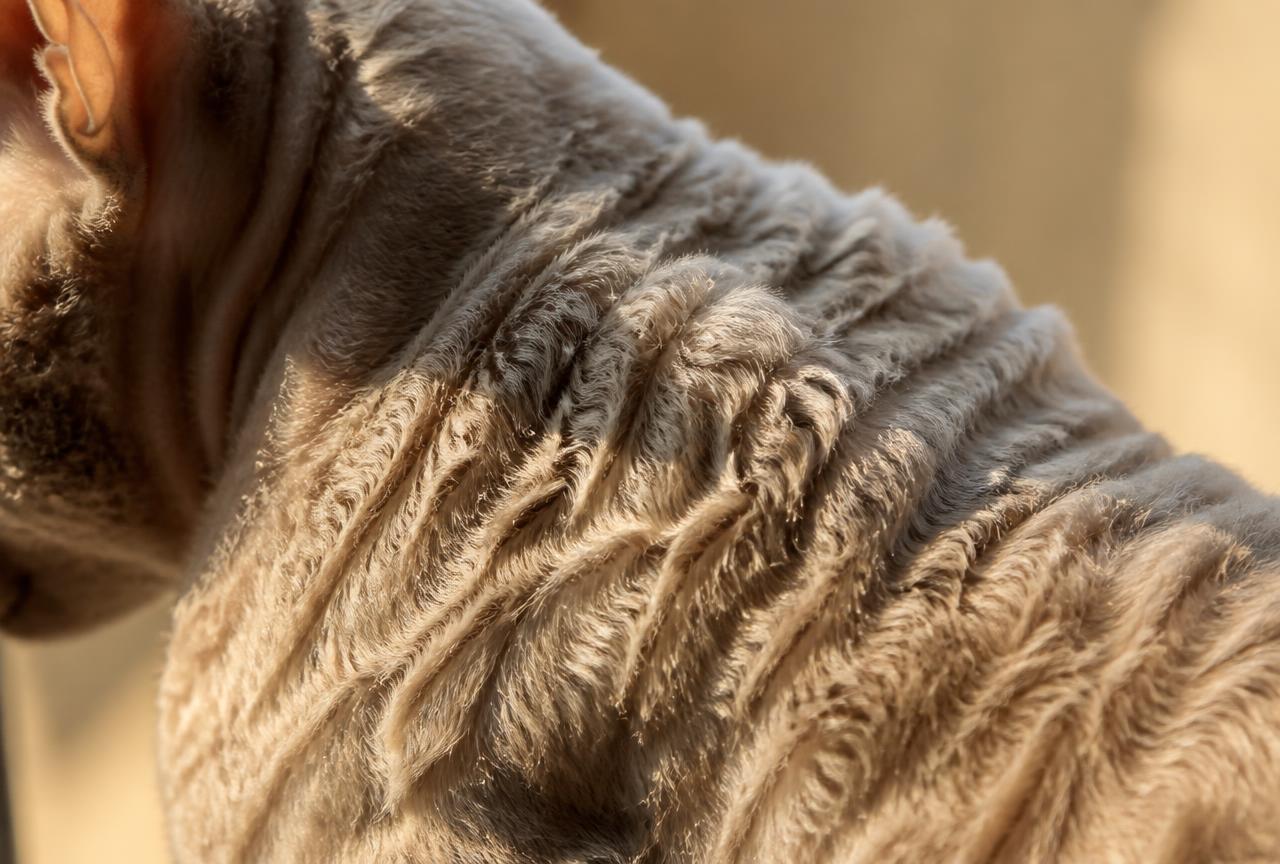
The coat is the signature and the most misunderstood part. It is short, soft and rippled, more crushed suede than fur, and in places, the chest, the belly, behind the ears, it thins to almost nothing. This is not a coat that needs brushing. A hard brush will damage it, and over-bathing strips it. What it needs instead is hands: a weekly run over the cat with your palms and a soft damp cloth, which lifts loose hair and spreads the skin oils that otherwise collect. The trade-off nobody mentions in the breed profiles is that this same sparseness means very little insulation. A Devon is always looking for heat, your neck, the radiator bed, under the duvet, the warm laptop, and in a cool home it will be visibly unhappy. Budget for warmth the way you would budget grooming for a Persian.
Temperament is where the breed earns its following, and it is not a subtle personality. A Devon does not observe the household; it participates. It rides shoulders. It supervises cooking. It gets into the wardrobe, opens the cupboard you thought was secure, and appears on top of a door frame you did not know it could reach. It is dog-like in its attachment without being placid, the attention comes with constant physical inventiveness, and the phrase owners use most often is that it behaves like a small monkey. It is moderately vocal but not loud, more chirp and trill than the Siamese howl, and it uses the voice to keep the conversation going rather than to complain.
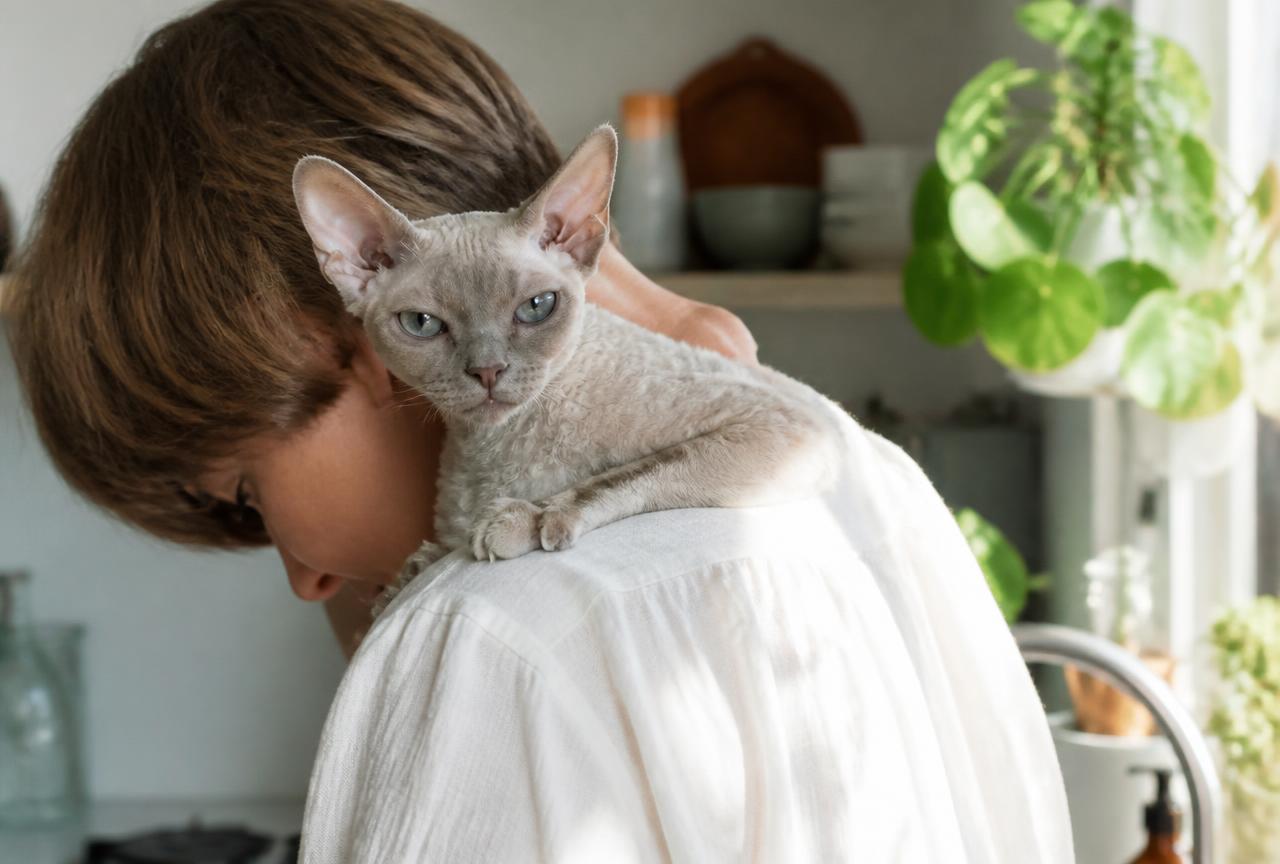
That intensity of attachment has a hard edge, and it is the single most important thing to understand before buying. This breed genuinely suffers alone. It is not a cat that sleeps through an empty flat and greets you at six; it is a cat that spends the day looking for someone. If the house is empty for eight hours on weekdays, home two together, Devons live happily with other cats and with dogs, or choose another breed. We would put this ahead of every other consideration on the page.
Practically, the breed suits a flat very well provided the flat goes upward. A small, light, agile cat needs routes: a tall tree, wall shelves, a legitimate high vantage point in the room the household uses. Deny that and the routes become the curtains, the top of the fridge and the bookcase, and the cat will find them within a week. Two proper play sessions a day, ten minutes each with a wand, take the edge off a genuinely high energy level. Food intake is often higher than the small body suggests, since a poorly insulated, busy cat burns through it, though weight is rarely the problem it is in the calmer breeds.
On health, two items deserve real attention. Hypertrophic cardiomyopathy occurs here as across pedigree cats, and breeding animals should be screened by echocardiogram, not by stethoscope, ask for the dates. Devon Rex myopathy, a hereditary muscle weakness that shows in kittens as head bobbing, a weak neck and difficulty swallowing, has a genetic test available, and any reputable breeder will have used it and will show you the results. Beyond that: patellar luxation appears in the breed, skin and ear-fold cleaning is routine housekeeping, and dental disease deserves the same attention it does in any cat.
The Devon Rex is not the cat for everyone, and the mismatch is easy to predict. Anyone wanting a calm, self-contained, dignified animal will be exhausted. Anyone who is out all day will end up with an unhappy cat. But for a home with people in it, warmth, some height on the walls and an appetite for company, it is one of the most rewarding cats you can live with, funny, physically affectionate, low-maintenance in the literal grooming sense, and involved in absolutely everything you do.
The most companionable cat in this index and the least willing to be left out of anything. Low grooming, high involvement, and a genuine need for warmth and company.
Grooming, realistically
- 1Run your hands over the whole cat weekly and wipe with a soft damp cloth. Never use a hard brush, it breaks the fragile coat.
- 2Clean the ear folds weekly with a cotton pad and a vet-approved ear cleaner; oils and wax build up faster than in a normal-coated cat.
- 3Check the skin creases, chin and nail beds for greasy residue and wipe them when needed.
- 4Trim nails every two to three weeks; a climbing cat wears them unevenly.
- 5Bathe only when genuinely greasy, a few times a year at most, with a mild cat shampoo. Over-bathing makes the skin produce more oil.
- 6Brush teeth several times a week and keep warm bedding clean and dry.
What you actually need
- Soft microfibre cloth
- Cotton pads and vet-approved ear cleaner
- Mild cat shampoo
- Nail clippers
- Cat toothbrush and enzymatic paste
- Heated bed or covered warm cave
Kitten to adult
| Age | Male | Female | What is happening |
|---|---|---|---|
| Birth | Coat often lightly waved. Some kittens moult out and re-coat over the first months, so a patchy phase is normal. | ||
| 8 weeks | Ears already look oversized. Kittens should be confident, warm and eating well; ask about the myopathy test before viewing. | ||
| 6 months | Full acrobatic phase. Climbing furniture must be in place by now or bad habits set. | ||
| 12 months | Close to adult size. Coat settles into its final ripple around this point. | ||
| 18–24 months | Fully mature. This is a genuinely small cat, a heavy Devon is usually overweight, not large. |
Ranges are typical, not targets. Judge condition by ribs and waist, and check with the ideal weight checker.
What to ask a breeder
- Have the parents been genetically tested for Devon Rex myopathy, and can I see the results?
- Have both parents been screened by echocardiogram for hypertrophic cardiomyopathy, and when?
- Have you seen patellar luxation in your line?
- Are the kittens raised in the house, handled daily and used to other animals?
- What do you feed, and how much does an adult of yours eat?
- Do you recommend homing two together, and would you home a single kitten to a house that is empty by day?
- What health checks, vaccinations and worming are done before the kitten leaves?
Health watch-list
What to ask a breeder about, and what to watch for over a lifetime. This is orientation, not veterinary advice, anything you notice belongs in front of a vet.
Hypertrophic cardiomyopathy
UncommonThickening of the heart muscle, present across pedigree cat populations. Breeding cats should be screened by echocardiogram rather than by listening to the chest. Fast breathing at rest or sudden hind-leg weakness is an emergency.
Devon Rex myopathy
RareA hereditary muscle weakness specific to the breed, showing in kittens as head bobbing, a weak neck and trouble swallowing. A genetic test exists and responsible breeders use it, ask to see the results for both parents.
Patellar luxation
OccasionalThe kneecap slips out of its groove, producing a skipping gait or reluctance to jump down. Mild cases need only weight management; significant ones may need surgery.
Skin and ear oiliness
CommonWith little coat to absorb them, skin oils collect in the ear folds, nail beds and skin creases. Weekly wiping prevents it. Bathing too often makes the skin produce more, not less.
Getting cold
CommonNot a disease, but a genuine welfare issue. A sparse coat insulates poorly, so provide heated or covered beds and keep the home warm. A cat seeking heat constantly and shivering indoors needs checking.
Dental disease
CommonPeriodontal disease and tooth resorption are widespread in cats. Brush several times a week and ask for an oral examination at every appointment.
What it costs to keep one
Realistic running cost
€78 / month
About €936 a year, or roughly €13,104 across a 14-year life, before purchase price, neutering and one-off vet events.
Before the cat arrives. Budget roughly €300–620 for trays, carrier, posts, bowls, bedding and grooming kit sized for this breed. Figures throughout are indicative and vary a good deal between countries.
Interactive · built for this breed
Is a Devon Rex right for your home?
Five questions covering what actually decides it: company, warmth, height and how much physical contact you want from a cat.
Verdict
Made for this cat
Warmth, company, height and contact, that is the entire brief, and you meet it. Expect a cat that is genuinely part of the household rather than a resident.
Check portions for a high-metabolism cat with the portion calculator, or compare alternatives in the matchmaker.
The verdict, by household
Flat dweller
Excellent
Family with young children
Very good
First-time owner
Good
Out at work all day
Poor
Multi-pet home
Excellent
Allergy-conscious
Mixed
When to call your vet
- Head bobbing, a weak neck, or difficulty swallowing in a kitten, signs of Devon Rex myopathy
- Fast or laboured breathing at rest, or open-mouthed breathing after mild activity
- Sudden hind-leg weakness or crying out, an emergency associated with heart disease
- Skipping steps, a hopping hind-leg gait, or reluctance to jump down
- Greasy, red or smelly ears, or persistent head shaking
- Sore, flaking or scabby skin, or patchy hair loss
- A cat that is constantly seeking heat and shivering in a warm room
Nothing here is a diagnosis. Breathing difficulty, sudden hind-leg weakness and straining to urinate are emergencies, go the same day.
Devon Rex vs the closest alternatives
| Breed | Weight | Energy | Grooming | € / month |
|---|---|---|---|---|
| Devon Rex | 2.5–4.5 kg | 9/10 | 2/10 | €78 |
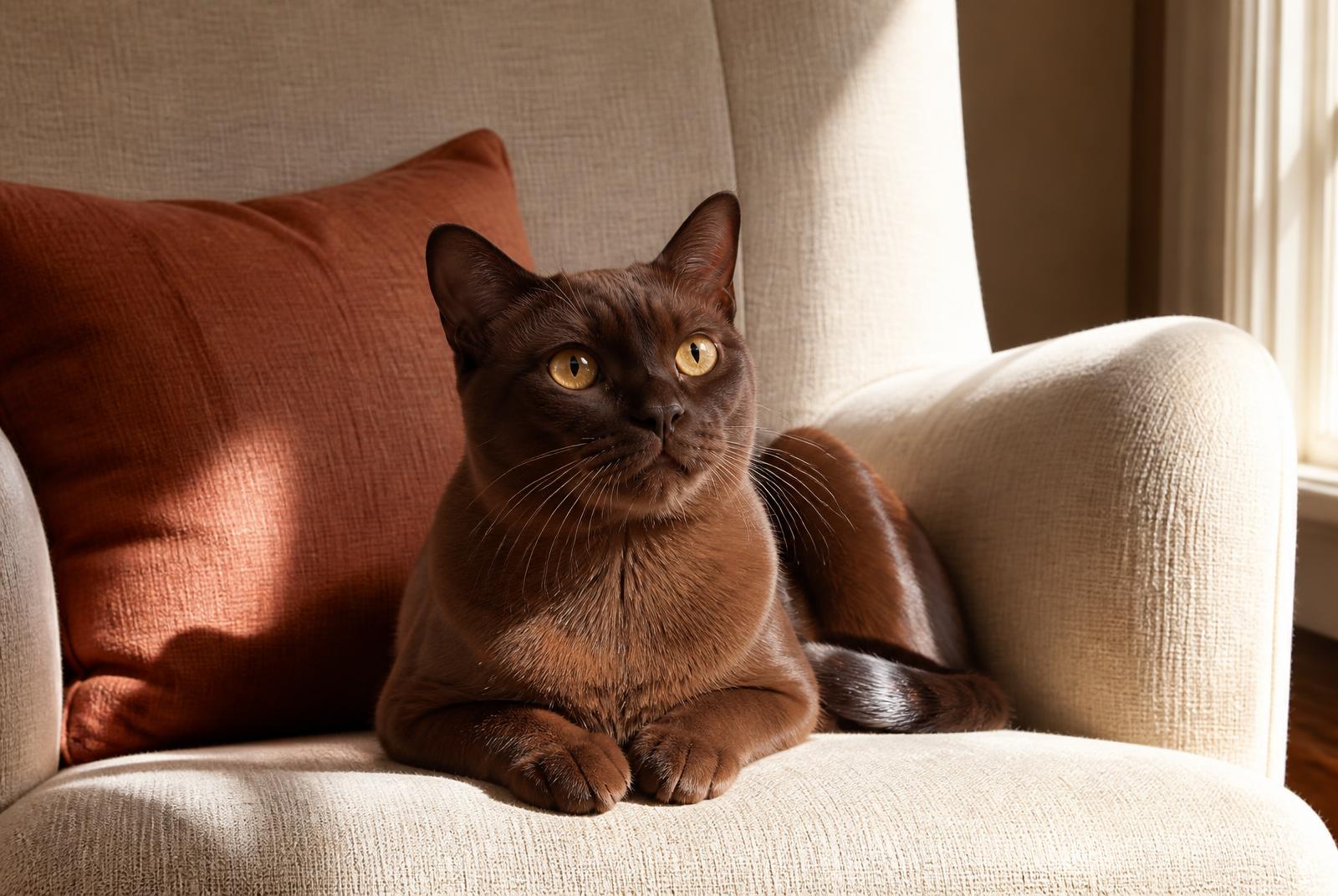
| Burmese | 3–6 kg | 8/10 | 2/10 | €81 |
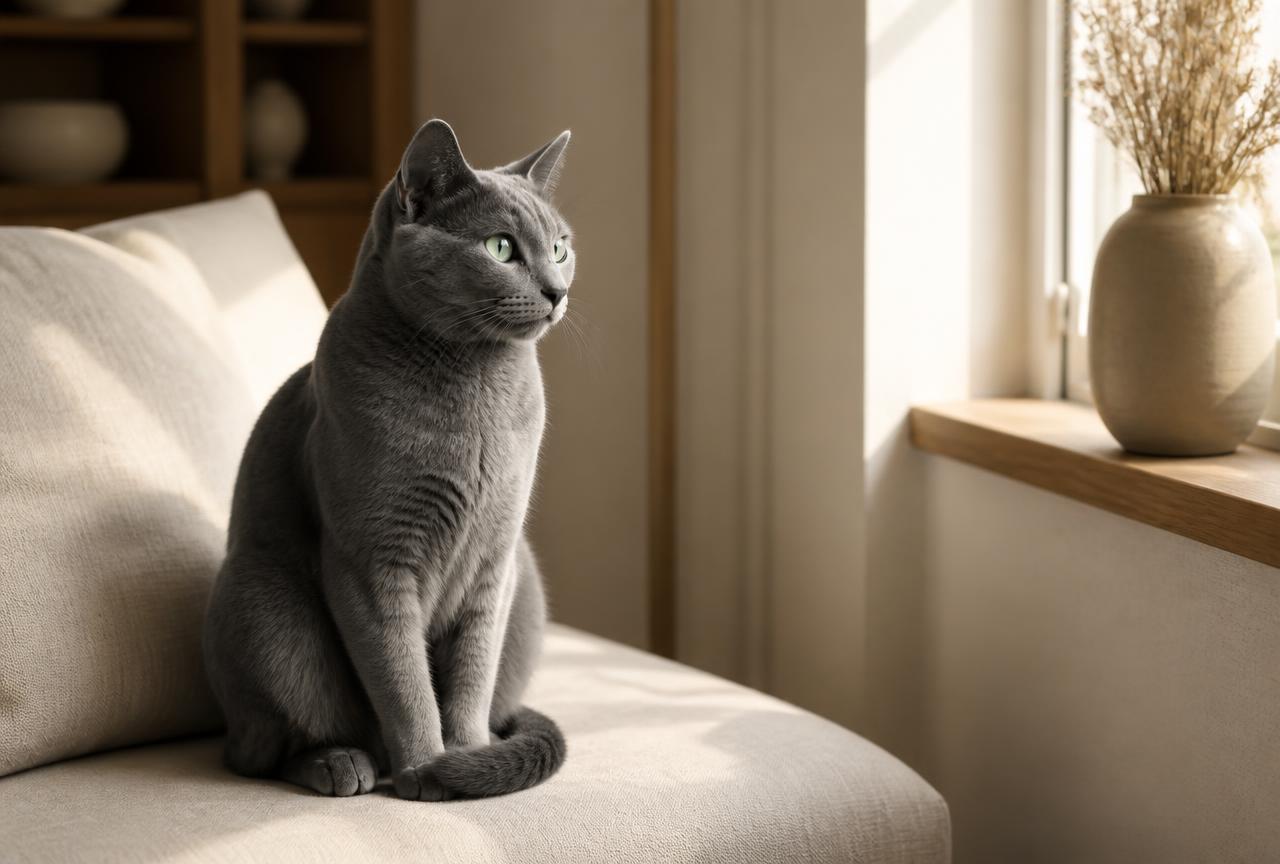
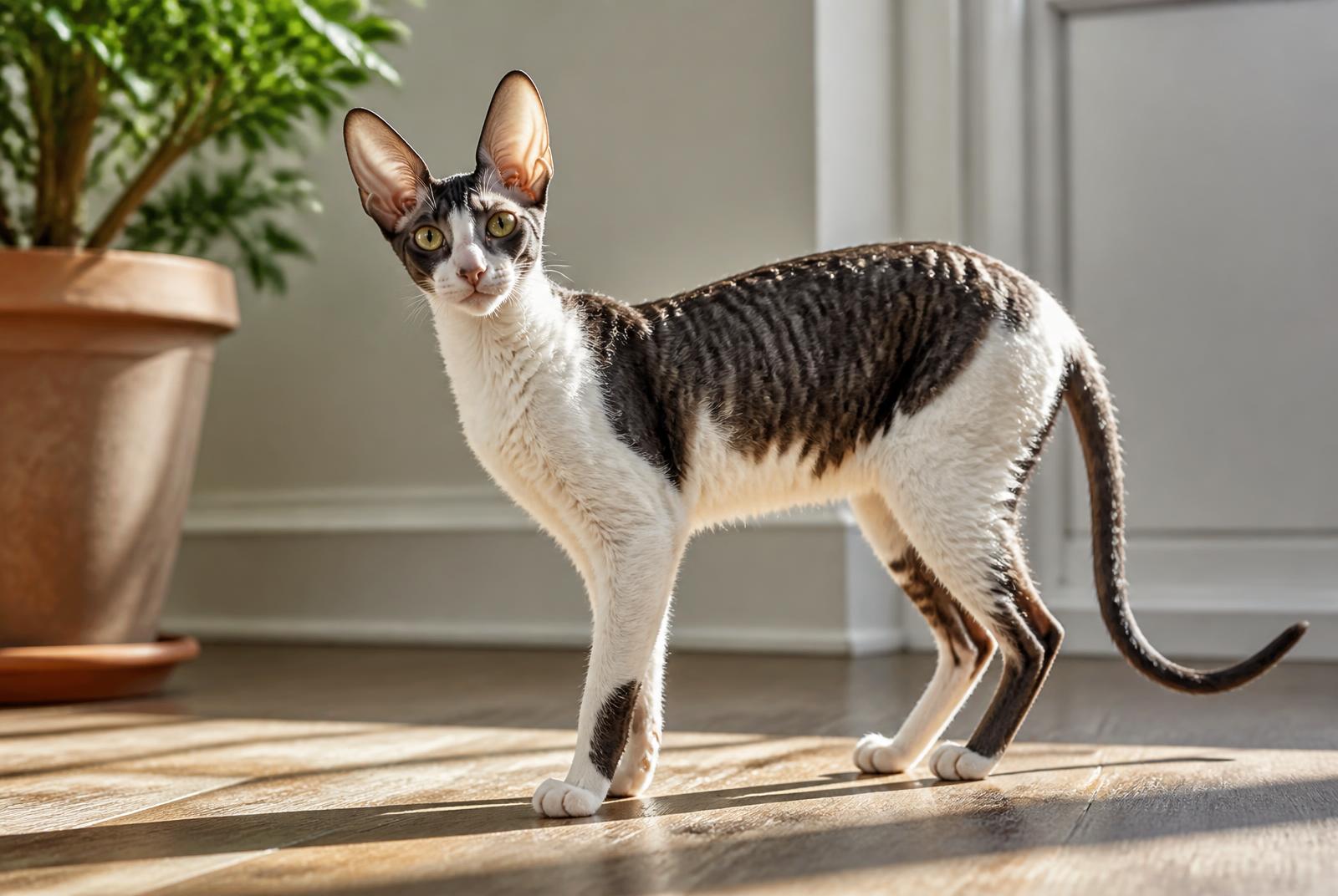
| Cornish Rex | 2.5–4.5 kg | 10/10 | 2/10 | €80 |
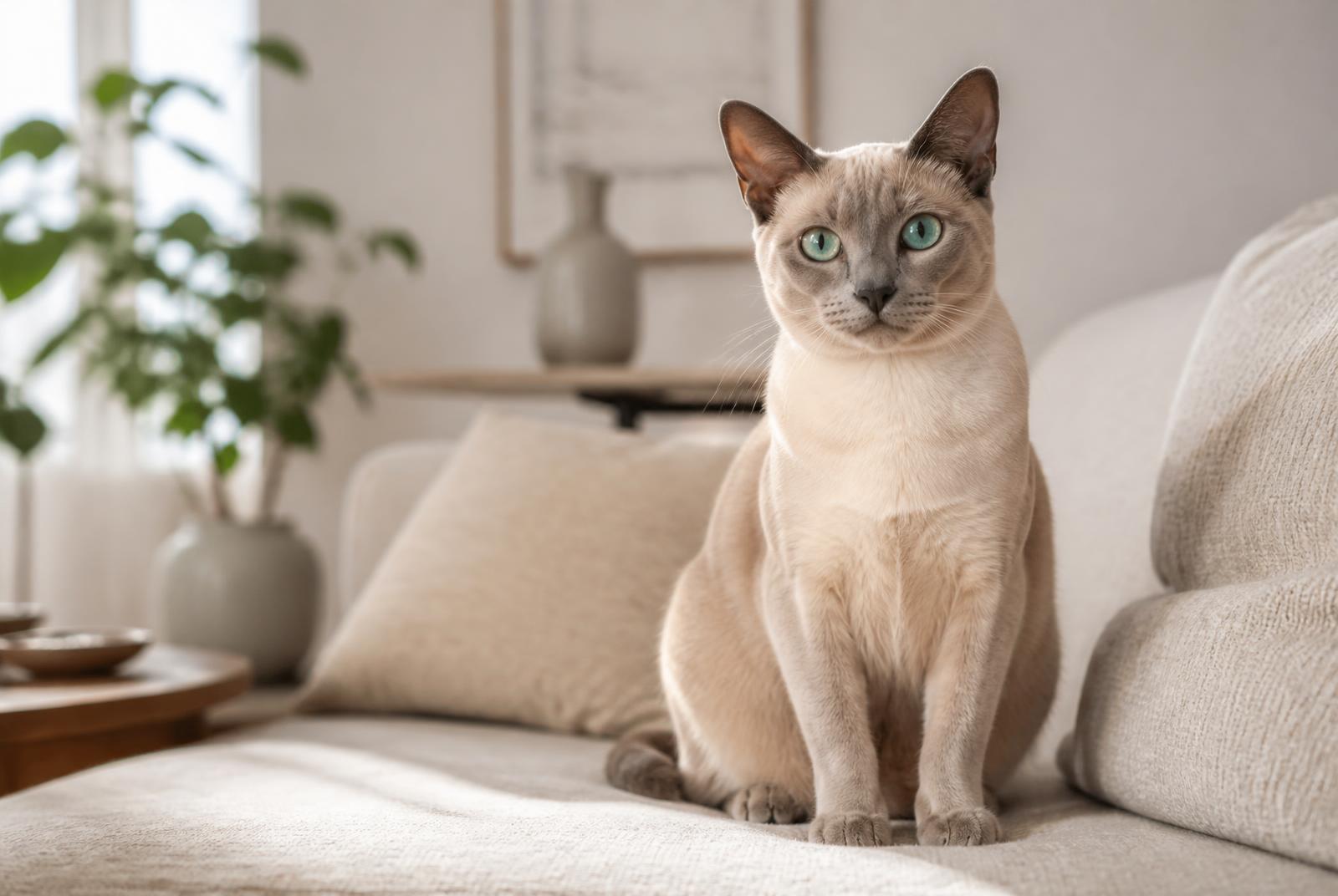
| Tonkinese | 2.5–5.5 kg | 8/10 | 3/10 | €79 |
Devon Rex questions, answered
Are Devon Rex cats hypoallergenic?
No. They shed very little, which means less allergen carried around the home on loose hair, and some people with mild sensitivity do better with them. But they produce Fel d 1 in normal quantities and plenty of allergic people still react. Spend an hour with adult Devons before committing.
How is a Devon Rex different from a Cornish Rex?
Different genes and different builds. The Cornish Rex has a marcel-waved coat of down hairs only, a longer whippet-like body and an egg-shaped head. The Devon has a looser, coarser ripple, a shorter cobby body, a pixie face and dramatically larger low-set ears. Both are people-focused; the Devon is the more mischievous of the two.
Do Devon Rex cats need brushing?
No, and brushing does harm. The coat is short and fragile and a bristle brush breaks it. Run your hands over the cat weekly, use a soft damp cloth to lift loose hair, and put the effort into the ears and skin folds instead.
Can a Devon Rex be left alone during the workday?
Not comfortably. This is the most people-dependent breed we cover and a long empty day is hard on it. If the house is out from nine to five, home two together, Devons live happily with other cats and dogs, or pick a more self-sufficient breed.
Do they really get cold?
Yes. A sparse coat with thin patches provides little insulation, which is why Devons seek out radiators, laptops, duvets and human necks. Keep the home warm, provide a covered or heated bed, and take shivering indoors seriously.
Are Devon Rex cats good with children and dogs?
Very. They are sociable, resilient and interested in whatever is happening, and they usually accept a confident dog quickly. The caution is physical: this is a small, fine-boned cat, so children need to learn gentle handling rather than grabbing.
What does a Devon Rex cost to keep?
Running costs are modest, a small cat with almost no grooming spend, though food intake is often higher than the size suggests. Setting up runs roughly EUR 300–620, because a tall climbing tree and warm bedding are essentials rather than extras. Insurance is worth having, given the heart watch-item.